



Description
Collector's Note – Why This Issue Matters
January 15, 1966 is a publication date of specific historical and editorial significance, and this New Yorker issue — with a Charles Saxon art studio painter cover — documents the magazine at a precise and consequential moment in its engagement with the mid-sixties world. Saxon was one of the New Yorker's most accomplished and most specifically characteristic cartoonists and cover artists, his work distinguished by a gentle, observational satire of upper-middle-class American life — its social pretensions, its domestic arrangements, its cultural aspirations — that gave his covers a documentary quality alongside their humor. An art studio painter cover by Saxon is quintessentially characteristic of his New Yorker work: the artist and the creative life as subjects for the kind of warmly ironic observation that was his signature. The "Letter from Manila" documented on page 84 is the most historically specific and most research-significant editorial item in this issue's confirmed contents. January 1966 was the first full month of Ferdinand Marcos's presidency of the Philippines — he had been inaugurated on December 30, 1965, just two weeks before this issue's publication — and a New Yorker letter from Manila in January 1966 is a contemporaneous primary document of the Philippine capital at the precise opening of the Marcos era, before the subsequent decades of authoritarian rule, martial law, and kleptocracy had defined how that presidency would be understood historically. For collectors building an archive of New Yorker issues from the mid-sixties, this January 15, 1966 edition is a precisely dated primary document of the magazine at a historically specific geopolitical moment.
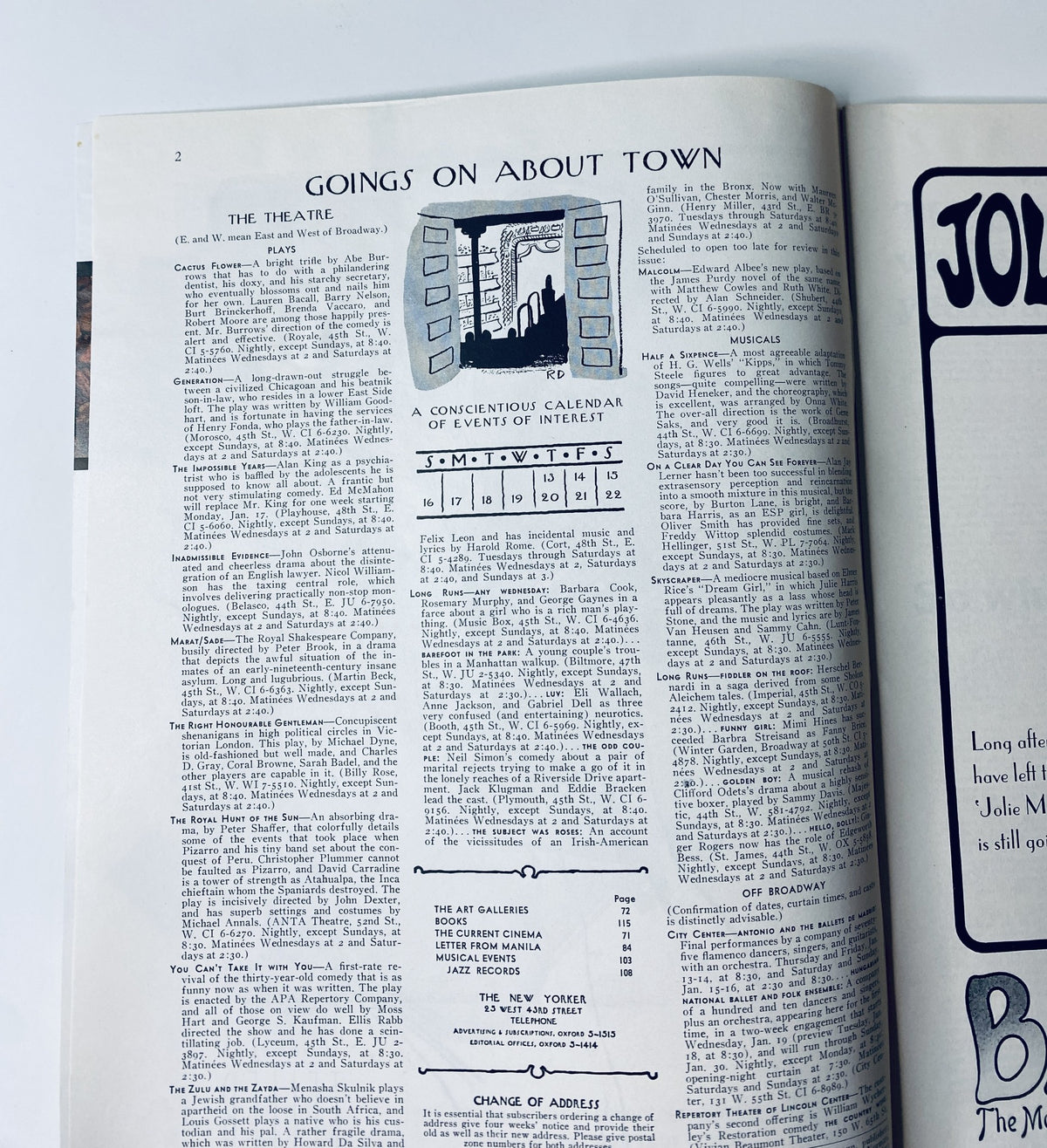
The "Jazz Records" department on page 108 is a historically interesting editorial detail that distinguishes this issue from a typical New Yorker of the period. The New Yorker's jazz criticism tradition was one of the publication's more distinctive and less commonly discussed editorial contributions — the magazine's engagement with jazz as a serious art form requiring the same critical intelligence it brought to classical music, theater, and literature was both intellectually consistent with its broader editorial identity and historically significant as a primary document of how the American critical establishment was engaging jazz in the mid-sixties. January 1966 was a specific and rich moment in jazz history — John Coltrane's most experimental period was at its peak, Miles Davis was navigating his late-acoustic phase, and the avant-garde free jazz movement was generating the critical debates that would define the art form's self-understanding for the following decade. A New Yorker jazz records review from January 1966 is a primary document of how the publication's critical apparatus was engaging these specific musical developments at a historically specific moment. The Art Galleries on page 72 and Musical Events on page 103 add further cultural criticism dimensions that reflect the New Yorker's characteristic engagement with the full range of New York's performing and visual arts at the specific opening of the 1966 cultural season. Collectors researching New Yorker issues from 1966 will find this January 15 edition a precisely dated primary source of both international political journalism and mid-sixties cultural criticism.
The Charles Saxon cover deserves specific collector attention as a primary visual document of one of the New Yorker's most characteristic and most beloved mid-century cover artists. Saxon had been contributing to the magazine since 1956 and had developed through his first decade a specific visual language for American suburban and professional life that made his covers immediately recognizable. His art studio painter subject reflects the specific cultural moment of January 1966, when the New York art world was navigating the transition from the Abstract Expressionism that had defined the postwar era toward pop art, minimalism, and the conceptual movements that would define the following decade — the "painter" cover is therefore both a characteristic Saxon social observation and a specific cultural document of the art world's self-image at a moment of active transition. The issue's January 15 timing — mid-month in the calendar's most culturally self-reflective season — gives the art studio subject a seasonal resonance consistent with how the New Yorker engaged the beginning of each new cultural year with reflective, interior-focused cover imagery.
About the Publication
The New Yorker was founded in 1925 by Harold Ross and by January 1966 had been publishing for forty-one years under the editorships of Ross and William Shawn, whose tenure since 1952 had deepened the magazine's commitment to long-form journalism, literary fiction, poetry, and cultural criticism while maintaining the visual humor and illustration tradition that had defined it from the beginning. The January 15, 1966 issue represents the Shawn-era publication at a specific moment of editorial confidence and historical engagement — its coverage of Vietnam, civil rights, and the decade's cultural upheavals was producing some of the most significant journalism in the magazine's history, and the "Letter from Manila" documenting Marcos's opening weeks reflects the specific international journalism ambition that gave each Shawn-era New Yorker its characteristic breadth.
Key Highlights Inside
- Charles Saxon art studio painter cover — a primary visual document of one of the New Yorker's most characteristic mid-century cover artists, whose specific social observation of American professional and cultural life gave his covers a documentary quality alongside their humor, documented here at a specific January 1966 moment when the New York art world was navigating its most active postwar aesthetic transition.
- "Letter from Manila" on page 84 — a documented New Yorker dispatch from the Philippine capital published just two weeks after Ferdinand Marcos's December 30, 1965 inauguration, constituting a primary document of the Marcos presidency at its precise opening moment, before the subsequent decades of authoritarian rule had defined how that presidency would be historically understood.
- "Jazz Records" on page 108 — a documented New Yorker jazz criticism entry from January 1966, one of the most historically rich moments in jazz history, when Coltrane's experimental peak, Davis's late-acoustic phase, and the avant-garde free jazz debates were generating the critical conversations that would define the art form's self-understanding for the following decade.
- The Art Galleries on page 72, Musical Events on page 103, The Current Cinema on page 71, and Books on page 115 — the full cultural criticism architecture of a January 15, 1966 New Yorker, collectively constituting a primary source record of the New York performing arts, visual art, cinema, and literary landscape at the opening of the year's cultural season, produced by the critical roster that made the magazine's departments the most authoritative in the country.
- Note: Specific article titles within the departments, individual bylines, and confirmed secondary content details have not been individually verified for this issue beyond the documented table of contents entries. The highlights above reflect the New Yorker's well-established editorial format, the verified cover artist and subject, and the historical context of January 15, 1966.
Condition & Rarity
New Yorker issues from January 1966 are approaching their sixtieth year of existence, and the condition landscape for surviving copies from this mid-Shawn-era period reflects both the general attrition of that age and the specific collector significance of a Charles Saxon cover combined with a "Letter from Manila" at the opening of the Marcos presidency. Good condition with moderate signs of age and wear, corner creases, and light surface wear is an honest and transparent assessment for a fifty-nine-year-old weekly literary magazine — it describes a complete copy that retains structural integrity and readable content while carrying the authentic physical evidence of nearly six decades of existence. For a publication from this period and format, good condition with confirmed completeness represents a meaningful collector attribute — the New Yorker's staple-bound weekly format was susceptible to cover separation and page stress over time, and complete surviving copies from the mid-sixties in any readable condition constitute a meaningful survival. The plastic protective sleeve provides ongoing archival protection for a publication of this age and paper chemistry. Collectors evaluating surviving examples of this issue should prioritize the Saxon cover image integrity, the completeness of the Manila correspondence and jazz records sections, and overall structural soundness as primary condition criteria for a mid-sixties New Yorker of this historical and editorial significance.
Looking for More Issues Like This?
A complete Good-condition copy of The New Yorker from January 15, 1966 with the Charles Saxon art studio painter cover, a Letter from Manila at the opening of the Marcos era, and a Jazz Records section from one of the most historically rich moments in American jazz is a specifically layered mid-sixties literary and political journalism find — the convergence of Saxon's collected cover art, the Marcos inauguration context, and the jazz criticism documentation gives this issue a research profile extending across visual art, Southeast Asian political history, and American music criticism simultaneously. If this issue is no longer available, the full New Yorker collection at OriginalMagazines.com is the most comprehensive place to browse surviving issues from across the publication's history and locate other Saxon covers, Shawn-era international correspondence issues, or significant dates from the magazine's mid-sixties run. The 1966 magazine collection brings together surviving issues from across that year's major publications for collectors working to document the full breadth of American print culture during one of the decade's most historically consequential years.