
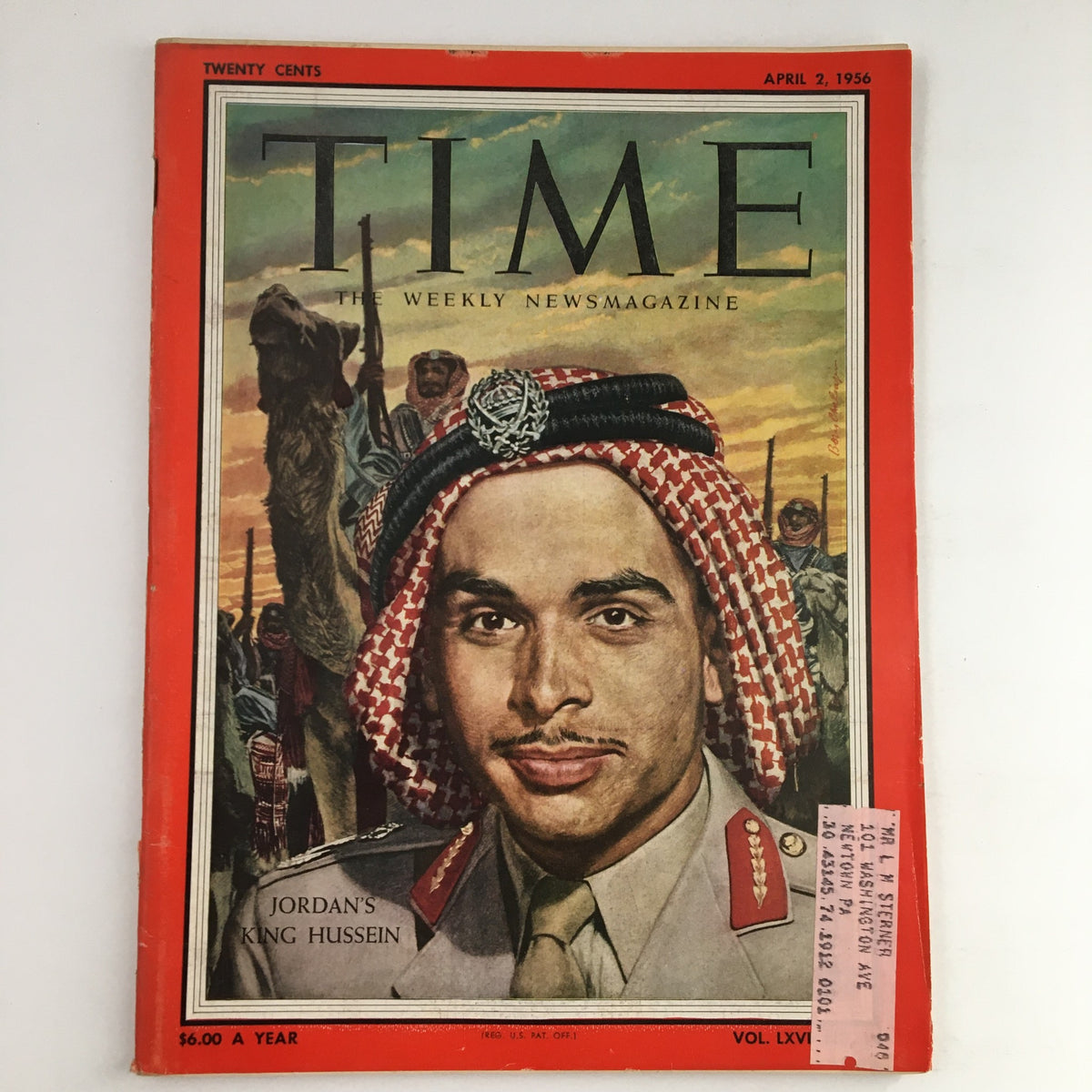

Description
Collector's Note – Why This Issue Matters
The April 2, 1956 issue of Time Magazine — Volume 67, Number 4 — featuring King Hussein bin Talal of Jordan on the cover is a primary document of one of the most consequential and consequentially timed episodes in the young Jordanian monarch's reign. Hussein had become King of Jordan in August 1952 at the age of 17 following the deposition of his father Talal, and by early 1956 was navigating one of the most acute political crises of his early rule. On March 1, 1956 — just one month before this issue's cover date — Hussein had dismissed General John Bagot Glubb, the British officer who had commanded Jordan's Arab Legion since 1939, in a dramatic assertion of Jordanian sovereignty that sent shockwaves through British foreign policy and the broader Arab world. The dismissal of "Glubb Pasha" was one of the defining moments of Arab nationalist assertion in the mid-1950s, a period in which Nasser's Egypt was reshaping the regional political landscape and the question of which Arab states would align with the West versus the emerging non-aligned movement was among the most consequential geopolitical questions of the Cold War. A Time cover on Hussein dated April 2, 1956 documents him at the specific moment of maximum international attention following the Glubb dismissal — a young king who had just made one of the most audacious political decisions of the Arab world's most turbulent decade. For collectors building archives of King Hussein magazines, this April 1956 issue is the primary American press documentation of that specific and historically consequential decision.
The April 2, 1956 date situates this issue at a specific and well-documented threshold in the broader regional geopolitical story of the mid-1950s. Nasser had nationalized the Suez Canal Company in July 1956 — just three months after this issue — and the Suez Crisis that followed in October-November 1956 would prove to be the defining event of the decade's Middle Eastern politics. The April 1956 Time cover on Hussein documents him in the specific pre-Suez moment when Arab nationalism's trajectory was not yet fully determined and when Hussein's dismissal of Glubb was being read by American and British policy makers as a potential indicator of Jordan's orientation in the Cold War competition for Arab alignment. The specific political meaning of Hussein's action — was it a genuine assertion of sovereignty, a tilt toward Nasser's pan-Arabism, or a calculated repositioning within the Western alliance? — was precisely the question that a Time cover feature in April 1956 would have addressed for its American readership, making this issue primary documentation of how American journalism was processing the Arab nationalist moment at the specific threshold before Suez transformed the regional calculus entirely. Collectors focused on 1956 magazines as documents of Cold War Middle Eastern history will find this issue occupying one of the most historically specific positions in the year's press record.
Hussein's subsequent career — he ruled Jordan until his death in 1999, surviving numerous assassination attempts, two Arab-Israeli wars, and the profound transformations of the Middle East across nearly five decades — gives this April 1956 cover a retrospective weight that is considerable. The young king photographed here, just 20 years old and one month removed from the most audacious political decision of his early reign, would prove to be one of the most consequential and durable figures in twentieth-century Arab political history. A Time cover from the first month of international attention to his political independence documents that story at its starting point — before the decades of survival and statecraft that would define his legacy were yet imaginable.
About the Publication
Time Magazine, founded in 1923 by Henry Luce and Briton Hadden, was by April 1956 the dominant American weekly news magazine with a circulation of several million and the editorial authority to shape how American readers understood international political figures and events. Its cover selections were deliberate editorial statements, and a Middle Eastern monarch cover in April 1956 — one month after the Glubb dismissal and three months before Suez — reflected the publication's editorial judgment that Hussein's specific political moment was among the most consequential stories for its American readership to understand. Volume 67, Number 4 places this issue in the magazine's thirty-third year of publication, fully established in the mature editorial identity that Luce had developed across three decades.
Key Highlights Inside
- King Hussein bin Talal cover — April 2, 1956 — Primary American press documentation of the 20-year-old Jordanian monarch one month after his March 1, 1956 dismissal of British General John Bagot Glubb — one of the defining moments of Arab nationalist assertion in the mid-1950s and the most consequential political decision of Hussein's early reign.
- Pre-Suez Crisis Middle Eastern politics — confirmed context — Published three months before Nasser's July 1956 nationalization of the Suez Canal, this issue captures the specific pre-Suez regional political atmosphere when the trajectory of Arab nationalism and Cold War Middle Eastern alignment was still being actively determined.
- Volume 67, Number 4 — verified issue identification — The confirmed volume and number designation allows precise placement in Time's publication archive and facilitates cross-referencing with library holdings and Cold War history resources for researchers verifying interior content.
- Glubb Pasha dismissal context — one month prior — The April 2 cover date places this issue exactly one month after Hussein's March 1 dismissal of the British commander of the Arab Legion, documenting the American press's specific engagement with that decision at the moment of its maximum geopolitical significance.
Note: Specific interior article titles and confirmed content beyond the cover subject have not been provided in the available listing. The highlights above reflect only what is verifiable from the listing and well-documented public record surrounding King Hussein, the Glubb dismissal, and the broader regional context of April 1956.
Condition & Rarity
Good condition with a confirmed front cover address label, minor wear throughout, and plastic protective covering represents a standard mid-grade assessment for a 69-year-old weekly news magazine. The confirmed subscription label on the front cover is the primary visual condition factor — its placement relative to the Hussein cover portrait should be assessed from available photographs for collectors for whom unobstructed cover display is a priority. Minor wear throughout on a newsprint weekly of this age is an expected characteristic of survival across nearly seven decades. The plastic protective covering indicates deliberate preservation at some point in the issue's history. Good condition in a publication of this age implies cover imagery intact and accessible, page integrity without significant brittleness, and interior content fully legible — the attributes that preserve its value as both a Cold War Middle Eastern history research document and a King Hussein collecting item. The address label's historical provenance — indicating this was a subscriber copy that passed through someone's household in 1956 — is itself a minor document of the issue's journey through time.
Looking for More Issues Like This?
Mid-1950s Time covers featuring Arab political figures at the specific threshold moments of the region's Cold War transformation — particularly the pre-Suez period in which Hussein's Glubb dismissal was the defining story as this April 1956 issue documents — are a specific and historically grounded collecting category that places this issue among the more consequentially situated in the publication's Middle Eastern coverage archive. The dedicated King Hussein magazine archive at OriginalMagazines.com is the most direct resource for collectors tracing his documented press presence across the nearly five decades of his reign. For collectors building a broader picture of Cold War Middle Eastern politics and American foreign policy journalism in the pivotal pre-Suez year, the full 1956 magazine collection covers the range of publications from the year whose second half would transform the regional landscape that this April issue documents at its most unsettled and consequential threshold.