
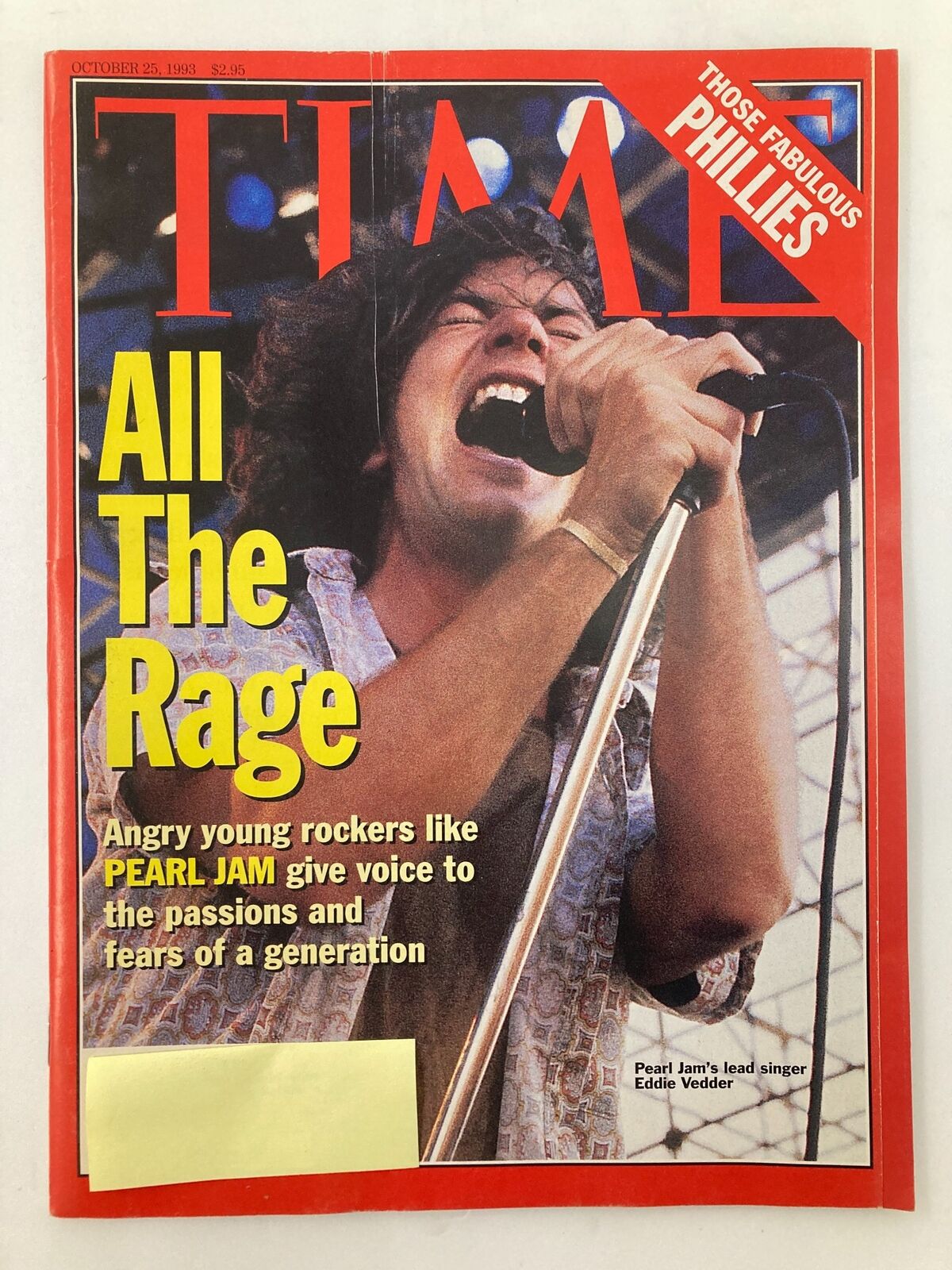


Description
Collector's Note – Why This Issue Matters
October 25, 1993 is one of the most historically specific and culturally significant dates in the entire relationship between American mainstream journalism and rock music, and a Time magazine cover featuring Eddie Vedder at this precise moment documents a cultural phenomenon at its most publicly charged and most historically consequential point. By the autumn of 1993 Pearl Jam had completed one of the most extraordinary ascents in the history of American popular music — their 1991 debut Ten had sold more than ten million copies in the United States alone, making it one of the best-selling debut albums in rock history, and their 1993 follow-up Vs. had broken the record for first-week album sales when it was released on October 19, 1993 — just six days before this issue appeared on newsstands. A Time cover feature on Eddie Vedder arriving in the same week as Vs.'s record-breaking debut was therefore a document of peak Pearl Jam at its most precisely documented moment — the mainstream media's acknowledgment that this band and this singer had achieved a cultural significance that demanded the full weight of America's most authoritative newsmagazine's editorial attention. The listing confirms that this issue includes a detailed article about Pearl Jam's influence on the nineties rock scene, making it a primary source for the band's cultural history rather than merely a collector's artifact. Collectors researching Eddie Vedder's documented presence in mainstream print media across his career will find the Eddie Vedder magazine collection the most concentrated resource for tracing his coverage from the early Pearl Jam years through his full public career.
The specific framing of this October 25, 1993 Time cover around Eddie Vedder rather than Pearl Jam as a collective reflects an editorial judgment about the nature of the band's cultural significance and its relationship to the broader grunge and alternative rock phenomenon that had been reshaping American popular music since Nirvana's Nevermind had detonated in 1991. Where Kurt Cobain had become the reluctant face of grunge's cultural moment — a figure who would eventually be destroyed by the weight of that representative function — Vedder had established a different kind of public identity: more physically imposing, more deliberately performative, more engaged with the social and political implications of his band's success, and more willing to engage with the mainstream media on his own terms even while maintaining a critical stance toward the commercial machinery of the music industry. A Time cover feature in October 1993 was therefore engaging with a figure whose relationship to his own celebrity was itself one of the most interesting and most publicly discussed aspects of the grunge moment — a singer who had become one of the most famous men in America while publicly questioning what that fame meant and what responsibilities it carried. The full Time magazine archive is essential for collectors researching the publication's engagement with rock music and cultural history across its most historically significant decades.
The October 1993 date also carries specific significance within the broader narrative of nineties music history that gives this issue additional resonance for collectors approaching it as a cultural document. The release of Vs. on October 19 and this Time cover six days later arrived at a moment when the alternative rock moment that Nirvana and Pearl Jam had inaugurated was at its commercial and cultural peak — before the grunge backlash, before Cobain's death in April 1994 would permanently alter the narrative of the era, and before the alternative scene's mainstream absorption would gradually dissolve the distinction between alternative and mainstream that had given it its energy and its meaning. A Time cover featuring Vedder in October 1993 is therefore a document of the grunge moment at its last point of maximum cultural confidence, before the events of the following year would begin reshaping how the era would be remembered. The complete 1993 magazine archive provides essential context for understanding this issue within the full publishing and cultural landscape of the year the alternative decade reached its commercial apex.
About the Publication
Time was founded in 1923 by Henry Luce and Briton Hadden and grew across the twentieth century into the most widely read and institutionally authoritative weekly newsmagazine in the United States — a publication whose cover appearances were understood by the American public, by cultural figures, and by the media establishment alike as among the most significant markers of mainstream cultural recognition that American journalism could confer. Its format combined comprehensive weekly news reporting across politics, business, science, and culture with the analytical and contextual framing of a publication that understood itself as an interpreter of events rather than merely a reporter of them. A rock musician on the cover of Time was a specific kind of cultural statement — one that the magazine made rarely and deliberately, with full awareness that the choice would be understood as a declaration about which cultural figures and which cultural phenomena had achieved significance beyond their own immediate fan communities.
Key Highlights Inside
- A cover portrait of Eddie Vedder arriving in the same week as Vs.'s record-breaking first-week sales debut — the most precisely timed convergence of mainstream media recognition and commercial achievement in Pearl Jam's career, documented by one of America's most authoritative institutions at the exact moment of maximum cultural and commercial impact.
- A confirmed detailed article about Pearl Jam's influence on the nineties rock scene — a primary source document of the band's cultural significance as assessed by one of America's most authoritative journalistic institutions at the height of the alternative rock moment, six days after Vs. broke first-week album sales records.
- Broader news and analysis content consistent with Time's October 25, 1993 weekly format — the full range of domestic and international reporting surrounding the Vedder cover story, providing a complete snapshot of American life and preoccupations in the final week of October 1993.
- A document of the grunge moment at its last point of maximum cultural confidence — October 1993, before Kurt Cobain's death in April 1994 would permanently alter the narrative of the era and before the alternative scene's mainstream absorption would dissolve the cultural energy that had made this music historically significant.
- Note: The listing confirms an address label on the front cover and marks as condition attributes. Beyond the confirmed Vedder cover and detailed Pearl Jam article, specific additional article titles, named contributors, and full interior content details have not been independently confirmed for this issue. The highlights above reflect what is verifiable from the named cover subject, confirmed article content, date, and the publication's well-documented editorial format and approach for the period.
Condition & Rarity
Surviving copies of this issue present with the physical characteristics consistent with subscription copies that have passed through private ownership over three decades. The presence of an address label on the front cover confirms subscription rather than newsstand origin — a condition attribute that affects the cover face directly and that collectors evaluating any surviving copy of this issue should assess carefully against available photographs to determine the label's placement relative to the Eddie Vedder portrait and its impact on the cover's visual presentation as a display object. Minor wear throughout the magazine and marks at this age are the expected surface characteristics of a well-handled subscription copy from this period, consistent with a Good grade under standard periodical collecting criteria — fully readable, completely displayable as a historical document, and collectible with the honest patina that distinguishes an authentic survivor from an artificially preserved example. The inclusion of a protective plastic sleeve indicates conscious collectible treatment at some point in the magazine's ownership history, a circumstance that reliably correlates with better interior page condition, staple integrity, and spine stability than copies stored without protection. Early-nineties Time magazine covers featuring rock musicians at historically specific moments in their careers — and particularly this October 1993 Vedder cover arriving at the precise moment of Vs.'s record-breaking debut — represent one of the most specifically sought-after categories in the vintage music magazine collector market, primary documents from the most culturally significant week in Pearl Jam's commercial history.
Looking for More Issues Like This?
A Time magazine cover featuring Eddie Vedder from October 1993 — arriving in the same week as Vs.'s record-breaking debut and documenting the alternative rock moment at its peak cultural confidence — is among the most historically specific and culturally resonant items in the vintage music and mainstream media collector market. If this particular issue has already been claimed, the Eddie Vedder magazine collection at OriginalMagazines.com is the most comprehensive resource for finding other issues that document his career and Pearl Jam's cultural history across the full arc of their remarkable run. The full Time magazine archive is equally worth exploring for collectors researching the publication's engagement with rock music and the nineties cultural moment, and the complete 1993 magazine archive rounds out the picture for anyone researching the alternative rock decade at its commercial and cultural apex — the specific months before Kurt Cobain's death would permanently alter how the era would be understood and remembered.