


Description
Collector's Note – Why This Issue Matters
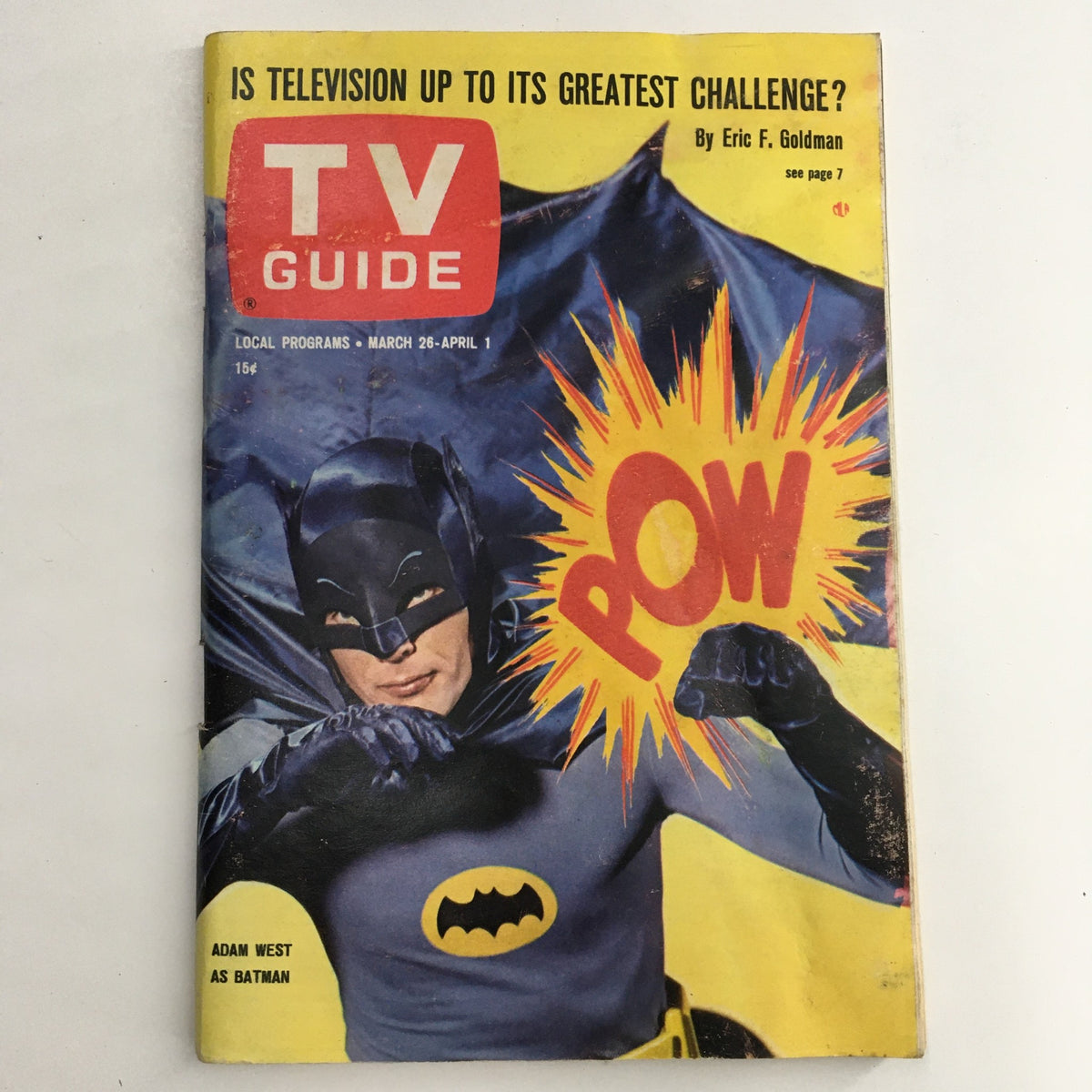
The March 26, 1966 issue of TV Guide Magazine, Volume 14, Number 13, featuring Adam West as Batman on the cover, documents the most culturally saturated moment of the Batman television phenomenon at its absolute peak. The ABC Batman series had premiered on January 12, 1966, airing twice weekly in prime time — Wednesday and Thursday evenings — in an unprecedented scheduling arrangement that reflected the network's confidence in the show's commercial potential. By the week of March 26, the series had been on the air for approximately ten weeks and had become one of the most talked-about television events in years. The show's combination of pop-art visual design, deliberate camp comedy, celebrity guest appearances as villains, and Adam West's deadpan heroism had made it a phenomenon that was simultaneously children's entertainment, adult satire, and genuine avant-garde pop culture — the kind of programming that people in 1966 discussed the morning after with the same intensity that prestige dramas would generate decades later. A TV Guide cover featuring Adam West in costume in March 1966 is a document of that specific cultural moment at its height. For collectors building an archive of TV Guide issues documenting landmark American television, this March 1966 edition is a primary document of one of the most significant pop culture phenomena of the decade.
The March 26, 1966 date places this issue at a specific point in the Batman series' first season — the show was still in its initial creative peak, the villain rotation was generating weekly press discussion, and the series' cultural impact was being processed by the broader media in real time. TV Guide's decision to put West as Batman on its cover in this specific week reflects the magazine's editorial recognition that the show was the dominant topic in American television conversation. TV Guide covers in 1966 carried genuine cultural authority: the publication was the most widely read weekly magazine in the United States by this period, reaching more American households than any news or entertainment publication, and its cover selections both reflected and shaped what American viewers considered culturally significant. The newsstand origin confirmed in this listing — no address label — gives this cover particular display value, since the Batman costume image benefits from unobstructed presentation. Publications from 1966 document American popular television culture at one of its most creatively and commercially energetic moments, and this TV Guide issue is among the most historically specific examples of the year.
About the Publication
TV Guide Magazine, founded by Walter Annenberg in 1953, was by March 1966 the most widely read weekly magazine in the United States — a publication whose combination of local television listings, national feature journalism, and celebrity coverage gave it a reach into American households that no news or entertainment publication could match. Its cover selections functioned as genuine cultural signals about which television programs mattered most to the national audience, and a Batman cover in March 1966 was the publication's stamp of approval on the season's most-discussed show. Its format combined the practical utility of program listings with the entertainment authority of celebrity features, making it a unique artifact in the history of American television media.
Key Highlights Inside
- Cover featuring Adam West as Batman — published March 26, 1966, approximately ten weeks into the series' first season and during the height of the Batman television phenomenon's initial cultural saturation, by the most widely read weekly magazine in the United States.
- Television programming listings and features from March 1966 — primary source documentation of the American network television landscape during one of its most commercially and creatively active seasons, anchored by the Batman phenomenon.
- Newsstand copy with no label — confirming clean cover presentation without mailing label adhesion or removal marks, the preferred configuration for display collectors of TV Guide issues from this era, and particularly valuable for a cover whose Batman costume imagery benefits from unobstructed presentation.
- Note: The listing confirms a filled-out crossword and some marks — condition factors that should be assessed from the provided photographs. Specific feature articles and interior content beyond the confirmed cover subject are unverified for this issue.
Condition & Rarity
Good condition with minor wear throughout, a completed crossword, and some marks is an honest condition profile for a weekly publication now sixty years old. The completed crossword is the most unusual condition disclosure — its location within the magazine and its impact on adjacent pages should be assessed from the provided photographs for collectors whose primary interest is content completeness. The marks are cosmetic issues whose extent and placement should be similarly evaluated from the photos. The newsstand origin and absence of a label are favorable for the cover's display potential. The plastic protective covering indicates deliberate subsequent preservation storage. For a staple-bound weekly publication of this vintage, the primary condition factors are cover image clarity — the Adam West Batman portrait is the primary visual and collectible attribute — and the integrity of the staple binding, which bears the most structural stress in TV Guide issues of this age.
Looking for More Issues Like This?
A label-free March 1966 TV Guide with Adam West as Batman on the cover is one of the more historically specific configurations in the publication's 1960s archive — the most widely read American weekly magazine documenting the most-discussed television show of its season at its cultural peak. If this issue has already been claimed, the full archive of TV Guide issues spans the publication's decades of television coverage and surfaces other significant celebrity covers and landmark television moments. The broader 1966 magazine collection offers additional context for this specific and culturally vibrant year in American television and popular culture history.