



Description
Collector's Note – Why This Issue Matters
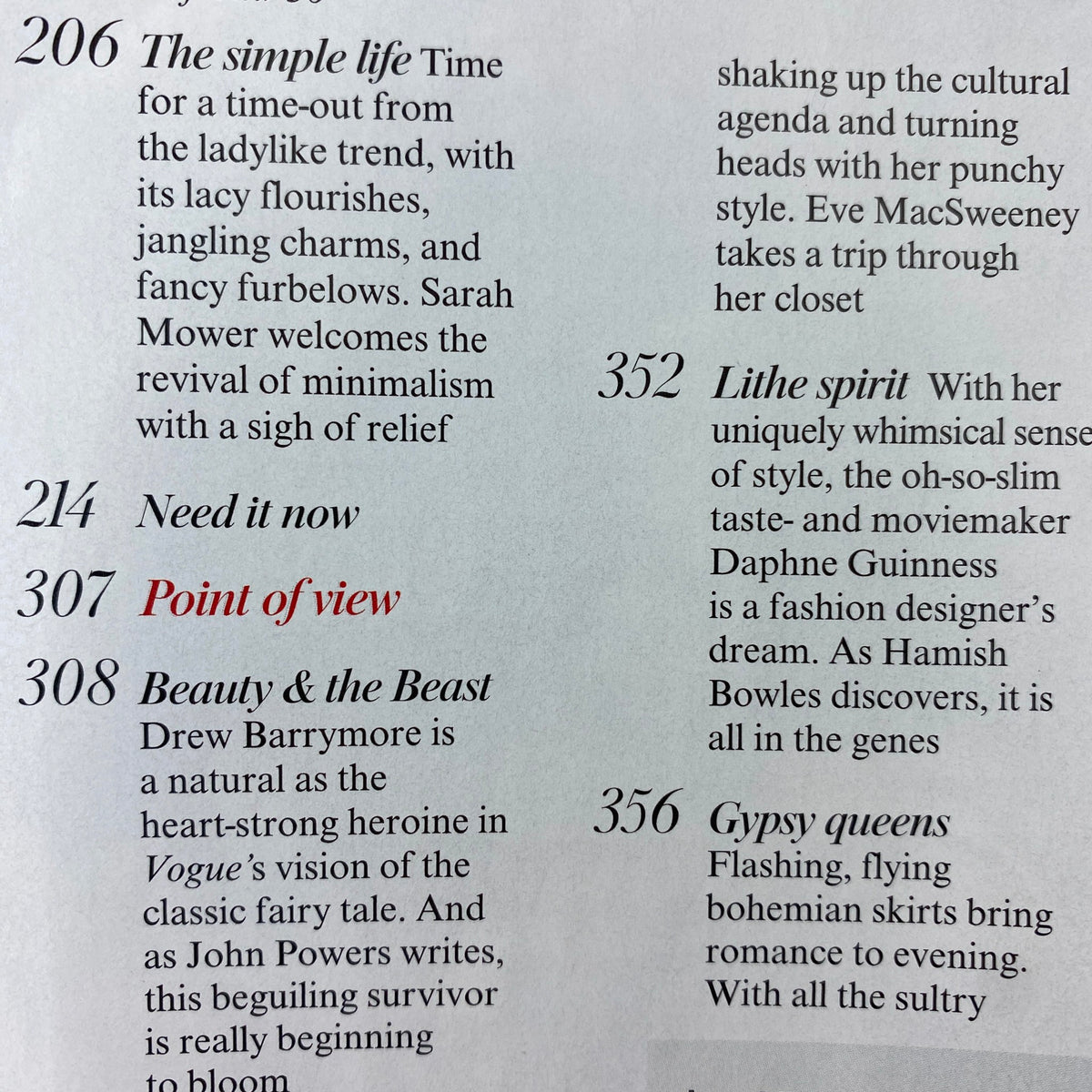
The April 2005 issue of Vogue, with Drew Barrymore on the cover, documents a specific and genuinely interesting moment in a career that had been one of the most publicly watched in American entertainment since childhood. By April 2005, Barrymore was thirty years old and had successfully navigated a trajectory that included child stardom, a very public adolescent crisis, and a sustained adult career rebuilding that had made her one of the most commercially bankable actresses in Hollywood — the Charlie's Angels films, Never Been Kissed, and 50 First Dates had established her as a reliable draw across romantic comedies and action entertainment. The confirmed interior feature — "Beauty and the Beast" by John Powers, with a fairy tale visual framing — engages her public persona directly: "a natural as the heart-strong heroine" and "this beguiling survivor is really beginning to bloom" are editorial characterizations that acknowledge the arc of her career rather than simply celebrating a current film. A Vogue cover and feature in April 2005 represents a specific kind of mainstream cultural validation — an invitation into the fashion establishment's most authoritative publication — and the fairy tale framing reflects the magazine's engagement with her career narrative as much as her star power. For collectors building an archive of Drew Barrymore magazine covers and pop culture history, this April 2005 Vogue is a primary document of her adult career consolidation.
The confirmed supporting content makes this issue more historically interesting than a routine cover appearance. Sarah Mower's "The Simple Life" feature (page 206) documents a specific mid-2000s fashion moment — the return of minimalism as a relief from the "ladylike trend" with its lace and charms — with the kind of opinionated, historically aware fashion criticism that distinguished Vogue's editorial voice from its competitors. The Daphne Guinness feature (page 352) by Hamish Bowles is a culturally specific piece: Guinness, the Anglo-Irish heiress and style figure whose connections to the Guinness family and the fashion world made her a recurring subject in Vogue's social and cultural coverage, is documented here as a "taste- and moviemaker" with a "whimsical sense of style" — the kind of profile that Vogue's cultural range allowed it to pursue alongside celebrity covers. Vogue issues from the mid-2000s document American fashion at a specific post-1990s, pre-social media moment, and this April 2005 edition captures the publication's particular editorial voice with unusual clarity through its confirmed content. Publications from 2005 document American celebrity and fashion culture at a specific transitional moment in media history.
About the Publication
American Vogue in April 2005 was operating under the editorship of Anna Wintour, who had led the magazine since 1988 and had by the mid-2000s consolidated its identity as the definitive voice of American fashion with genuine cultural breadth. The April issue carried the weight of the spring fashion preview, and its deployment of Barrymore as cover subject — combined with the fairy tale editorial concept and the John Powers profile — reflects the magazine's consistent practice of engaging celebrity images within a specifically constructed editorial narrative rather than simply reproducing star power. Vogue's readership in 2005 was fashion-forward, culturally engaged, and expected the publication to provide editorial intelligence alongside aspiration.
Key Highlights Inside
- "Beauty and the Beast" by John Powers (p.308) — Drew Barrymore as the fairy tale heroine, with editorial text engaging her career narrative as a "beguiling survivor" who is "really beginning to bloom," documenting both her star power and the specific arc of her public story.
- "The Simple Life" by Sarah Mower (p.206) — a fashion editorial welcoming the mid-2000s minimalism revival as relief from the ladylike trend, with opinionated fashion criticism characteristic of Vogue's editorial voice under Wintour.
- "Lithe Spirit: Daphne Guinness" by Hamish Bowles (p.352) — a profile of the Anglo-Irish style figure and moviemaker whose fashion connections and aesthetic individuality made her a recurring Vogue cultural subject in this period.
- Label-free cover — confirming newsstand origin and clean cover presentation, the preferred configuration for display collectors of mid-2000s Vogue issues.
Condition & Rarity
Very good condition with minor edge wear is an appropriate rating for a monthly fashion magazine now twenty years old. The absence of a mailing label confirms newsstand origin — subscriber copies of mid-2000s American Vogue were delivered with address labels applied directly to the cover, and label-free examples are the preferred configuration for display collectors. The plastic protective covering indicates deliberate preservation storage. For a glossy-stock monthly publication of this vintage, the primary condition factors to assess in any surviving copy are cover surface brightness and color saturation — the Barrymore cover photograph is the primary visual and collectible attribute — spine integrity, and the completeness of interior pages including the confirmed feature content.
Looking for More Issues Like This?
A label-free, very good condition April 2005 Vogue with Drew Barrymore on the cover and confirmed content including the Sarah Mower minimalism feature and the Daphne Guinness profile is a more editorially layered find than a routine celebrity cover. If this one has already been claimed, the archive of Drew Barrymore magazine covers and features is the natural first stop. The full Vogue magazine collection spans the publication's entire run, and the 2005 magazine archive offers broader context for this specific year in American fashion and celebrity culture.