



Description
Collector's Note – Why This Issue Matters
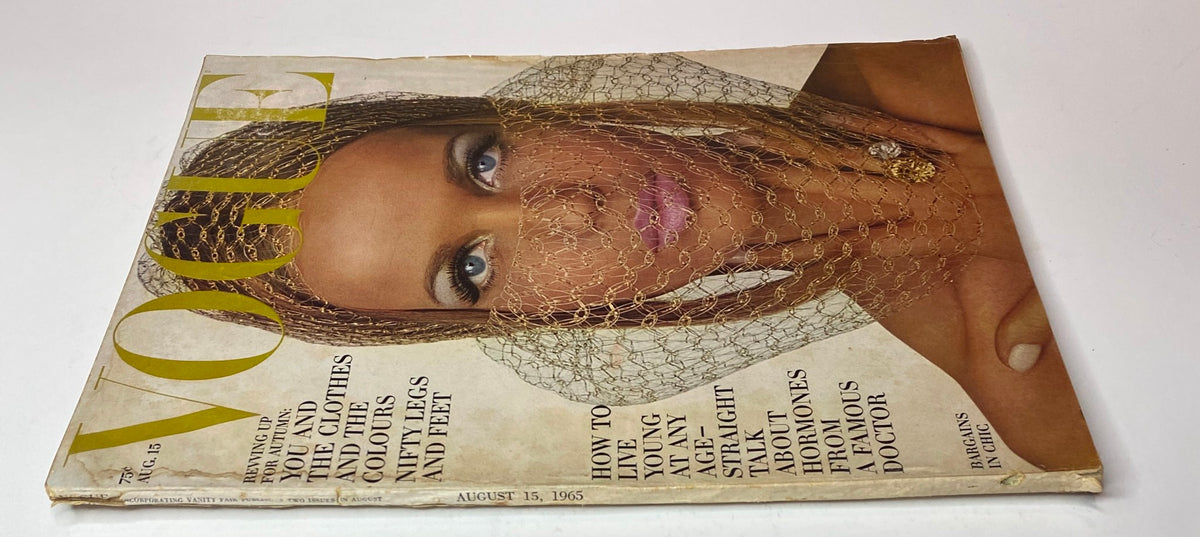
The August 15, 1965 issue of Vogue Magazine, with Veruschka von Lehndorff on the cover photographed by Irving Penn, is a document of mid-1960s fashion photography at its most collaborative and artistically charged. Veruschka — the German-born model born Vera Gottliebe Anna Gräfin von Lehndorff-Steinort — had emerged as one of the most visually distinctive and intellectually serious models of the decade, a figure whose aristocratic bearing, extraordinary height, and willingness to engage with avant-garde creative concepts made her a natural subject for the most ambitious photographers of the era. Irving Penn's pairing with Veruschka for a Vogue cover was a meeting of two figures who both understood fashion photography as a serious art form rather than commercial illustration, and the confirmed description of the cover — silver shimmer lids, porcelain skin, short hairstyle in a silver snood — reflects the specific evening beauty aesthetic that Penn and his subjects were developing at this moment. The August 15, 1965 date places this cover in the period immediately before Veruschka's most celebrated work with photographer Franco Rubartelli, and before her appearance in Antonioni's Blow-Up in 1966 would make her internationally famous beyond the fashion world. For collectors building an archive of Veruschka magazine covers and 1960s fashion photography, this Irving Penn Vogue cover is the most photographically distinguished configuration of her pre-Blow-Up career.
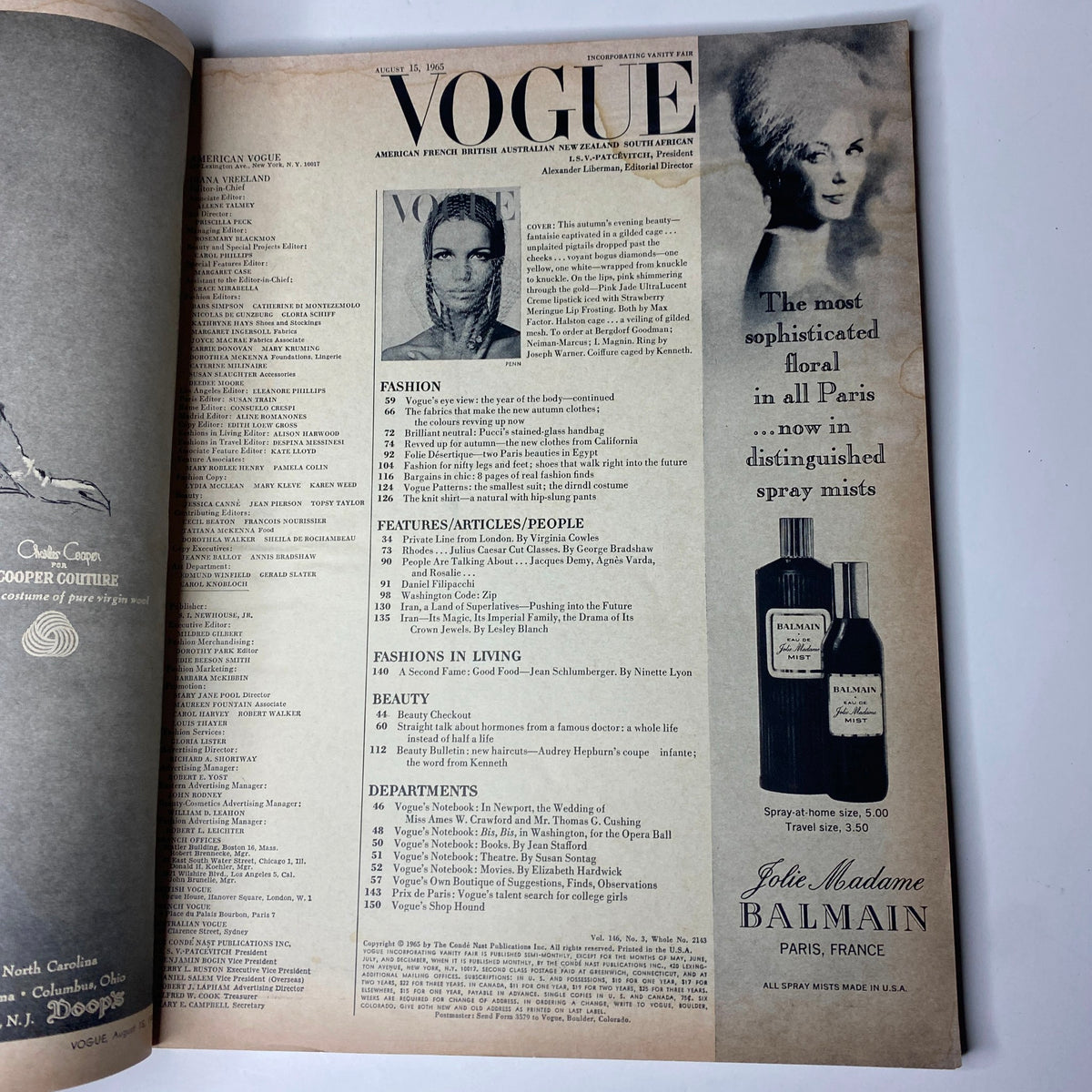
The confirmed table of contents makes this issue an unusually substantive primary document of mid-1960s American fashion and cultural life. The "Evening Brilliance" beauty feature (page 84), the fall fabric preview (page 124), and "Vogue's Eye View: The year of the body" (page 59) together constitute a comprehensive editorial statement about where fashion was heading in late 1965 — a moment when the decade's most radical silhouette changes were still gathering momentum and when Vogue was actively shaping the conversation about what "the body" meant as a fashion concept. The cultural notes feature on Agnès Varda and her film Cléo de 5 à 7 (page 90) reflects Vogue's consistent practice under Diana Vreeland of commissioning cultural content that operated at the intersection of fashion and contemporary art. Jean Schlumberger's good food feature (page 140) — the celebrated jewelry designer profiled through his cooking — is a characteristic Vreeland-era touch: the fashion world's most interesting personalities revealed through their non-fashion passions. Vogue magazine issues from the mid-1960s document the publication at the height of its Vreeland-era creative ambition, and this August 1965 edition captures that ambition across multiple editorial registers. Publications from 1965 document American fashion and culture at one of its most genuinely transformative moments.
About the Publication
American Vogue in August 1965 was operating under the editorship of Diana Vreeland, who had joined the magazine in 1963 and who was in the middle of what is widely regarded as the most creatively ambitious period in the publication's twentieth-century history. Vreeland had expanded the magazine's scope beyond conventional fashion into art, travel, politics, and ideas, and her commissioning of major photographers — Penn, Avedon, and others — combined with her engagement with cultural figures from across the arts gave each issue of this period a creative density that later decades of the publication have not replicated. The August 15 twice-monthly edition was a standard production in Vogue's twice-monthly publication schedule of the era, but the confirmed editorial content reflects the full ambition of Vreeland's vision.
Key Highlights Inside
- Cover featuring Veruschka von Lehndorff photographed by Irving Penn — a pairing of one of the decade's most artistically serious models with one of its greatest photographers, published before Veruschka's 1966 appearance in Antonioni's Blow-Up would extend her fame beyond the fashion world.
- "Vogue's Eye View: The year of the body" (p.59) and "Evening Brilliance" (p.84) — editorial content engaging the mid-1960s fashion moment's most significant conceptual development, the body as the primary fashion statement, at the precise moment when that conversation was shaping the decade's most radical silhouette changes.
- "Fall Preview: Soft-fall fabrics and five-point trends" (p.124) — comprehensive fall fashion preview documenting the directional editorial choices that Vogue was making for the coming season.
- "Cultural Notes: Jacques Bercy, Agnès Varda, and the film Cléo de 5 à 7" (p.90) — engagement with French New Wave cinema in a fashion magazine, characteristic of Vreeland-era Vogue's consistent integration of contemporary art and cultural movements into its editorial framework.
- "A Second Fame: Good Food—Jean Schlumberger" by Ninette Lyon (p.140) — a profile of the celebrated jewelry designer through his passion for cooking, reflecting Vreeland's editorial practice of revealing the fashion world's most interesting figures through their non-fashion lives.
- "A Ballet of Haircuts: Inspired by Audrey Hepburn" (p.112) — beauty content engaging Hepburn's enduring influence on 1960s short-hair aesthetics, published the same issue as an Agnès Varda film feature, capturing the specific cultural cross-referencing that defined Vreeland's editorial intelligence.
Condition & Rarity
Good condition is an appropriate assessment for a twice-monthly fashion magazine now sixty years old. The absence of a mailing label confirms newsstand origin — subscriber copies of mid-1960s American Vogue were delivered with address labels applied directly to the cover, and label-free examples are the preferred configuration for display collectors, avoiding the adhesion or removal damage that affects many surviving copies of this era. The plastic protective covering indicates deliberate preservation storage. For a coated-stock publication of this vintage, the primary condition factors are cover surface brightness — the Penn cover photograph is the primary visual and collectible attribute — spine integrity, and the completeness and quality of the interior photography and feature content across what appears to have been a substantively produced edition.
Looking for More Issues Like This?
A label-free August 1965 Vogue with a Veruschka cover photographed by Irving Penn and this depth of confirmed editorial content — including the Agnès Varda cultural notes and the Vreeland-era body-as-fashion editorial — is a historically layered find that serious collectors of both 1960s Vogue and fashion photography will recognize immediately. If this issue has already been claimed, the archive of Veruschka magazine covers and 1960s fashion photography is the natural first stop. The full Vogue magazine collection and the 1965 magazine archive offer additional context for this extraordinary year in American fashion and cultural history.