





Description
Collector's Note – Why This Issue Matters
The August 1994 issue of Vogue featuring Karen Mulder photographed by Steven Meisel is a document of the supermodel era at its absolute commercial and cultural peak — a precise moment when the handful of women who occupied the top tier of the modeling world were as famous as any film star, as commercially powerful as any athlete, and as culturally visible as any musician. Mulder, the Dutch model who had risen to the front rank of the profession in the early 1990s, was by 1994 one of the most recognizable faces in international fashion, a fixture at the Paris couture shows and a consistent presence in the campaigns of the houses whose advertising defined the decade's luxury aesthetic. Her placement on the August cover of American Vogue — the summer blockbuster issue that typically carried the magazine's highest newsstand circulation of the year — was an editorial statement about her standing within the hierarchy of a profession that had, by 1994, become a fully fledged celebrity category. The photographer behind the cover was Steven Meisel, whose relationship with Vogue had by this point made him the most influential fashion photographer in the world — the artist whose editorial vision shaped the magazine's visual identity more completely than any other single contributor and whose cover assignments were the most coveted in the industry. A Meisel cover for Vogue was not an assignment; it was a collaboration between the magazine's two most powerful visual forces, and the result was invariably a cover that set rather than followed the visual conversation in fashion photography. Collectors building a focused archive of Meisel's Vogue cover work will find the Vogue magazine collection at OriginalMagazines.com the most comprehensive resource for tracking down individual issues.
The table of contents preserved with this issue reveals a magazine operating at the full breadth of its editorial ambition in the middle of a decade that was producing some of the most interesting fashion journalism in the publication's history. The cover story on Calvin Klein — profiled by Reed with portraits by Annie Leibovitz at precisely the moment the designer was, as the listing notes, being named womenswear designer of the year — is alone sufficient to make this a historically significant issue. Klein in 1994 was at a genuine inflection point: his minimalist aesthetic had become the dominant influence in American fashion, his fragrance business was generating revenues that dwarfed his clothing sales, and the tension between commercial success and design integrity that the Reed profile appears to address directly was a defining question of the era's fashion culture. The decision to assign his portrait to Annie Leibovitz — whose relationship with Vogue under Anna Wintour had made her the magazine's premier celebrity photographer — signals the level of editorial investment the magazine placed in this story. Alongside it, Suzy Menkes's feature on the future of fur engages with one of the most contested questions in 1990s fashion, addressing the collision between the industry's traditional luxury values and the animal rights activism that was fundamentally challenging its most iconic product. These are not light features. They are serious journalism on serious subjects, and they confirm that this issue of Vogue was doing considerably more than presenting clothes. Collectors interested in the full scope of Karen Mulder's magazine coverage will find related material in the Karen Mulder magazines collection at OriginalMagazines.com.
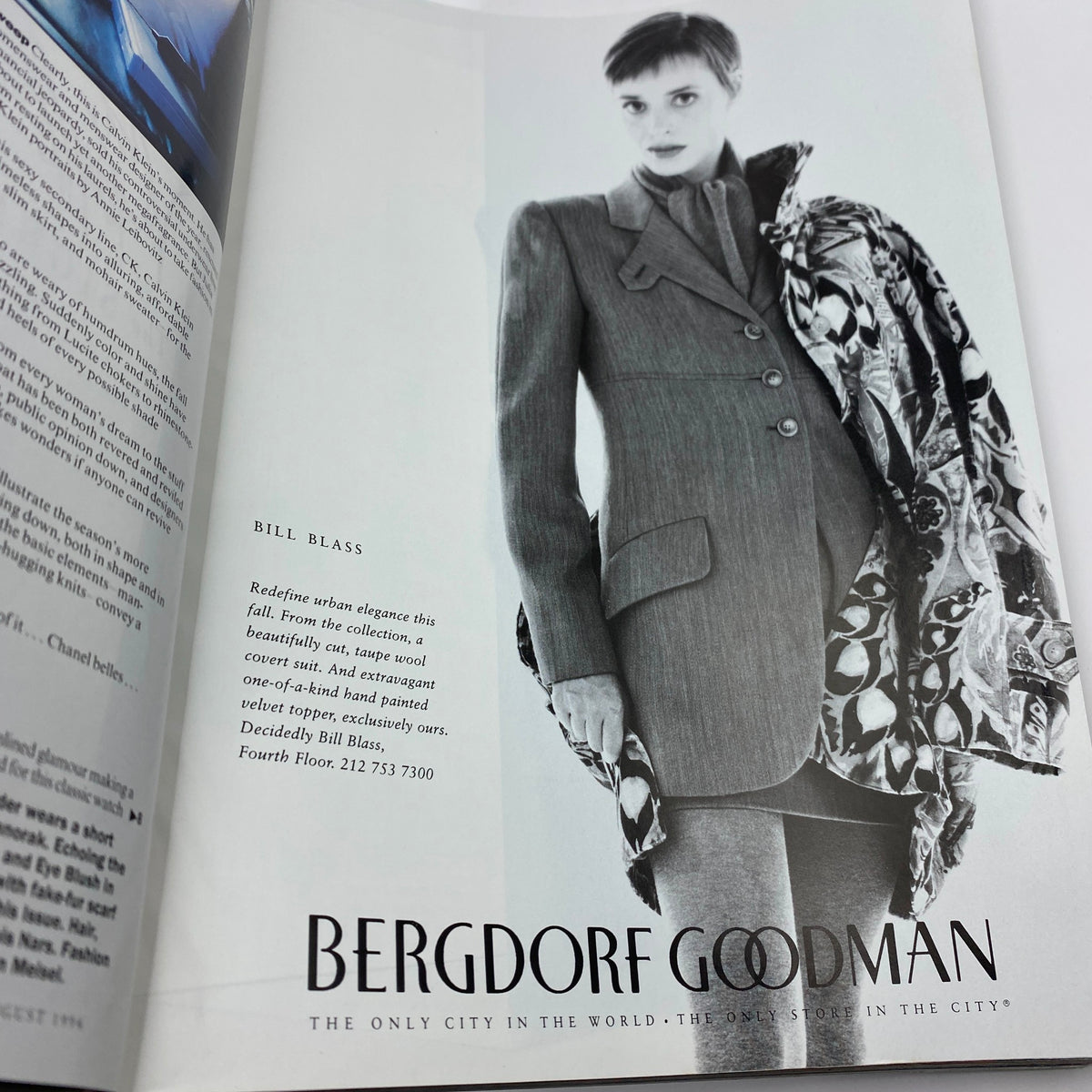
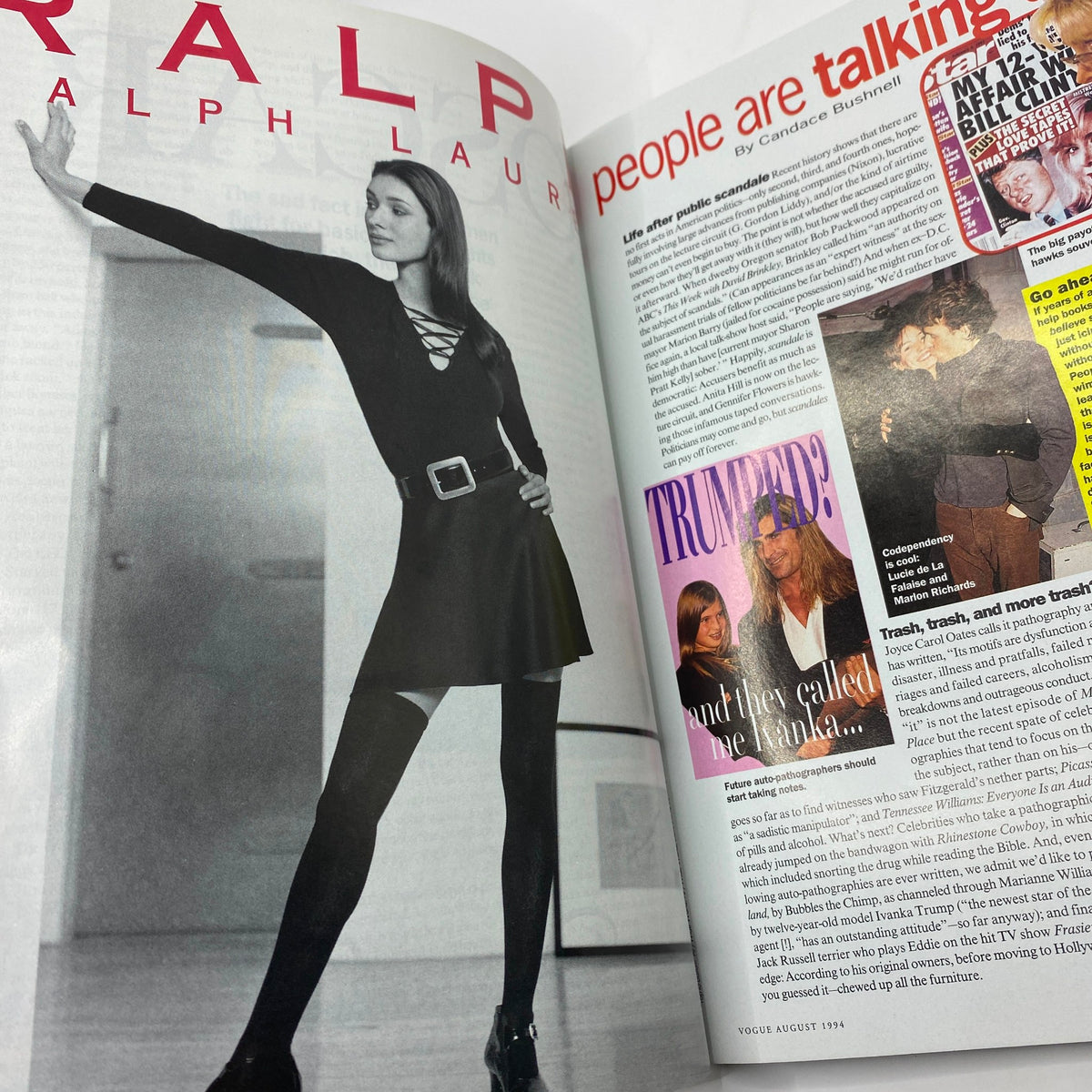
The fashion photography documented in this issue's table of contents further establishes its significance as a primary document of the mid-1990s visual aesthetic. Arthur Elgort shooting overcoats, Ellen Von Unwerth on suits — these are not routine fashion assignments but contributions from two of the most distinctive and celebrated photographers in the industry, each bringing a completely different visual sensibility to the seasonal fashion story. The editorial architecture of a mid-1990s Vogue issue like this one — Meisel on the cover, Leibovitz on the Klein portrait, Elgort and Von Unwerth in the fashion well — represents a concentration of photographic talent that no other publication could assemble or would attempt to assemble, and it is part of what makes individual issues from this period rewarding as both historical documents and visual artifacts. The 1994 magazines collection at OriginalMagazines.com offers the broader context of a year that was one of the most visually and editorially fertile in the history of American fashion publishing.
About the Publication
Vogue was founded in 1892 and transformed into the global fashion authority it remains under Condé Nast's ownership from 1909 onward. By August 1994, under the editorship of Anna Wintour — who had taken the helm in 1988 and fundamentally reshaped the magazine's editorial identity — Vogue was operating with a clarity of vision and a concentration of talent that made it the unquestioned center of gravity in international fashion publishing. Wintour's editorial philosophy combined an absolute commitment to fashion as the primary subject with a broader cultural ambition: the conviction that fashion was inseparable from art, politics, celebrity, and ideas, and that the magazine should address all of those domains with the same seriousness it brought to clothes. The result, in the early-to-mid 1990s, was a publication whose fashion content was matched by journalism of genuine substance — profiles, essays, and cultural criticism that treated its readership as intellectually engaged adults rather than passive consumers. The August issue was traditionally one of the most important of the annual calendar, carrying the fall fashion preview and typically featuring the magazine's most ambitious photography commissions, which makes it a consistently rewarding issue for collectors across any year of Wintour's tenure.
Key Highlights Inside
- Cover: Karen Mulder photographed by Steven Meisel — a Meisel cover for Vogue at the height of the supermodel era, pairing the most influential fashion photographer of the decade with one of the most prominent models of the early 1990s in the magazine's highest-visibility seasonal issue, representing a primary document of the visual aesthetic that defined mid-decade American fashion photography.
- Calvin Klein profile with portraits by Annie Leibovitz — a major feature on the designer at the moment of his greatest critical recognition and commercial complexity, with portraits by the magazine's most celebrated photographer, documenting Klein at the precise point when his minimalist aesthetic had achieved industry dominance and his business was undergoing fundamental transformation.
- Suzy Menkes on the future of fur — a substantive piece of fashion journalism by one of the most respected fashion critics of the era, engaging with the contested question of fur's place in an industry increasingly challenged by animal rights activism, representing the kind of culturally serious content that distinguished Wintour-era Vogue from purely commercial fashion publishing.
- Fashion photography by Arthur Elgort and Ellen Von Unwerth — fall fashion features shot by two of the decade's most distinctive photographers, each contributing a visually specific and editorially authoritative interpretation of the seasonal story alongside the Meisel cover, making this issue an unusually rich document of the range of photographic approaches that coexisted within a single issue of the magazine.
- The Wonderbra and the 1990s silhouette — a feature on the cultural phenomenon of the push-up bra and its influence on the decade's fashion silhouette, documenting one of the most discussed and debated fashion stories of 1994 at the moment of its peak cultural salience.
- Media industry feature: new magazine launches — a front-of-book piece on three women starting their own glossy publications in different cities, offering a glimpse into the early-to-mid 1990s magazine industry at a moment of expansion and diversification that the subsequent rise of digital media would make look, in retrospect, like the final flourishing of a particular publishing era.
Condition & Rarity
Surviving copies of this issue should be evaluated with attention to the condition expectations appropriate for a large-format glossy magazine now thirty years old. Vogue's high-quality coated paper stock ages considerably better than the newsprint or standard magazine stock used by contemporary publications, retaining color saturation and image clarity well into middle age when storage conditions have been reasonable. The primary condition considerations for a Karen Mulder-Meisel cover issue are the integrity of the cover image — specifically whether the color, surface sheen, and detail of Meisel's photography remain fully visible without significant fading, scratching, or moisture damage — and the completeness of the interior, which in a table-of-contents-documented issue like this one can be verified against the specific features listed. The absence of a newsstand address label is a positive condition attribute that preserves the cover surface in its intended state; labeled subscriber copies represent a significant portion of what survives from Condé Nast publications of this era, making clean unlabeled examples consistently more desirable for display. The plastic protective covering indicates deliberate preservation and more careful storage than an unprotected copy would typically have received. For a Meisel cover with a documented table of contents that confirms the presence of major features by Leibovitz, Menkes, Elgort, and Von Unwerth, condition grades across a reasonable spectrum retain genuine relevance — the completeness and integrity of the interior photography and journalism are as important as the cover presentation in determining the issue's full value as a collector's object.
Looking for More Issues Like This?
Steven Meisel cover issues of Vogue from the early-to-mid 1990s are among the most actively collected numbers in the magazine's modern run, and a Karen Mulder cover from the August 1994 issue — with its documented major features on Calvin Klein, fur, and the decade's fashion silhouette — is a particularly content-rich example that rewards both display and close reading. For collectors focused on Mulder's magazine presence across the supermodel era, the Karen Mulder magazines collection at OriginalMagazines.com is the best place to explore what's available across publications and years. Those building a broader archive of Vogue under Wintour's editorship will find the Vogue collection equally rewarding, and the 1994 magazines collection offers essential context from a year that stands as one of the most visually and editorially significant in the history of American fashion publishing.