



Description
Collector's Note – Why This Issue Matters
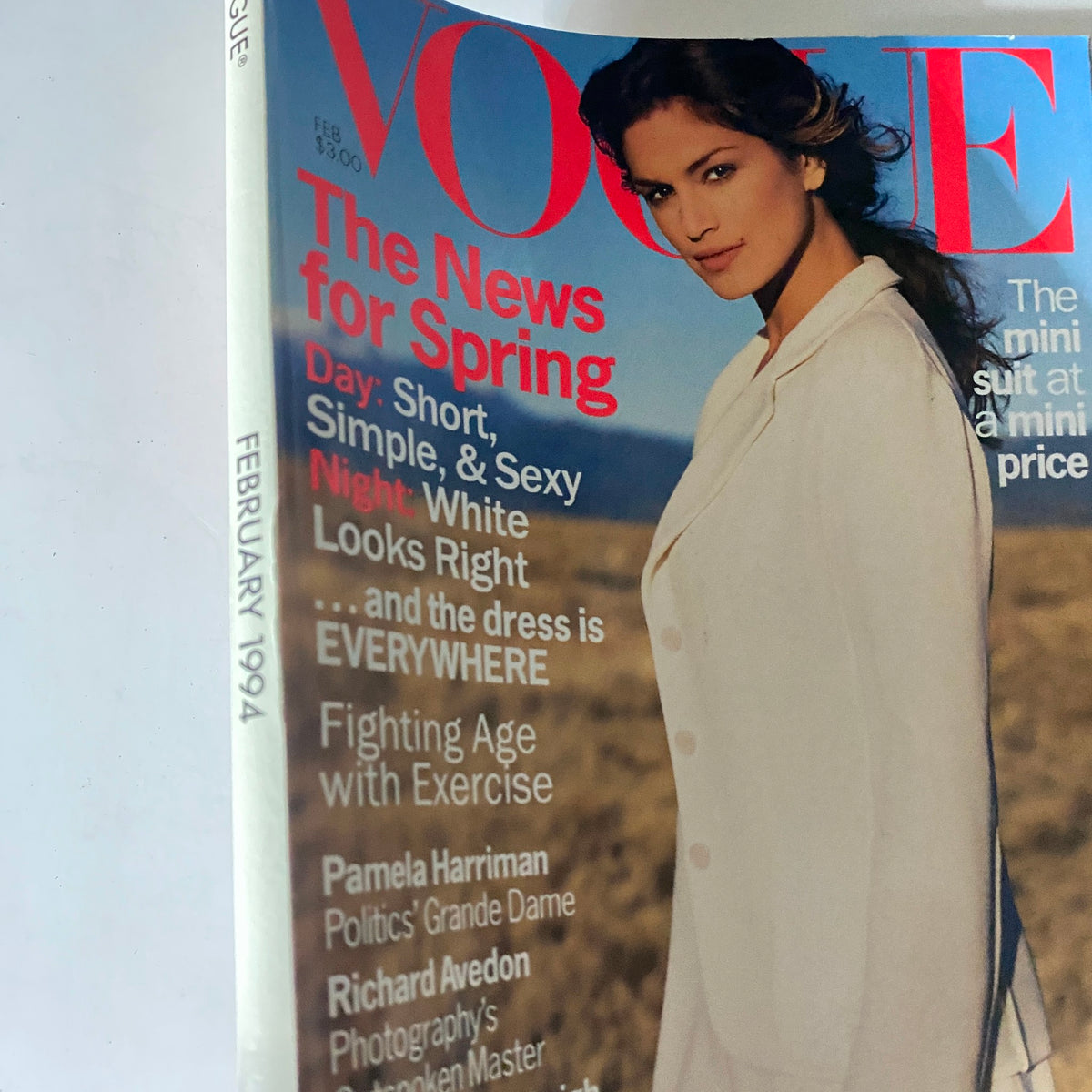
The February 1994 issue of Vogue featuring Cindy Crawford on the cover documents the world's most commercially dominant model at the absolute peak of her cultural saturation. Crawford in early 1994 was not simply a supermodel — she was a media institution. Her MTV show House of Style had been running since 1989 and had made her a household presence beyond the fashion world; her fitness video Cindy Crawford: Shape Your Body had sold millions of copies; she had appeared in dozens of major advertising campaigns simultaneously; and her face was as recognizable globally as any film star's. A February Vogue cover — the Valentine's month issue, traditionally among the year's highest-circulation numbers — was the natural home for the era's most visible face. For collectors building a focused archive through Cindy Crawford's most significant print appearances, a no-label American Vogue cover from her peak year is among the most display-worthy items in the collection.
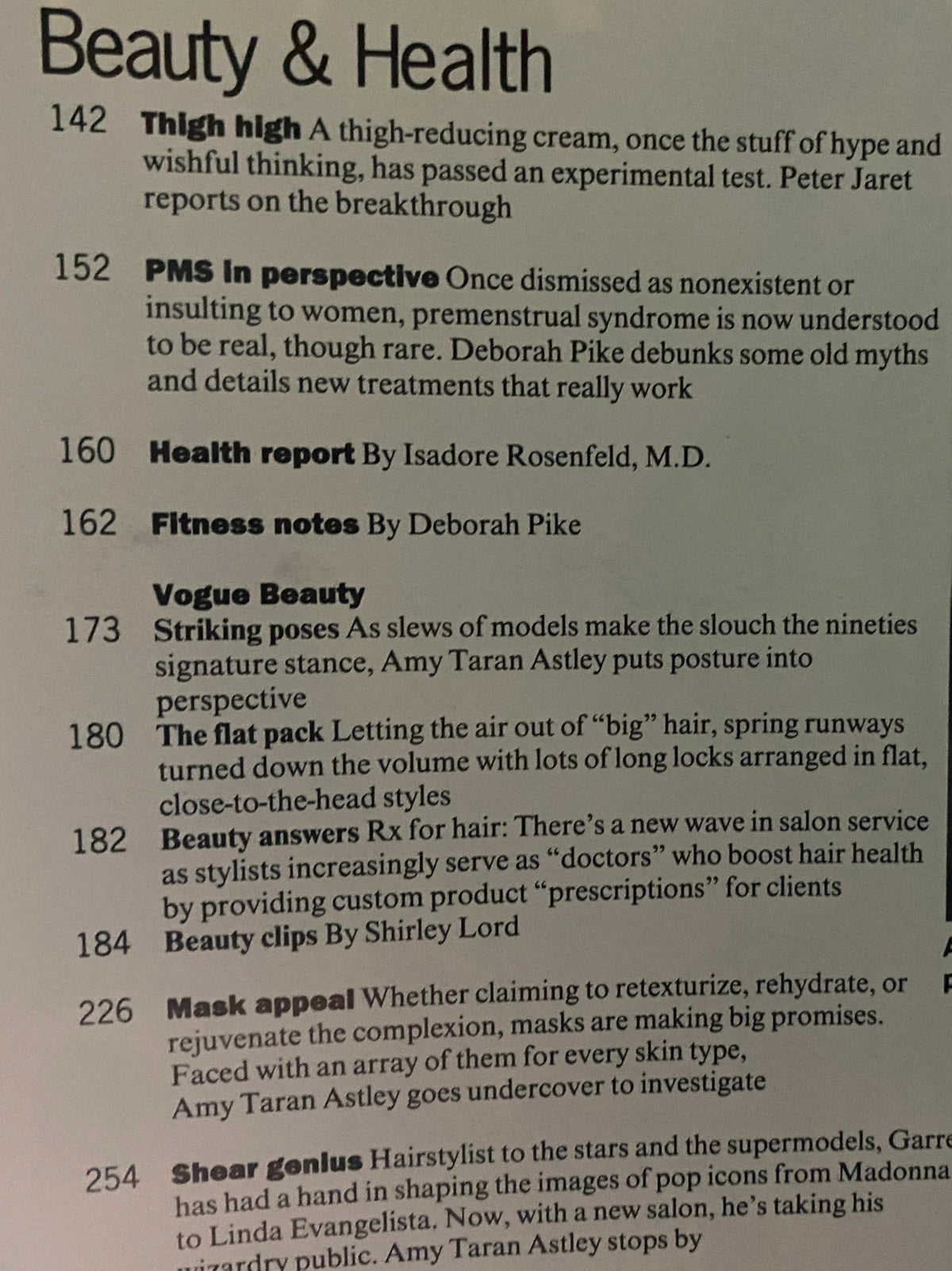
The editorial content documented in the listing reflects Vogue's February 1994 editorial identity with particular clarity. The health and beauty coverage — a thigh-reducing cream study, a substantive PMS piece by Deborah Pike that explicitly pushes back against the dismissal of women's health concerns, and Isadore Rosenfeld's regular health column — reflects the magazine's consistent effort under Anna Wintour to integrate serious women's health journalism alongside fashion content. The posture feature examining the mid-1990s slouch as a "nineties signature stance" is a small but historically precise detail: the deliberate anti-posture of mid-decade fashion — slouched, slightly indifferent, post-supermodel in its affect — was a real aesthetic shift that Vogue was documenting in real time. The "flat hair" feature on post-runway volume reduction similarly captures a specific moment in the decade's beauty aesthetic. The profile of hairstylist Garrett — whose client list ran from Madonna to Linda Evangelista — documents the celebrity hair culture of the early 1990s at the precise moment that ecosystem was fully developed. Anyone building a serious archive through the Vogue run of the supermodel era will find this issue both visually and editorially representative of the magazine at full early-1990s operation.
The broader cultural context of February 1994 is worth noting briefly. This was the month after the Northridge earthquake (January 17, 1994) and the month the sports world was consumed by the Tonya Harding/Nancy Kerrigan story — the kind of news environment against which a Vogue focused on posture, hair, and health reads as a deliberate refuge of aesthetic stability and feminine authority. Crawford's cover presence in that context was itself a kind of cultural reassurance — the decade's most familiar face on the decade's most authoritative fashion publication. Collectors focused on American magazine culture in the mid-1990s will find this issue a document of Vogue operating at confident institutional authority during a turbulent news cycle.
About the Publication
Vogue magazine, founded in 1892 and under the editorship of Anna Wintour since 1988, was by February 1994 the unquestioned authority in American fashion journalism, combining high-fashion editorial photography with cultural commentary, health journalism, celebrity profiles, and beauty coverage aimed at an educated, fashion-literate readership. Its monthly format and glossy production values made each issue a curated statement, and its cover selections — overseen by Wintour with meticulous personal attention — were treated as cultural endorsements of genuine significance. The early-1990s issues reflect the magazine at the height of the supermodel era it had helped create, with Crawford, Evangelista, Campbell, Turlington, and their contemporaries providing both editorial content and cover presence across the publication's most commercially successful years.
Key Highlights Inside
- Cover featuring Cindy Crawford — the era's most globally recognized supermodel, photographed for the February 1994 issue at the peak of her crossover presence across fashion, television, fitness media, and advertising simultaneously.
- "Striking Poses" by Amy Taran Astley — a beauty feature examining the mid-1990s slouch as the decade's defining stance, a period-specific document of how Vogue was framing the aesthetic shift away from the structured formality of 1980s fashion.
- PMS coverage by Deborah Pike — substantive women's health journalism explicitly pushing back against the historical dismissal of premenstrual syndrome, reflecting Vogue's consistent integration of serious health reporting alongside its fashion content.
- Thigh-reducing cream study by Peter Jaret — a health journalism piece engaging with one of the decade's most discussed beauty science topics, presented as genuine experimental reporting rather than product promotion.
- Garrett hairstylist profile by Amy Taran Astley — a document of the celebrity hair culture ecosystem in early 1994, with a client list spanning Madonna and Linda Evangelista that places the profile directly within the supermodel era's defining visual infrastructure.
- "The Flat Pack" hair feature and related beauty coverage — documenting the mid-1990s departure from high-volume 1980s hair toward the flatter, closer styles of the decade's second half, captured at the runway moment of that transition.
Condition & Rarity
Surviving copies of this issue in very good condition with only minor edge wear represent a strong example of a thirty-year-old glossy monthly magazine that has been stored with consistent care. Very good condition for a Vogue of this vintage indicates that the Crawford cover image reads cleanly with full color retention, the spine shows no significant cracking or separation, and the interior pages retain their gloss and structural integrity. A no-label newsstand copy is the preferred state for display-oriented collectors, allowing the Crawford cover to present without subscriber information interrupting the image — label-free copies of actively collected supermodel-era Vogue issues command a consistent premium in the market. A plastic protective sleeve confirms deliberate preservation effort. This issue is sought by Cindy Crawford collectors, Vogue supermodel-era completists, and 1990s fashion historians simultaneously, giving it broad and sustained collector appeal across multiple communities.
Looking for More Issues Like This?
Cindy Crawford Vogue covers in no-label, very good condition from her peak years are among the more actively collected items in supermodel-era magazine collecting, and the February 1994 issue is one of the stronger examples given both its cover and its documented interior content. If this one has already found a home, the Cindy Crawford magazines collection at OriginalMagazines.com gathers her most significant print appearances across the publications that defined her era. The full Vogue collection is essential for anyone building a serious run of the magazine's supermodel-era covers, and the complete 1994 magazines collection offers broader context for fashion and culture from the mid-decade moment.