



Description
Collector's Note – Why This Issue Matters
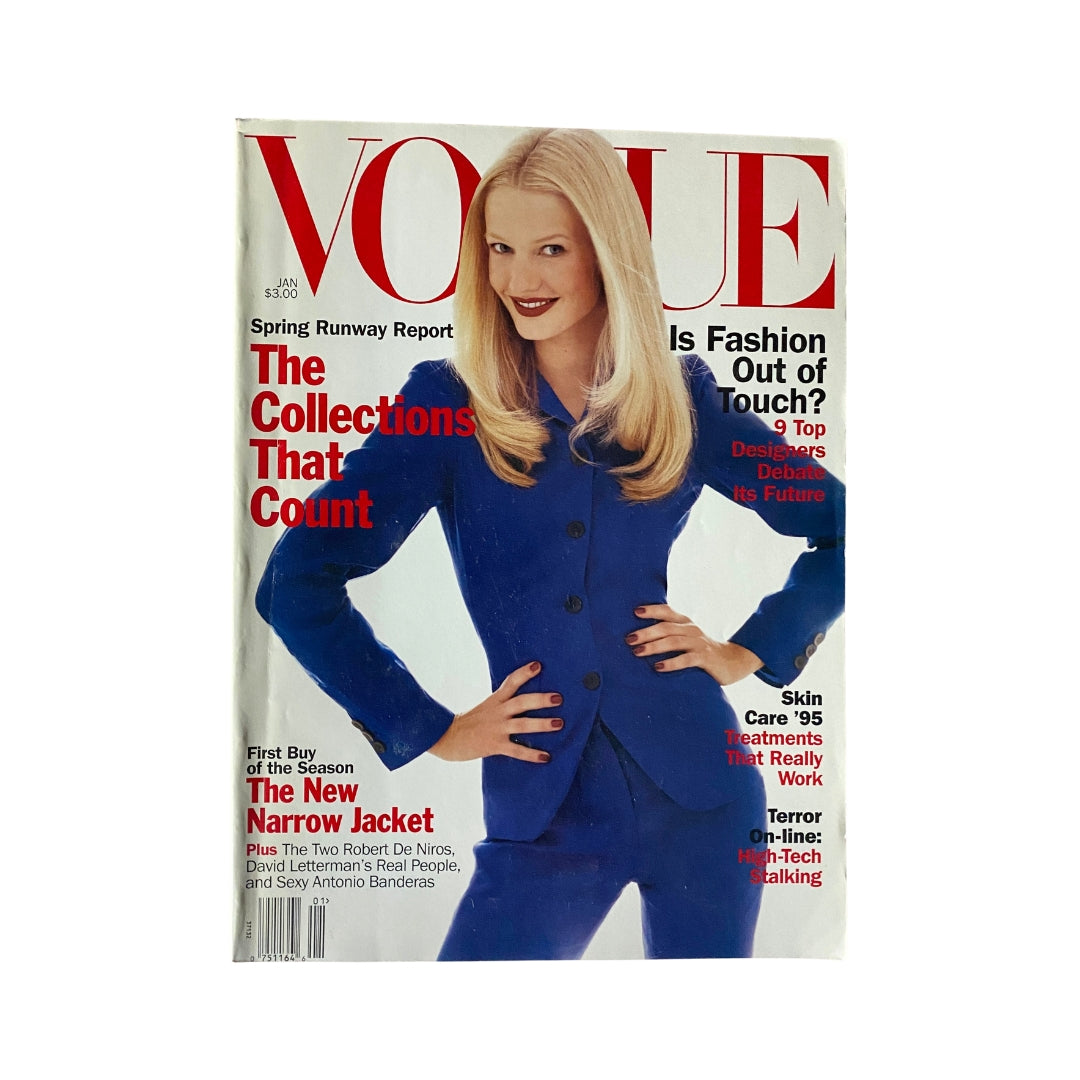
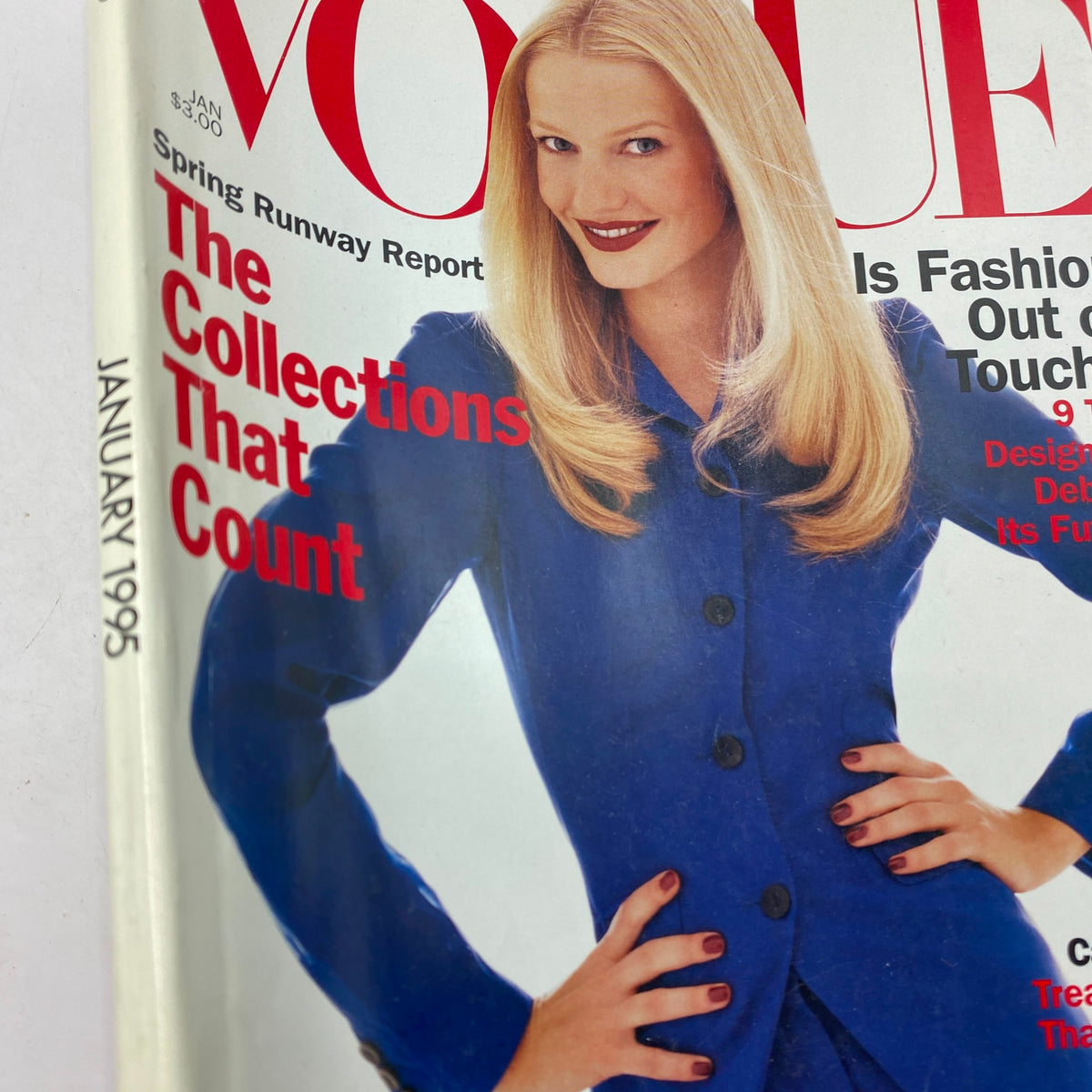
The January 1995 issue of Vogue features Dutch supermodel Karen Mulder on its cover, arriving at a moment when Mulder stood among the most prominent working models of the mid-1990s supermodel era. By 1995, the modeling landscape was still dominated by a small group of internationally recognized faces who commanded cover after cover across the major fashion publications, and Mulder's presence here reflects her firm standing within that elite group. A January issue carried particular editorial weight within Vogue's annual calendar, traditionally serving as the magazine's first major preview of the spring collections following the previous autumn's runway shows. This timing meant the issue functioned as an early signal of where fashion was heading for the new year, making it a useful reference point for understanding how the industry framed its own direction at the start of 1995.
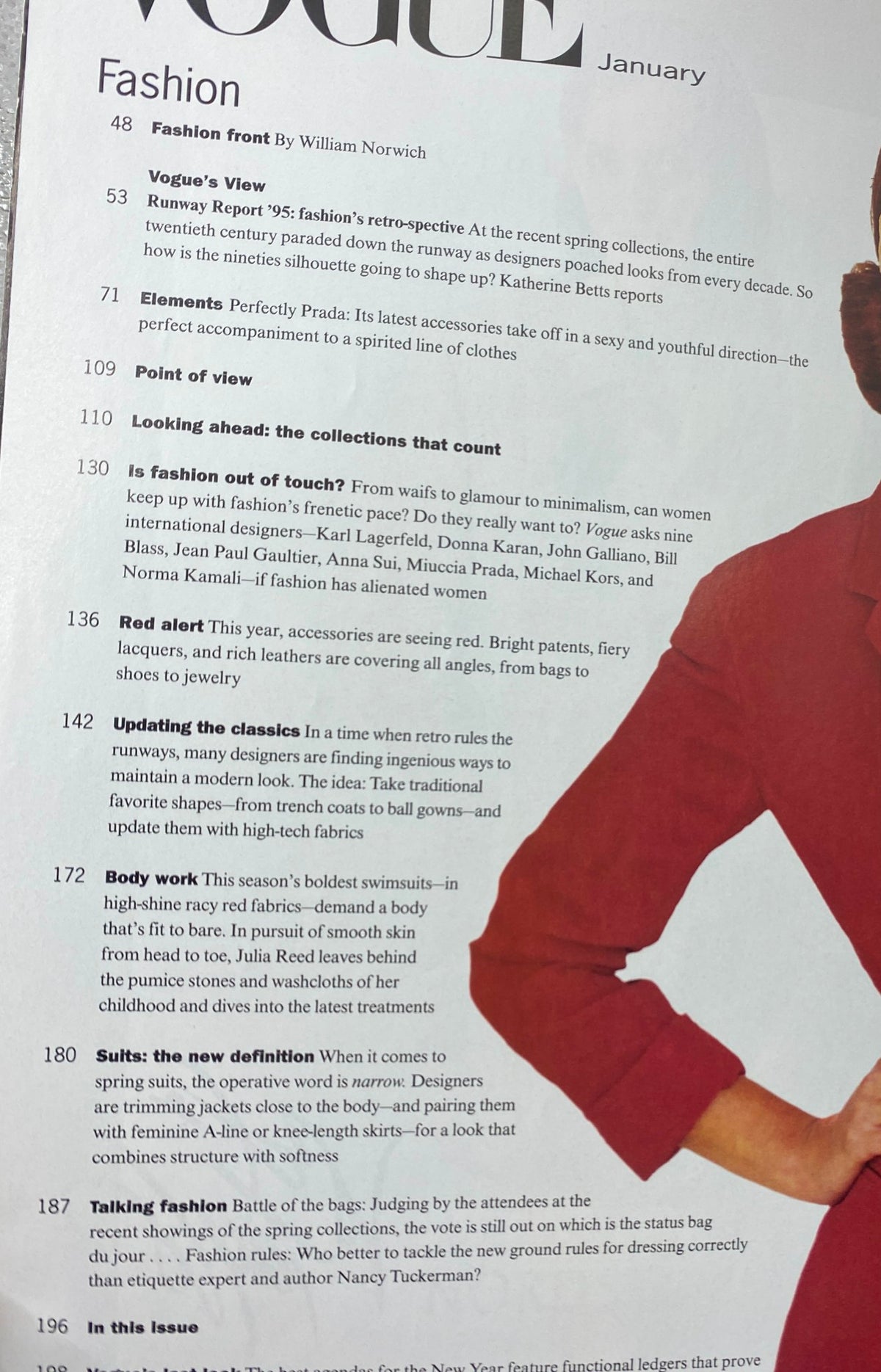
This issue's most distinctive editorial undertaking is its feature titled "Is Fashion Out of Touch?", in which Vogue posed a single pointed question to nine of the era's most influential designers: Karl Lagerfeld, Donna Karan, John Galliano, Bill Blass, Jean Paul Gaultier, Anna Sui, Miuccia Prada, Michael Kors, and Norma Kamali. The piece asked whether the rapid pace of fashion, then swinging between waif aesthetics, glamour, and minimalism, had left ordinary women behind. Assembling commentary from a panel of this caliber within a single feature reflects the kind of editorial ambition Vogue regularly brought to its most reflective, industry-facing pieces during this period. The inclusion of designers spanning such a wide range of aesthetic philosophies, from Galliano's romantic maximalism to Kamali's body-conscious minimalism, gives the piece unusual breadth as a snapshot of mid-1990s designer thinking.
The issue's "Runway Report '95" feature, subtitled "fashion's retro-spective," captures a specific and well-documented trend from the era: designers drawing simultaneously from looks across the entire twentieth century during the recent spring collections. Written by Katherine Betts, the piece grapples directly with the question of how a coherent nineties silhouette could emerge from such a thoroughly retrospective season. This kind of trend analysis, attentive to the tension between nostalgia and a distinct contemporary identity, was characteristic of Vogue's approach to runway reporting during the mid-1990s. Paired with a feature on bold, racy red swimwear and another on narrow-cut spring suits, the issue captures a fairly complete picture of how the season's most distinctive silhouettes were being interpreted across multiple categories of fashion.
Taken together, this issue offers an unusually substantive cross-section of mid-1990s Vogue, anchored by Karen Mulder's cover presence and deepened considerably by its nine-designer feature on fashion's relationship with women. It sits within the broader context of 1995 magazines and the long editorial history of Vogue itself, capturing a specific, well-documented moment in the magazine's ongoing examination of its own industry. Few single issues combine a major supermodel cover with a feature drawing commentary from nine of the era's most significant designers within the same set of pages. That density of specific, attributable content is precisely what gives this issue lasting reference value for collectors of 1990s fashion media.
About the Publication
Vogue has stood as one of the most influential fashion publications in the world since its founding in the late nineteenth century, evolving into the definitive record of high fashion, photography, and style for an international readership well before this 1995 issue's publication. By the mid-1990s, the magazine's editorial format combined a front-of-book "Vogue's View" section covering quick-hit trend and culture pieces with longer fashion portfolios, runway reports, and substantive industry-facing features examining fashion's broader cultural role. This structure allowed the magazine to address both immediate seasonal trends and more reflective industry analysis within a single issue, distinguishing it from narrower trend-report publications. The magazine's January issues traditionally carried particular significance, serving as an early preview of the season's spring collections and often setting the tone for how the industry would discuss the year ahead. Vogue's willingness to assemble multi-designer panel features, as seen in this issue's nine-designer piece on fashion's relationship with women, reflects the level of access and industry standing the magazine held throughout the 1990s. The magazine's audience spanned dedicated followers of high fashion as well as readers drawn to its broader cultural and industry commentary. Vogue maintained a consistent structural rhythm across issues during this period, typically opening with shorter trend and culture pieces before moving into longer fashion features and runway analysis. That consistent format is part of what allows an issue like this one to be so precisely dated and contextualized within the magazine's broader 1990s output.
Key Highlights Inside
- Cover feature on supermodel Karen Mulder, photographed for a January issue that traditionally served as Vogue's first major preview of the spring collections. Mulder's presence reflects her standing among the era's most prominent working models. January covers held particular significance within Vogue's annual editorial calendar.
- "Is Fashion Out of Touch?", a feature gathering commentary from nine influential designers, including Karl Lagerfeld, Donna Karan, John Galliano, Bill Blass, Jean Paul Gaultier, Anna Sui, Miuccia Prada, Michael Kors, and Norma Kamali. The piece examines whether fashion's rapid pace had alienated everyday women. This represents one of the issue's most editorially ambitious features, given the breadth of designers involved.
- "Runway Report '95: Fashion's Retro-Spective," written by Katherine Betts, examining how designers drew on looks from across the entire twentieth century during the recent spring collections. The piece grapples with how a coherent nineties silhouette could emerge from such a retrospective season. This feature reflects Vogue's characteristic attention to the tension between nostalgia and contemporary fashion identity.
- "Perfectly Prada," covering the brand's latest accessories line, described as taking a sexy and youthful direction suited to the season's more spirited clothing lines. This piece captures Prada's accessories positioning at a specific point in the mid-1990s. It reflects the issue's attention to individual designer houses alongside its broader trend coverage.
- "Body Work," a feature on the season's boldest swimwear, focused on high-shine red fabrics and written in part by Julia Reed. The piece pairs its fashion coverage with commentary on the skincare and body treatments associated with baring more skin. This feature reflects Vogue's tendency to blend fashion reporting with adjacent beauty and wellness content.
- "Suits: The New Definition," examining the spring season's narrow-cut jackets paired with feminine A-line or knee-length skirts. The piece frames this combination as a deliberate balance between structure and softness. It captures a specific tailoring trend documented for the 1995 spring season.
- "Talking Fashion," covering the ongoing debate over which handbag held status among attendees at the recent spring collections, alongside a piece on contemporary dress etiquette from author Nancy Tuckerman. This front-of-book feature reflects Vogue's lighter, more conversational coverage of industry chatter. It rounds out the issue's blend of serious industry commentary and more accessible style reporting.
Condition & Rarity
Condition for fashion magazines of this type and era is generally assessed through cover gloss retention, spine and binding integrity, page completeness, and the absence of significant creasing, tearing, or soiling. An issue described as great condition for its age, with only minor wear along the edges, generally indicates a cover that retains strong color saturation and gloss, with binding and interior pages intact and free from major structural damage. The absence of a subscriber label is generally viewed favorably among collectors, since newsstand copies without label residue or sticker removal marks tend to present a cleaner, unobstructed cover image, which matters significantly for an issue valued in part for its cover photography of Karen Mulder. A protective plastic covering plays a meaningful preservation role for glossy fashion magazines of this kind, guarding against humidity, handling wear, and gradual fading of the cover's color and gloss over time. Issues from the mid-1990s, now roughly three decades old, are old enough that cover gloss degradation and minor edge softening become more common even among carefully stored examples. Binding integrity is an especially important factor for an issue with this much interior editorial content, since a complete and intact set of fashion features and runway reports adds considerably to the issue's reference value for collectors. Given the issue's combination of a notable supermodel cover and an unusually substantive nine-designer feature, well-preserved copies are likely to hold particular interest among collectors focused on 1990s fashion journalism specifically. Collectors evaluating any surviving copy of this issue should weigh cover clarity and overall structural completeness as the primary indicators of long-term collectible condition.
Looking for More Issues Like This?
An issue combining a prominent mid-1990s supermodel cover with a nine-designer feature of this editorial weight represents a particularly well-documented piece of fashion publishing history, making it an interesting target for collectors focused on this specific period. If this exact January 1995 issue isn't what you're looking for, the broader Karen Mulder collection spans material connected to her career across multiple publications and years. For collectors more interested in the publication itself, the wider Vogue collection offers decades of covers and editorial eras, including the magazine's broader history of substantive industry-facing features like this one. For those focused on this specific year, the full range of 1995 magazines brings together material from across that year, spanning multiple publications beyond fashion alone. Browsing by person tends to suit collectors building a career-spanning archive around a specific model, while browsing by publication or year suits those more interested in a particular editorial era or cultural moment. Each of these three collections offers a distinct and practical path toward finding comparable material if this exact issue isn't available. Together, they cover the main angles from which a piece like this is typically sought out.