


Description
Collector's Note – Why This Issue Matters
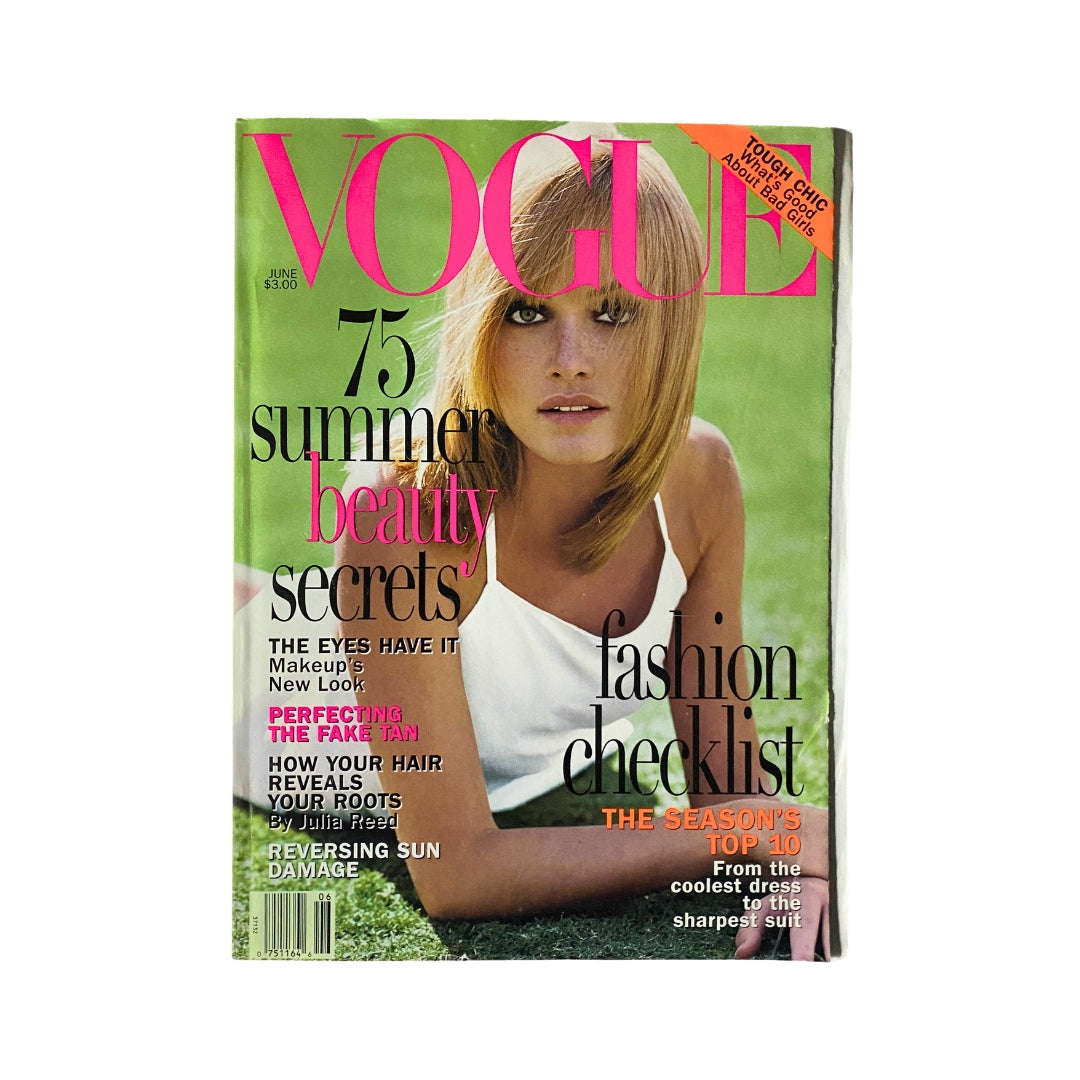
The June 1995 issue of Vogue featuring Amber Valletta on the cover documents one of the defining supermodels of the mid-1990s at the absolute center of her career. Valletta, alongside Shalom Harlow, Stella Tennant, and a handful of others, represented the generation of models who succeeded the "Big Six" supermodels of the late 1980s and early 1990s — Karen Mulder, Linda Evangelista, Christy Turlington, Naomi Campbell, Cindy Crawford, and Claudia Schiffer — with a slightly cooler, more androgynous aesthetic that matched the fashion industry's mid-decade sensibility shift. She had appeared on dozens of international Vogue covers and walked exclusively for Chanel, Valentino, Versace, and Prada, and her partnership with photographer Steven Meisel had produced some of the decade's most discussed editorial images. A June 1995 American Vogue cover represents her at peak visibility and editorial authority. For collectors building a focused archive through the Vogue magazine run of the 1990s, Valletta covers from her mid-decade peak are among the most visually distinctive and culturally specific issues the publication produced during this period.
The editorial content of this issue is unusually rich and rewards close attention. The Julianne Moore profile by Sean Elder documents an actress in the middle of her own remarkable career ascent — 1995 was the year of Safe, Todd Haynes's harrowing study of environmental illness that is now considered one of the decade's most important films, and Moore was being recognized as one of the most serious and formally adventurous actresses working in American cinema. The piece by Candace Bushnell — who would publish the column that became Sex and the City in book form later that year — is a document of her voice at the precise moment of her cultural emergence. The Mary Pierce profile photographed by Helmut Newton combines two of the decade's most significant cultural figures: Pierce, who was on the verge of breaking into the top tier of women's tennis, and Newton, whose fashion and portrait photography defined a particular kind of powerful femininity throughout his career. The feature on Edward Hopper and the Whitney retrospective, written by novelist Leonard Michaels, and the George Packer piece on post-apartheid South Africa one year after the first free elections add genuine literary and journalistic weight that distinguishes this as an issue of substantive editorial ambition alongside its fashion content. Anyone researching American fashion and cultural journalism in 1995 will find this issue a particularly dense and rewarding primary source.
The "Call of the Wild" feature by Katherine Dunn — examining the cultural figure of the "bad girl" in art and fashion — is itself a period-specific document of mid-1990s cultural criticism engaging with one of the decade's defining aesthetic preoccupations. Dunn, author of the cult novel Geek Love, brought a distinctive literary intelligence to fashion cultural criticism, and her presence in Vogue reflects the magazine's consistent effort under Anna Wintour to recruit writers whose bylines carried genuine credibility beyond the fashion world. The Jeffrey Steingarten bread feature — a topic he had made his own through years of Vogue food writing — and Hamish Bowles on the post-eighties interior aesthetic together provide the cultural and domestic context that rounds out what is, by any measure, one of the stronger editorial packages in the magazine's mid-1990s run.
About the Publication
Vogue magazine, founded in 1892 and under the editorship of Anna Wintour since 1988, was by June 1995 the unquestioned authority in American fashion journalism, combining high-fashion editorial photography with cultural commentary, celebrity profiles, and long-form journalism aimed at an educated, fashion-literate readership. Its monthly format and glossy production values made each issue a curated statement about where fashion, culture, and ideas intersected at a given moment, and its cover selections — overseen by Wintour with meticulous personal attention — functioned as endorsements of both aesthetic and cultural significance. The mid-1990s issues reflect the magazine at full editorial confidence under Wintour's direction, with the fashion content and cultural journalism operating in genuine productive tension.
Key Highlights Inside
- Cover featuring Amber Valletta — one of the defining models of the mid-1990s fashion moment, documented at the peak of her editorial authority and career visibility.
- Julianne Moore profile by Sean Elder — a portrait of one of American cinema's most formally adventurous actresses at the moment of her breakthrough to critical recognition, published the same year as her landmark performance in Todd Haynes's Safe.
- "People Are Talking About" column by Candace Bushnell — a document of her editorial voice at the precise moment of her cultural emergence, just as the column that would become Sex and the City was gaining its audience.
- Mary Pierce profile photographed by Helmut Newton — a pairing of a rising tennis talent on the verge of stardom with one of the twentieth century's most significant fashion and portrait photographers.
- Edward Hopper essay by novelist Leonard Michaels, tied to the Whitney Museum retrospective — cultural criticism of genuine literary distinction engaging with one of American painting's most enduring figures.
- George Packer on South Africa one year after the first free elections, "Call of the Wild" by Katherine Dunn on the cultural figure of the bad girl, Jeffrey Steingarten on flatbreads, and Hamish Bowles on the post-eighties interior — a full editorial package of unusual depth and range for a single monthly issue.
Condition & Rarity
Surviving copies of this issue in very good condition with only minor edge wear represent a strong example of a thirty-year-old glossy monthly magazine that has been stored with consistent care. Very good condition for a Vogue of this vintage indicates that the cover image reads cleanly with full color retention, the spine shows no significant cracking, and the interior pages retain their gloss and structural integrity. A no-label newsstand copy is the preferred state for display-oriented collectors, allowing the Valletta cover to present without subscriber information interrupting the image — label-free copies of actively collected issues command a consistent premium in the market. A plastic protective sleeve confirms deliberate preservation effort. This issue is sought across multiple collecting communities: Vogue completists, Amber Valletta collectors, mid-1990s fashion historians, and researchers interested in the writers and cultural figures profiled inside — a convergence of interest that gives this specific issue broader collector appeal than a standard monthly cover edition.
Looking for More Issues Like This?
The June 1995 Amber Valletta cover is one of the stronger editorial packages in the mid-1990s Vogue run — both visually and in terms of interior content — and label-free copies in very good condition are not always easy to locate. If this one has already found a home, the full Vogue magazine collection at OriginalMagazines.com spans the publication's covers and editorial history across multiple decades and is the right place to continue. The complete 1995 magazines collection is also worth exploring for anyone building a broader archive of fashion and cultural journalism from the mid-decade moment.