




Description
Collector's Note – Why This Issue Matters
The June 2000 issue of Vogue, featuring Gisele Bündchen and George Clooney on its cover, is a primary document of American fashion and celebrity culture at a historically specific and increasingly well-regarded transitional moment — the first summer of the new millennium, observed by a cultural landscape that was simultaneously processing the Y2K anticlimax, the final months of the Clinton era, the dot-com boom's approach to its peak, and a fashion industry in the middle of one of its most consequential generational transitions. The specific pairing of Bündchen and Clooney on a single Vogue cover in June 2000 is an editorial statement whose historical meaning becomes clearer with retrospective distance. Gisele Bündchen in June 2000 was not yet the fully dominant commercial force she would become within two or three years — she was at the specific transitional moment between her late-1990s critical ascendancy within the fashion industry and the mainstream cultural ubiquity that would make her the defining supermodel of the early 2000s. Her association with the concept of the "body" supermodel — a deliberate editorial counter-positioning to the heroin chic aesthetic that had dominated the mid-1990s — had made her one of the most discussed figures in fashion, and her Vogue cover appearances from this window are among the most historically significant in her archive. For collectors building a serious archive of Gisele Bündchen magazine covers across the full arc of her career, this June 2000 issue captures her at the specific cusp between breakthrough and dominance — a window that serious collectors consistently identify as the most historically layered in her cover archive.
George Clooney's presence alongside Bündchen on this cover carries its own specific historical weight that the confirmed interior content of this issue illuminates directly. The Lisa DePaulo profile "Catch Him If You Can" situates Clooney explicitly in relation to The Perfect Storm — the Warner Bros. disaster film released on June 30, 2000, making this issue's June cover date a precise promotional alignment with one of the summer's most anticipated major releases. By June 2000, Clooney had completed his transition from television stardom — his nine-season run on ER had concluded in 1999 — to established film leading man, with Out of Sight (1998) and Three Kings (1999) having demonstrated both his commercial viability and his willingness to pursue challenging material. The Perfect Storm represented his first major summer blockbuster lead, and a Vogue cover profile timed to its release documents the specific cultural moment at which his film career was consolidating around the leading-man identity that would define the following decade. Collectors focused on the George Clooney magazine archive will find this issue capturing him at a career inflection point of genuine historical significance — the summer blockbuster launch that completed his post-ER transition and the Vogue cover that certified his crossover from television star to Hollywood leading man in the cultural register that the fashion press controls.
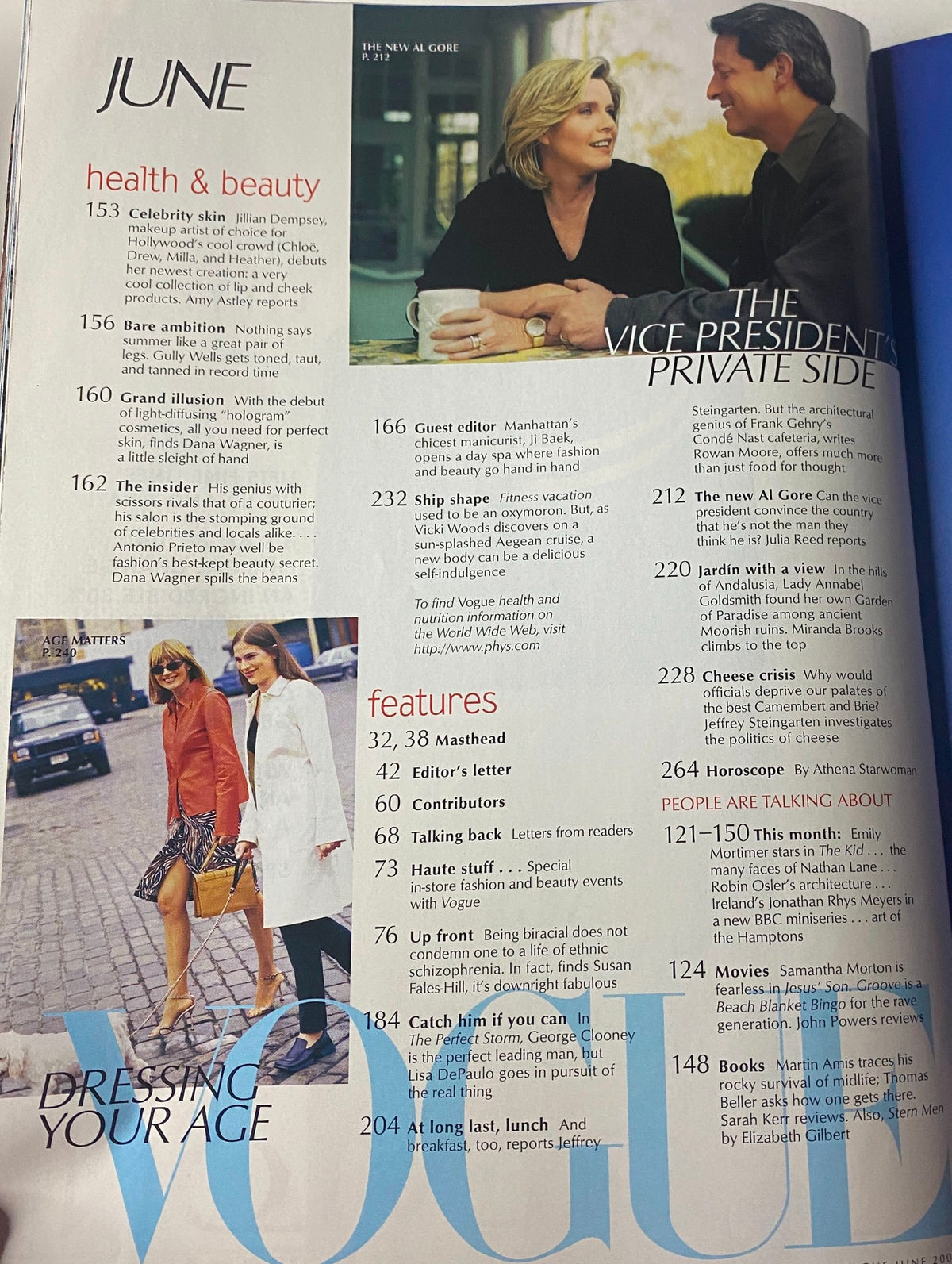
The depth and specificity of the confirmed interior content of this issue makes it an unusually rich primary document of the precise cultural moment of June 2000 across multiple dimensions simultaneously. The confirmed features — André Leon Talley's seasonal fashion direction, Sally Singer's runway report on Fall 2000, Plum Sykes on the Hermès spiked cuff, the Frank Gehry Condé Nast cafeteria profile by Rowan Moore, Julia Reed's profile of Al Gore's image repositioning ahead of the 2000 presidential campaign, Jeffrey Steingarten on French cheese politics, and the People Are Talking About section's references to Emily Mortimer, Jonathan Rhys Meyers, and the Hamptons art scene — constitute a comprehensive primary document of what upper-register American cultural life was engaging with in the summer of 2000 with a specificity that no single-subject issue could achieve. The Al Gore image piece is particularly revealing as a period document: Gore was in the active campaign to succeed Clinton, and a Vogue feature examining his public image repositioning in June 2000 — five months before the November election whose outcome would be decided by the Supreme Court — captures a political moment whose historical significance was not yet fully visible at the time of publication. For collectors building a comprehensive archive of the full Vogue magazine run, or researching the broader cultural landscape of the turn-of-the-millennium moment across publications, this issue provides the kind of editorial depth and period specificity that makes it a reference document rather than simply a celebrity collectible.
About the Publication
Vogue is an American fashion magazine founded in 1892 and acquired by Condé Nast in 1909, under whose ownership it developed into the most globally authoritative fashion publication in the world and the title against which every other fashion magazine has historically measured itself. By June 2000 it was operating under the editorship of Anna Wintour, who had held the position since 1988 and whose twelve years in the role had produced a consistent editorial vision — fashion as cultural authority, the cover as a statement about who and what matters in the intersection of style and society, and the September issue as the annual apex of the publication's editorial and commercial ambitions — that made Vogue under her tenure a primary document not only of fashion but of the broader celebrity and cultural hierarchies that the magazine both reflected and actively constructed. Its readership in 2000 comprised the fashion industry's professional community, serious fashion enthusiasts, and the culturally engaged general reader whose interest in style as a dimension of cultural life distinguished them from the purely trend-following consumer that lower-tier fashion titles served. The June issue occupied a specific and significant position in the annual editorial calendar — the first major summer issue, the transition from the spring collections to fall preview content, and the moment at which the magazine's cover choices signaled which figures and aesthetics would define the coming season's cultural conversation.
Key Highlights Inside
- Gisele Bündchen and George Clooney cover — June 2000 — A primary Vogue document pairing the supermodel at her pre-dominance transitional moment with the actor at the precise summer blockbuster launch that consolidated his post-television film career, producing a cover whose dual subject historical significance becomes more legible with each year of retrospective distance from the specific cultural moment of June 2000.
- "Catch Him If You Can" — Lisa DePaulo profile of George Clooney — A confirmed interior feature situating Clooney in relation to The Perfect Storm, released June 30, 2000, documenting his public persona and career positioning at the specific moment of his transition from established critical favorite to major summer blockbuster leading man — and providing the primary editorial rationale for his Vogue cover appearance in the same issue.
- Fashion editorial content — André Leon Talley, Sally Singer, Plum Sykes — Confirmed features by three of the most significant editorial voices in late-1990s and early-2000s American fashion journalism: Talley's seasonal fashion direction, Singer's runway report establishing why "real clothes" — trenches, LBDs, crocodile jackets — defined Fall 2000, and Sykes's examination of the Hermès spiked cuff as a cultural phenomenon — collectively constituting a primary document of the specific aesthetic conversation that high fashion was conducting in the summer of 2000.
- "The New Al Gore" — Julia Reed political profile — A confirmed interior feature examining the Vice President's public image repositioning five months before the November 2000 presidential election — a period document of the specific political moment whose outcome, decided by the Supreme Court in December 2000, would prove to be among the most consequential in modern American history, here captured through the culturally specific lens of Vogue's editorial perspective on public persona and self-presentation.
- Frank Gehry / Condé Nast cafeteria — Rowan Moore architectural profile — A confirmed feature documenting one of the most discussed architectural commissions of the late 1990s at the moment of its completion, situating Vogue's editorial world within the broader cultural geography of turn-of-the-millennium New York and providing a primary document of how architecture, corporate culture, and the fashion media were intersecting at the peak of the dot-com era's aesthetic ambitions.
- Health, beauty, and additional features — confirmed full editorial contents — An unusually complete and verified table of contents including Amy Astley on celebrity beauty products, Dana Wagner on hologram cosmetics, Jeffrey Steingarten on French cheese politics, and the full roster of People Are Talking About subjects — collectively constituting one of the most comprehensively documented single issues in the Vogue collector archive for this period, providing primary source material for researchers across fashion, celebrity, politics, architecture, and cultural history simultaneously.
Condition & Rarity
Surviving copies of this issue described as being in good condition with minor edge wear represent a solid and display-quality position within the collector grading spectrum for a twenty-five-year-old fashion magazine — a publication whose oversized format, as with all Vogue issues from this era, creates specific vulnerabilities to spine stress, corner compression, and cover surface abrasion during storage and handling that standard-format magazines of equivalent age do not share to the same degree. The confirmed absence of a mailing label places surviving copies in the newsstand-origin category that collectors of Vogue specifically prioritize, as subscription labels on issues of this format were positioned directly over cover imagery and either permanently obscure the primary photograph or leave adhesive residue and surface damage when removed — damage that is irreversible and that materially affects both display quality and technical grade. A protective plastic covering applied during preservation indicates deliberate archival handling that has helped maintain cover surface integrity and limit further deterioration. Vogue's oversized format was printed on high-quality coated stock that resists yellowing and color degradation significantly better than the papers used by lower-budget publications of the same era, meaning that well-preserved copies of this issue retain their original photographic color fidelity — including the cover image of Bündchen and Clooney — to a degree that makes condition a particularly consequential variable when evaluating display-quality copies. Cover flatness, spine integrity, and page completeness are the primary condition factors collectors should assess in any surviving example of this issue, with the label-free status representing the most significant single provenance attribute for display-quality evaluation.
Looking for More Issues Like This?
A label-free Vogue cover pairing Gisele Bündchen at her pre-dominance transitional moment with George Clooney at his summer blockbuster career consolidation — backed by one of the most comprehensively documented interior tables of contents in the publication's early-2000s archive — is a specific and purposeful collecting target whose full historical significance rewards the serious attention of collectors working across fashion history, celebrity culture, and turn-of-the-millennium American cultural documentation. The Gisele Bündchen magazine collection at OriginalMagazines.com is the most focused resource for tracing her cover presence across publications and the full arc of her career, and the George Clooney magazine archive covers his parallel trajectory across the same period and beyond. For collectors building a more complete picture of the publication's editorial history, the full Vogue archive spans the title's run across multiple decades, and the 2000 magazine collection provides the wider turn-of-the-millennium cultural context for anyone approaching this issue as part of a broader era-focused archive.