





Description
Collector's Note – Why This Issue Matters
The November 1994 issue of American Vogue featuring Cindy Crawford on the cover documents the defining supermodel of the nineties at the absolute peak of her cultural dominance — and November 1994 is a specific and significant moment within that peak. Crawford's career had been building through the late eighties and had reached an extraordinary level of visibility by the early nineties: her MTV fitness videos, her marriage to Richard Gere, her Pepsi commercials, her Playboy appearances, and her sustained presence on the covers of the world's major fashion magazines had made her not merely a model but a global celebrity of the first order. By November 1994 she was one of the most recognizable human beings on the planet, and a Vogue November cover — the last major issue before the December holiday number, carrying the weight of the fall season's final fashion statement — represented the editorial endorsement of an institution that understood its own authority perfectly. For collectors building a serious archive of Crawford's career and media presence across the supermodel decade, the Cindy Crawford magazine archive is the most comprehensive resource for tracking her appearances across the decade's major titles, and this November 1994 issue represents one of the more historically weighty entries in that chronology.
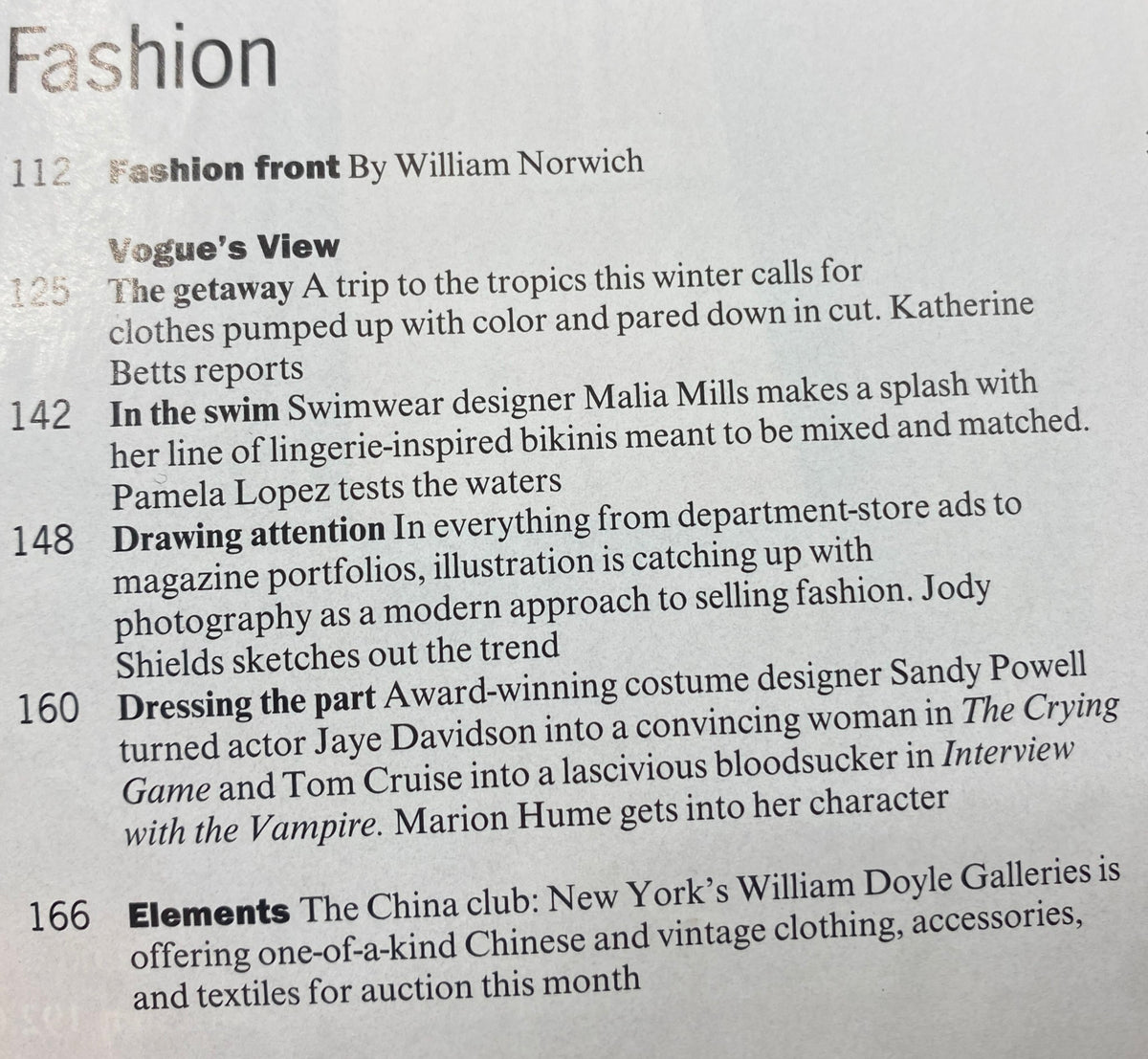
The editorial content documented in this issue's table of contents reflects the specific cultural preoccupations of late 1994 with precision and depth. Sandy Powell's costume design profile is particularly significant as a primary document: Powell had won the BAFTA for The Crying Game and was in 1994 doing the Tom Cruise vampire work on Interview with the Vampire, and a Vogue feature engaging with costume design as a form of fashion authority reflects the mid-nineties moment when the boundaries between film costuming and mainstream fashion were being actively renegotiated — a negotiation that would accelerate dramatically with the red carpet culture explosion of the later nineties. The feature on fashion illustration "catching up with photography as a modern approach to selling fashion" documents a specific mid-nineties aesthetic turn that is now well-recognized in fashion history — the renewed interest in drawn illustration as a commercial and editorial tool that emerged in the early-to-mid nineties and that produced some of the decade's most distinctive fashion imagery. Malia Mills' lingerie-inspired bikini line feature captures another specific moment: the mid-nineties boutique swimwear market and its challenge to the Sports Illustrated-dominated bikini aesthetic. The 1994 magazine collection provides cross-title context for the larger cultural conversations this issue was participating in, and the full scope of Vogue's cover history and editorial evolution is traceable through the Vogue magazine collection.
The William Doyle Galleries Chinese and vintage clothing auction feature is a detail that carries specific retrospective interest for collectors and researchers working on the history of vintage fashion collecting. In November 1994, the concept of vintage clothing as a mainstream fashion category was still relatively new, and a Vogue feature covering a one-of-a-kind Chinese and vintage clothing auction at one of New York's established auction houses represents the mainstream fashion establishment beginning to take vintage and heritage dressing seriously as a fashion category in its own right — a validation that contributed directly to the vintage fashion market's subsequent commercial expansion. William Norwich's "Fashion Front" column and Katherine Betts' tropical getaway feature round out a table of contents that captures the full range of Vogue's mid-nineties editorial breadth.
About the Publication
American Vogue, founded in 1892 and acquired by Condé Nast in 1909, is the flagship publication of the global fashion media industry and the standard against which all other fashion magazines have historically measured themselves. Under the editorship of Anna Wintour, who took the helm in 1988, the magazine developed an editorial identity that combined fashion authority with genuine cultural engagement — its covers became carefully negotiated statements of cultural currency, its fashion coverage engaged seriously with the economics and sociology of luxury consumption alongside the aesthetics of dress, and its feature content maintained a level of literary and journalistic seriousness that reinforced its claim to be something more than a fashion magazine. By November 1994, Wintour's tenure was in its sixth year and the magazine was fully established in its mature editorial identity, the supermodel era's celebrity culture having been absorbed into its cover strategy while the quality of the surrounding editorial content continued to reflect serious journalistic ambition.
Key Highlights Inside
- Cindy Crawford November 1994 cover — documenting the decade's defining supermodel at the height of her cultural dominance, her Vogue November cover representing editorial validation from the most authoritative voice in American fashion media at a moment of peak visibility and global celebrity.
- "Dressing the Part" (Marion Hume on Sandy Powell) — a feature on the award-winning costume designer responsible for The Crying Game and Interview with the Vampire, engaging with film costuming as a form of fashion authority at the precise moment when the boundaries between cinema costume and mainstream fashion were being actively renegotiated.
- "Drawing Attention" (Jody Shields on fashion illustration) — a document of the mid-nineties aesthetic turn toward drawn illustration as a commercial and editorial fashion tool, capturing a specific and now well-recognized moment in the visual history of fashion media.
- "In the Swim" (Pamela Lopez on Malia Mills) — coverage of the lingerie-inspired boutique swimwear designer at an early stage of her career, documenting the mid-nineties challenge to mainstream swimwear aesthetics from within the premium swimwear market.
- "Elements: The China Club" — a feature on William Doyle Galleries' Chinese and vintage clothing auction, functioning as a primary document of mainstream fashion's mid-nineties engagement with vintage and heritage dressing as a serious fashion category.
Condition & Rarity
Surviving copies of the November 1994 Vogue in collectible condition represent a meaningful find within the magazine's early-nineties run. The absence of a subscriber address label is a genuine positive in collector evaluation: the Cindy Crawford cover image survives fully intact as designed and printed, without the adhesive marks or obscured photography that subscription labels permanently leave behind — a distinction that matters both to display-focused collectors and to researchers documenting Crawford's cover chronology. Condition details beyond those indicated are best assessed through the provided photographs, which show the actual state of the surviving issue including any edge wear or surface characteristics consistent with thirty-plus years of age. The protective plastic sleeve is the standard archival measure for a magazine of this paper stock and production quality, stabilizing further deterioration from handling and environmental exposure without requiring any alteration to the original item.
Looking for More Issues Like This?
A no-label copy of the November 1994 Vogue featuring Cindy Crawford — with the Sandy Powell, fashion illustration, and vintage clothing editorial content documented here — is one of the more substantively interesting finds in the magazine's mid-nineties run, combining a peak-era Crawford cover with feature content that rewards serious research attention from multiple directions. If this particular issue is no longer available, the Cindy Crawford magazine collection is the best starting point for finding other issues that document her career across the decade's major titles. The full Vogue magazine archive covers the complete run of the title for collectors working through its history systematically, and the 1994 magazine collection provides broader context for anyone building an archive of the mid-nineties cultural and fashion moment.