




Description
Collector's Note – Why This Issue Matters
The November 1995 issue of Vogue featuring Kirsty Hume on the cover is a primary document of the publication at one of the most consequential transitional moments in its modern editorial history — the mid-point of Anna Wintour's tenure, seven years into her editorship, and the specific season in which the mid-1990s fashion landscape was being actively negotiated between the minimalism that had defined the early decade and the more maximalist directions that would emerge toward the decade's close. Kirsty Hume was one of the defining models of the mid-1990s — a Scottish-born supermodel whose angular features and distinctive presence placed her in the specific tier of models who dominated the editorial and advertising pages of the major fashion publications in the years between the peak of the original supermodel era and the emergence of the next generation. A confirmed November 1995 Vogue cover by Hume is primary documentation of her position within the mid-decade modeling hierarchy at a specific and well-defined moment in the fashion calendar. For collectors building archives of vintage Vogue magazines, the mid-1990s Wintour era issues represent the publication in the confident middle phase of the editorship that would define it for three decades.
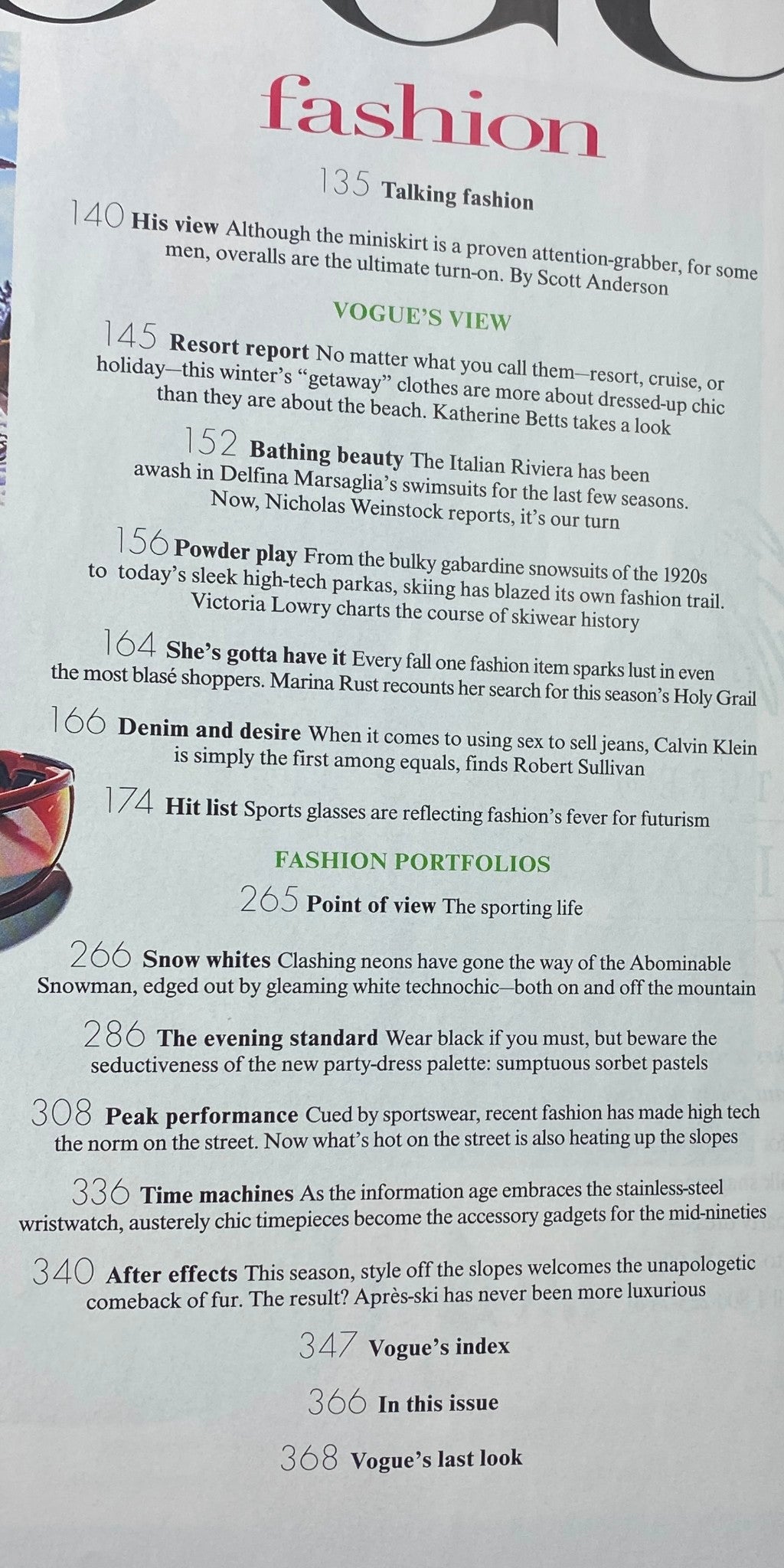
The confirmed table of contents reveals an issue of specific and layered fashion historical interest. The confirmed "Denim and Desire" feature by Robert Sullivan — exploring Calvin Klein's use of sex appeal to sell jeans — is primary press documentation of one of the most discussed marketing strategies in American fashion history, published at the specific moment when Klein's denim advertising was at its most culturally visible and controversial. The confirmed skiwear history feature by Victoria Lowry, tracing the evolution from 1920s gabardine snowsuits to 1990s high-tech parkas, represents exactly the kind of fashion historical documentation that gives a Vogue issue research value beyond its immediate editorial identity. The confirmed "Time Machines" feature on stainless-steel wristwatches as mid-1990s accessories and the "After Effects" piece on the return of fur in après-ski fashion both document specific trends at precisely the seasonal moment of their mainstream press validation. The "Resort Report" by Katherine Betts and the "Delfina Marsaglia" swimwear feature add international fashion coverage that reflects the publication's consistent editorial positioning of American fashion within a global luxury market context. Collectors focused on 1995 magazines as documents of mid-decade fashion and cultural life will find this issue unusually rich across its confirmed editorial range.
The specific November 1995 date carries a further layer of fashion historical significance. The mid-1990s represented the peak commercial moment of the supermodel era that had begun in the late 1980s, and simultaneously the period in which the industry's attention was beginning to shift toward a new aesthetic vocabulary — the waif look, the heroin chic controversy, the emergence of a new generation of models and designers who would define the decade's second half. A November 1995 Vogue with Kirsty Hume on the cover and a table of contents that spans Calvin Klein's denim marketing, high-tech sportswear, and the return of fur documents the specific mid-decade moment when these competing aesthetic and commercial directions were most visibly in simultaneous operation.
About the Publication
Vogue, published by Condé Nast and founded in 1892, was by November 1995 seven years into Anna Wintour's editorship, which had begun in 1988 and had established a distinctive visual identity — high-contrast celebrity covers, a consistent emphasis on the intersection of fashion and culture, and the editorial authority to make or validate trends across the American and international fashion industry. Its November issue occupied a significant position in the fashion calendar year, addressing the resort, holiday, and pre-spring editorial categories that gave it one of its most commercially concentrated and editorially ambitious seasonal moments. Its audience was the fashion-literate, culturally engaged American woman who Wintour's editorial vision addressed with a combination of aspirational imagery, celebrity access, and the kind of substantive fashion cultural journalism confirmed in this issue's table of contents.
Key Highlights Inside
- Kirsty Hume cover — November 1995 — A confirmed cover by one of the defining models of the mid-1990s editorial and advertising market, documented at the specific moment of her peak visibility in the fashion press and representing the specific tier of model stardom that bridged the original supermodel era and the generation that followed.
- "Denim and Desire" by Robert Sullivan — confirmed feature — Primary press documentation of Calvin Klein's sex-in-advertising strategy for denim, published at the precise moment of its maximum cultural visibility and controversy in the mid-1990s American fashion market.
- Skiwear history feature by Victoria Lowry — confirmed — A fashion historical survey from 1920s gabardine snowsuits to 1990s high-tech parkas, providing the kind of longitudinal fashion documentation that gives this issue research value beyond its immediate editorial identity.
- "Time Machines" — stainless-steel wristwatches as mid-1990s accessories — confirmed — Primary documentation of a specific accessory trend at the moment of its mainstream press validation, capturing the specific mid-decade aesthetic relationship between sportswear-influenced functionalism and luxury accessory culture.
- "After Effects" — fur return in après-ski fashion — confirmed — Documentation of fur's mid-1990s commercial and editorial rehabilitation in the context of luxury sportswear, published at the seasonal moment of its most visible mainstream press presence.
- "His View" by Scott Anderson — confirmed — A mid-1990s male perspective on the miniskirt and overalls as fashion objects, providing a primary document of the specific gender dynamics and fashion commentary conventions of mid-decade Vogue editorial culture.
Condition & Rarity
Very good condition with minor edge wear, no subscription label, intact pages with no loose leaves, and plastic protective covering represents a strong grade assessment for a 30-year-old monthly fashion magazine printed on coated stock. The no-label newsstand status is the primary positive visual attribute, preserving the full Kirsty Hume cover photography without address obstruction — a meaningful distinction for display-oriented collectors and for those building archives of unobstructed Wintour-era Vogue covers. Very good condition in a coated-stock glossy publication of this vintage typically means cover color retention without significant fading, page integrity without tanning or brittleness, and spine condition without significant stress — characteristics confirmed by the listing's note that no pages are loose. The plastic protective covering indicates deliberate preservation. Minor edge wear on a publication of this age is a minimal condition factor. The confirmed intact page block with no loose leaves is a meaningful positive structural attribute, distinguishing this issue from copies that have been read repeatedly without protective storage.
Looking for More Issues Like This?
Mid-1990s Vogue issues from the Wintour era with confirmed tables of contents documenting the specific fashion cultural debates of the decade's midpoint — Calvin Klein's advertising strategies, the high-tech sportswear crossover, the rehabilitation of fur — are among the more editorially substantive and research-valuable issues in the publication's 1990s run, and the November 1995 Kirsty Hume cover in very good no-label condition is a particularly clean example of the era. The complete Vogue magazine archive at OriginalMagazines.com spans many decades of the publication's history and is the most productive resource for collectors researching other mid-1990s Wintour era issues and the broader arc of the publication's editorial evolution. For collectors building a broader picture of fashion and cultural life at the mid-point of the 1990s, the full 1995 magazine collection covers the range of titles from a year whose fashion landscape this issue documents with unusual editorial specificity.