




Description
Collector's Note – Why This Issue Matters
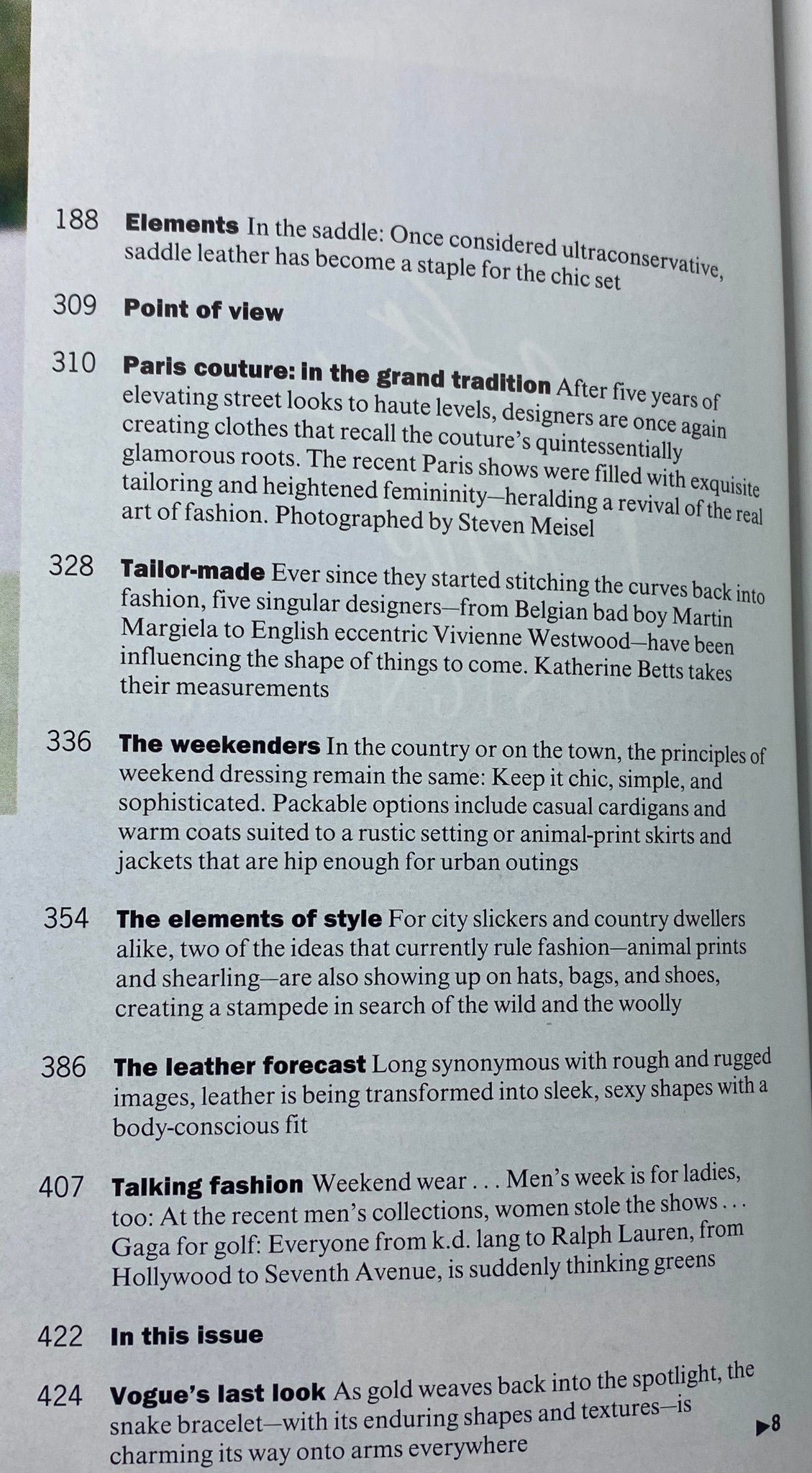
The October 1994 issue of Vogue featuring Kirsty Hume on the cover documents the Scottish model at the specific moment of her most sustained high-fashion editorial prominence, and the confirmed interior content makes this one of the most photographically and editorially significant numbers in the publication's mid-nineties run. Hume had emerged as one of the defining faces of the early-to-mid nineties high fashion world, her strong, angular features and ability to embody multiple aesthetic registers making her a consistent choice for the most ambitious editorial work of the period. An October Vogue cover — the publication's primary autumn fashion statement — placed her at the center of the magazine's most important seasonal issue, and the confirmed editorial content inside reflects the full ambition of that placement. The confirmed Paris couture feature, photographed by Steven Meisel, is the most significant single editorial credit in this issue: Meisel's couture photography for Vogue in the mid-nineties is among the most studied work of his career, and a confirmed Meisel-photographed Paris couture spread in the October 1994 issue is a primary document of his creative contribution to the magazine's visual identity during one of its most photographically consequential periods. For collectors building archives of vintage Vogue magazines, confirmed Meisel-photographed major fashion editorials are among the most historically significant interior content in the publication's nineties run.
The confirmed editorial content of this issue documents a specific and historically well-defined moment in fashion's aesthetic evolution. The Paris couture feature's framing — describing designers "once again creating clothes that recall the couture's quintessentially glamorous roots" after "five years of elevating street looks to haute levels" — is a primary document of how the fashion press understood and articulated the mid-nineties couture revival, placing this October 1994 issue at the specific inflection point when the grunge and street-influenced aesthetic of the early decade was beginning to give way to a renewed interest in femininity and craft. The Katherine Betts feature on five designers — confirmed to include Martin Margiela and Vivienne Westwood — documents the specific designers whose work was being identified as the primary shapers of the new tailored silhouette at a precisely dated moment in their respective career trajectories. Margiela's inclusion here is historically specific: by October 1994 he had been producing collections for six years and was beginning to attract the broader critical attention that would eventually make him one of the most discussed designers in fashion history. Collectors of 1994 magazines focused on fashion history will find this issue provides a remarkably complete picture of the specific aesthetic transition of autumn 1994.
The confirmed "Talking Fashion" section's reference to k.d. lang and golf, alongside the men's collections crossover note, documents the specific cultural texture of the mid-nineties fashion moment with the kind of named incidental detail that makes a primary source distinctly useful to researchers. The saddle leather feature, the animal prints and shearling coverage, and the leather forecast collectively document the specific material and aesthetic vocabulary of autumn 1994 fashion with a completeness and named specificity that distinguishes a well-documented issue from one where interior content must be inferred.
About the Publication
Vogue, published by Condé Nast and founded in 1892, was by October 1994 operating under Anna Wintour's editorship — which had run continuously since 1988 and had made the magazine the globally dominant fashion authority it remains. Its audience was fashion-literate, affluent, and culturally engaged, with expectations that the October issue would deliver both the season's most important fashion editorial and substantive coverage of the designers and cultural forces defining the autumn moment. The October issue was traditionally one of the most photographically ambitious and editorially substantial numbers of the annual calendar — its role as the primary autumn fashion statement gave it a weight in the publishing year comparable only to the September number.
Key Highlights Inside
- Kirsty Hume October 1994 cover — A confirmed autumn cover by one of the decade's most prominent high-fashion models, placed at the center of the magazine's primary seasonal statement at the specific moment of the mid-nineties couture revival.
- Paris couture editorial — photographed by Steven Meisel (page 310) — A confirmed Meisel-photographed major fashion editorial documenting the Paris couture revival of autumn 1994, representing his ongoing creative contribution to the magazine's visual identity during one of his most historically studied periods.
- "Tailor-Made" — five designers including Martin Margiela and Vivienne Westwood, by Katherine Betts (page 328) — A confirmed feature on the designers identified as primary shapers of the new tailored silhouette, with Margiela documented at a specific early-career moment before his canonical status in fashion history had been fully established.
- Couture revival framing — "quintessentially glamorous roots" after five years of street influence — A confirmed primary editorial articulation of how the fashion press understood the mid-nineties aesthetic transition, providing a precisely dated statement of the cultural argument that autumn 1994 fashion was making.
- Autumn 1994 material vocabulary — saddle leather, animal prints, shearling, leather — Confirmed specific material and aesthetic coverage documenting the primary fashion vocabulary of autumn 1994 with named detail that provides precisely dated primary sources for fashion material historians.
- "Talking Fashion" — k.d. lang, golf, men's collections crossover — Confirmed incidental cultural content documenting the specific cultural texture of the mid-nineties fashion moment with named detail characteristic of the most historically useful primary sources.
Condition & Rarity
Very good condition with minor edge wear, no subscription label, and plastic protective covering represents a strong collector-grade example of a thirty-year-old fashion magazine with the confirmed editorial significance of this issue. Vogue is printed on high-quality coated stock designed to showcase fashion photography, and issues stored in protective coverings typically retain their cover surface and interior page quality well over time. The no-label newsstand status confirms the full Hume cover image is unobstructed — the preferred state for display-grade collecting of a cover whose photographic quality is its primary visual attribute. The confirmed table of contents with page numbers indicates full interior content integrity, including the Meisel couture spreads, which are the primary photography content worth confirming for vibrancy and completeness from available photographs.
Looking for More Issues Like This?
Mid-nineties Vogue issues with confirmed Steven Meisel major fashion editorial credits are among the most specifically sought in the fashion magazine collector market, and an October 1994 number with the Paris couture revival documentation and the Margiela-Westwood tailor feature makes this historically rich well beyond its Kirsty Hume cover. The broader Vogue magazine archive at OriginalMagazines.com spans many decades of the publication's run and regularly surfaces other Meisel-era autumn issues and landmark fashion editorial numbers from the nineties. For collectors focused on the specific aesthetic transition of 1994, the full 1994 collection documents a year when fashion was actively negotiating one of its most consequential mid-decade turns.