




Description
Collector's Note – Why This Issue Matters
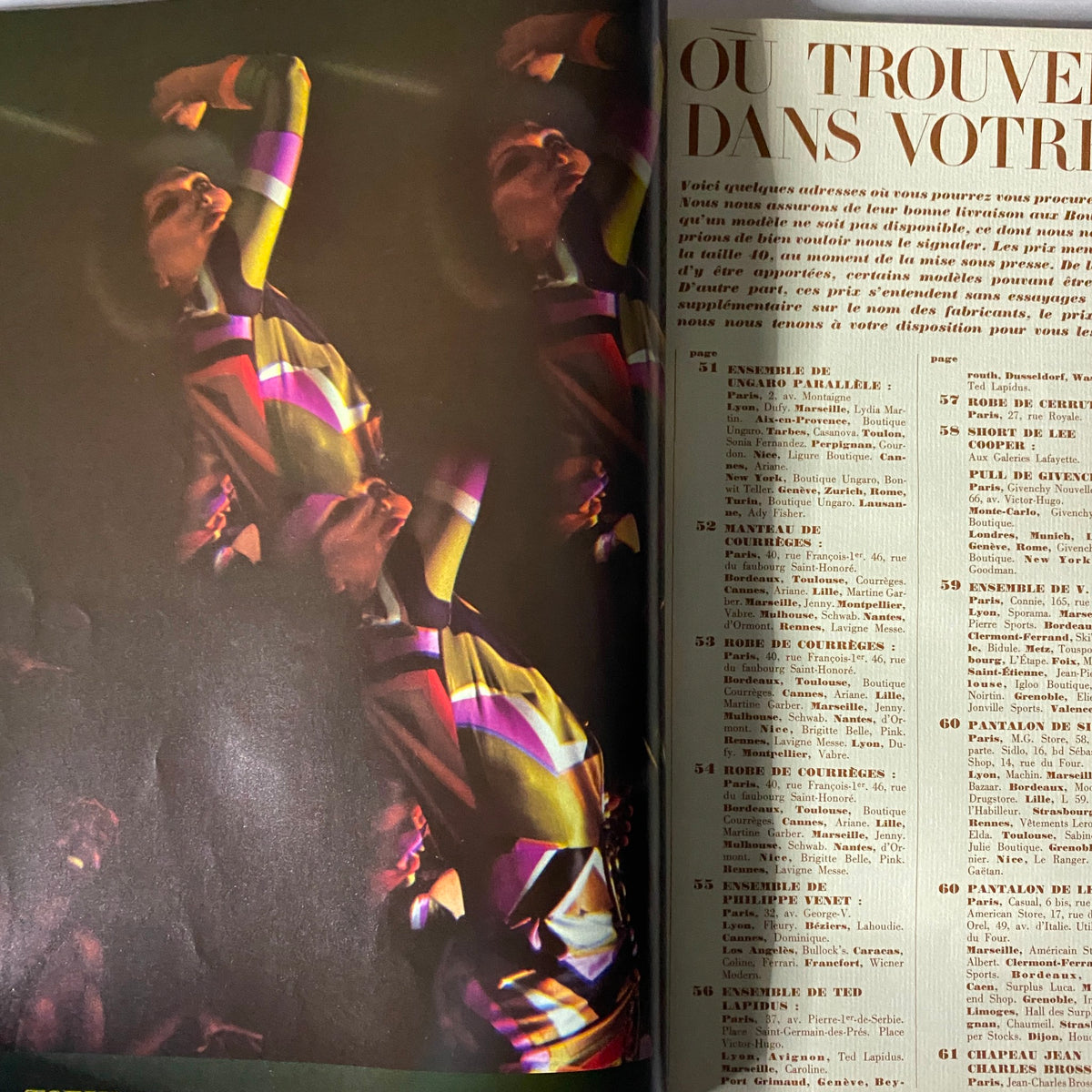
The April 1971 issue of Vogue Paris featuring Candice Bergen on the cover arrives at one of the most creatively fertile and culturally turbulent moments in the history of French fashion publishing. The early 1970s were a period of genuine upheaval in the fashion world: the dominance of Parisian haute couture was being challenged by ready-to-wear, youth culture was reshaping what elegance could mean, and the rigid formality of 1960s fashion was giving way to something more fluid and personal. This issue's editorial content reflects that transition with unusual precision — the emphasis on mode facile-à-porter (easy-to-wear fashion), the dedicated feature on city jeans, the photography of Florentine youth, and the safari and khaki coverage all point toward a magazine actively negotiating the boundary between the traditional haute couture authority of Vogue Paris and the new democratizing energy of early-1970s street style. Collectors who follow Candice Bergen's magazine appearances across this period will find her Vogue Paris cover a particularly significant entry — Bergen was not merely a model but a working actress and photographer in her own right, and her presence on a French Vogue cover in 1971 reflects the era's collapse of the distinction between Hollywood celebrity and high fashion.
The table of contents for this issue is exceptionally rich and warrants close attention. The listing of an unpublished Ernest Hemingway novel excerpt — Îles à la dérive, the French edition of Islands in the Stream — is a remarkable editorial inclusion. Islands in the Stream had been published posthumously in 1970, just one year before this issue, and serializing excerpts from it in the pages of Vogue Paris reflects the magazine's ambition to be taken seriously as a literary and cultural publication rather than purely a fashion vehicle. The international photography program in this issue is equally ambitious: swimwear photographed in Indonesia, Greek fashion on Greek women, German fashion on Madame Gernot Langes-Swarovski of the Swarovski crystal dynasty, and Italian knitwear on Florentine youth. The Ursula Andress khaki feature adds another Hollywood name alongside Bergen. This is Vogue Paris operating at its most expansive editorial definition — fashion, literature, celebrity, international travel, and beauty in a single April issue. For collectors documenting 1971 through its fashion press, this issue is among the more content-rich examples from that year's magazine landscape.
About the Publication
Vogue Paris — the French edition of Condé Nast's flagship fashion title — was founded in 1920 and operated independently of the American Vogue with its own editorial staff, photographers, and creative identity. By the early 1970s it was widely considered the most artistically and editorially adventurous of all the international Vogue editions, with a tradition of commissioning photography that pushed against the conventions of fashion imagery in ways that its American counterpart rarely matched. Its readership was affluent, internationally minded, and expected to be treated as sophisticated participants in fashion culture rather than passive consumers. The magazine was published in French throughout this period, giving it a distinct voice and audience from the American edition, and its covers — frequently featuring international models, Hollywood actresses, and European aristocracy — reflected a particular intersection of glamour, intellect, and aesthetic ambition that defined the publication at its best. Early-1970s issues of Vogue Paris are among the most studied in fashion history programs precisely because they document the transition between two eras of fashion with unusual candor and visual sophistication.
Key Highlights Inside
- Candice Bergen cover: Bergen appears on the cover in April 1971, when she was actively working as both an actress and a photojournalist — her placement on a French Vogue cover reflecting the era's growing convergence of Hollywood celebrity and high fashion editorial.
- Ursula Andress in khaki: A second Hollywood name featured inside — Andress, internationally famous since Dr. No (1962), photographed in the safari-influenced khaki aesthetic that was one of the defining fashion directions of the early 1970s.
- Hemingway excerpt — Îles à la dérive: An extract from the posthumously published Islands in the Stream, printed in French in the pages of a fashion magazine just one year after the novel's original publication — a remarkable literary inclusion that reflects Vogue Paris's ambition to function as a cultural publication beyond fashion's conventional limits.
- International photography program: The issue documents swimwear shot in Indonesia, Greek fashion on Greek subjects, German fashion on Madame Gernot Langes-Swarovski, and Italian knitwear photographed on the youth of Florence — an unusually ambitious global editorial scope for a single issue.
- City jeans and easy-to-wear fashion features: The Les jeans de ville and mode facile-à-porter sections document denim and casual wear entering the formal vocabulary of French fashion journalism — a historically significant editorial moment in the transition from structured 1960s fashion to the relaxed aesthetics of the early 1970s.
- Beauty, cuisine, and tourism sections: The full editorial range of the issue extends to beauty photography and makeup, a Florida tourism feature with practical travel guidance, and the Cuisine en Vogue section — reflecting the magazine's consistent position as a complete lifestyle publication rather than a narrowly fashion-focused title.
Condition & Rarity
A no-label copy of Vogue Paris in excellent condition with light wear is the preferred state for serious collectors of this title. French Vogue of the early 1970s was printed on high-quality coated stock for its photographic pages and somewhat lighter stock for text sections, and surviving copies in excellent condition with the cover imagery intact and interior pages stable represent the upper tier of what is available from this era. The absence of an address label eliminates the most common cover deficit in surviving copies of this vintage — French magazine subscriber labels of this period were typically applied directly to the cover and their removal almost invariably caused surface disruption. The protective covering indicates deliberate preservation. When evaluating any surviving copy of this issue, the Bergen cover portrait's surface condition is the primary grading variable, followed by the integrity of the international photography spreads — which are the visual core of the issue's collectible and historical value. The Hemingway excerpt pages should also be assessed for any separation or damage, as literary content of this significance adds a distinct documentary dimension to the issue's overall grading.
Looking for More Issues Like This?
No-label copies of early-1970s Vogue Paris in excellent condition — particularly issues with this density of named subjects, international photography, and literary content — are among the more rewarding finds in the vintage fashion magazine market, and this April 1971 issue is unusually well-documented for its era. If it has already found a home, the archive of Candice Bergen magazine appearances is worth browsing for other significant covers across her career. The full Vogue magazine collection covers the breadth of both the American and international editions across the decades, and the 1971 magazine archive offers additional context for that pivotal year in fashion and cultural history.