




Description
Collector's Note – Why This Issue Matters
The April 1979 issue of Vogue Paris featuring Gia Carangi on the cover arrives at one of the most concentrated and consequential moments in the history of fashion modeling. Carangi had emerged from Philadelphia to New York in 1978 and within months had become one of the most in-demand models on the international circuit, her dark, androgynous beauty and raw, instinctive presence before the camera producing images that were immediately recognized as different from anything the industry had seen. A Vogue Paris cover in April 1979 — she was barely twenty years old — placed her at the apex of the fashion world's hierarchy at a speed that was almost without precedent. Vogue Paris in this period was the most editorially authoritative and visually adventurous edition of the magazine internationally, and a cover there carried a different weight than a cover in any other market. For collectors researching Gia Carangi's appearances in vintage magazines, her late-1970s Vogue Paris covers represent the primary visual documents of her career at its most luminous — before the personal struggles that would end her modeling years and her life at twenty-six became known.
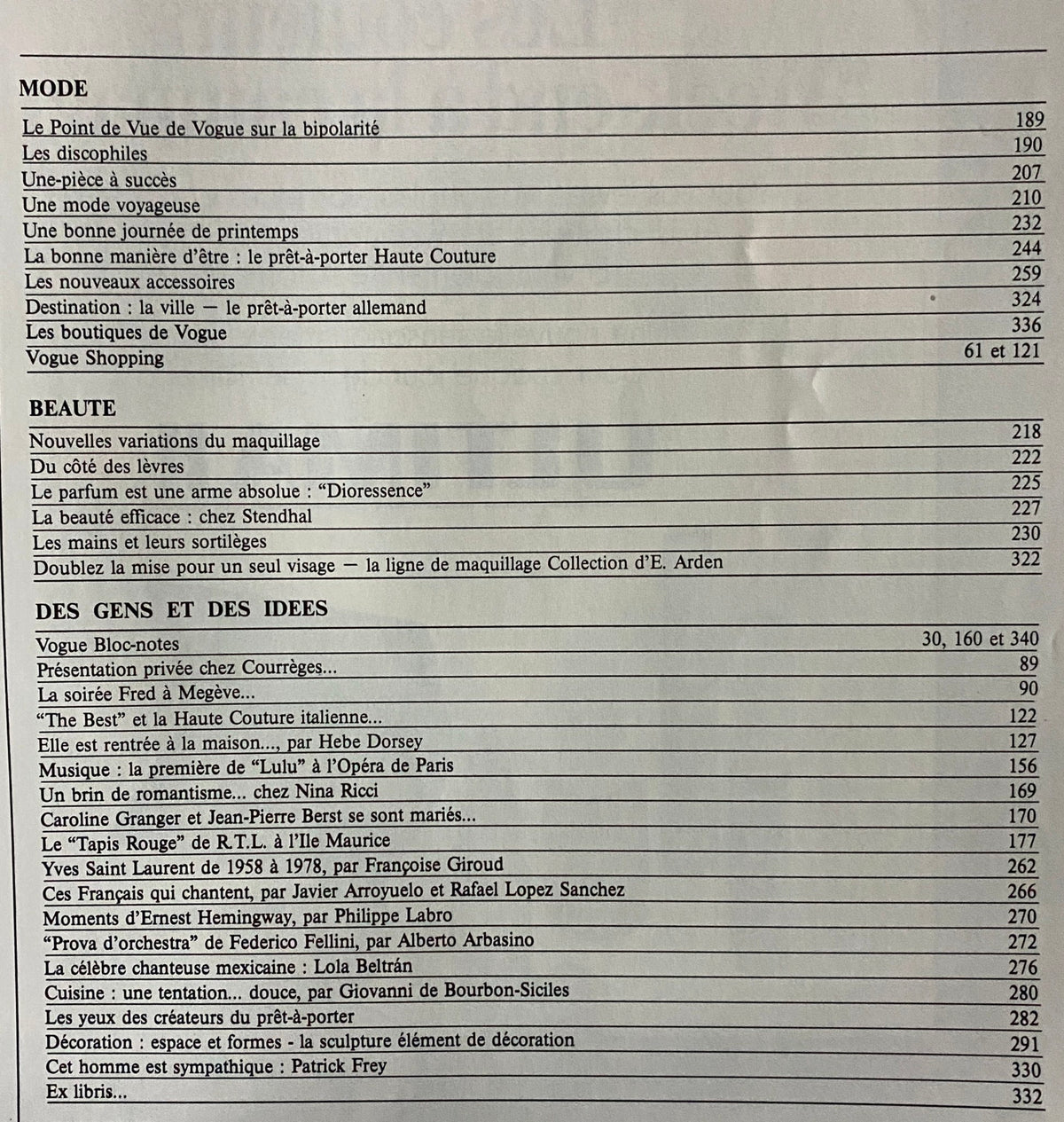
The table of contents reveals an issue of considerable editorial substance surrounding that cover. Françoise Giroud — one of the most significant French journalists and public intellectuals of the twentieth century, co-founder of L'Express, former Secretary of State for Women's Affairs under Giscard d'Estaing — contributes a piece on Yves Saint Laurent from 1958 to 1978, a retrospective on twenty years of the designer who more than anyone else had defined French fashion in the postwar era. Philippe Labro writes on Hemingway moments. Alberto Arbasino reviews Federico Fellini's Prova d'orchestra, the Italian maestro's most recent film. A private presentation at Courrèges and a Nina Ricci romanticism feature document the couture world's social calendar with the intimacy that distinguished Vogue Paris from all competitors. The fashion content itself — the bipolarité editorial, the discophile-inspired looks, the une-pièce à succès, the German prêt-à-porter — documents the specific aesthetic tensions of late-1970s fashion at the moment when the post-punk and disco worlds were both pressing against the established couture hierarchy. Anyone building a research collection around vintage Vogue issues across editions will find the French edition of this period among the most intellectually ambitious, and the 1979 magazine archive places this issue within a year of considerable fashion and cultural transition.
About the Publication
Vogue Paris, the French edition of the Condé Nast flagship, had by the late 1970s established itself as the most editorially adventurous and internationally influential edition of the magazine, operating with a degree of creative independence from the American mother publication that allowed it to pursue more challenging fashion photography, more literary editorial contributions, and a more explicitly European cultural perspective. Its readership was affluent, cosmopolitan, and fashion-literate, spanning France and the international luxury fashion market, and its covers and editorial photography were considered by many in the industry to be the highest expression of fashion magazine visual ambition anywhere in the world during this period. Published in French throughout, it combined haute couture coverage, prêt-à-porter reporting, beauty, and a cultural journalism section — "Des Gens et des Idées" — that regularly attracted serious literary and intellectual contributors alongside its fashion content.
Key Highlights Inside
- Cover featuring Gia Carangi — the American model at the very beginning of her international rise, appearing on one of fashion's most prestigious covers at approximately twenty years old, in images that represent the primary visual record of her career at its most vital.
- Françoise Giroud on Yves Saint Laurent 1958–1978 — a retrospective on twenty years of the defining French couturier by one of France's most significant journalists and public intellectuals, making this a primary document of how the fashion establishment understood Saint Laurent's legacy at the close of his second decade.
- "Le Point de Vue de Vogue sur la bipolarité" (p. 189) and "Les discophiles" (p. 190) — fashion editorial documenting the specific aesthetic tensions of late-1970s fashion between formal and informal, structured and fluid, at the moment when disco culture and post-punk were both pressing against established couture conventions.
- Philippe Labro on Hemingway, Alberto Arbasino on Fellini's Prova d'orchestra, and coverage of Lola Beltrán — a cultural journalism section that positions this fashion issue as a serious literary and cinematic document alongside its mode and beauté content.
- Private presentation coverage at Courrèges, Nina Ricci romanticism, "The Best" and Italian haute couture, and the Fred soirée at Megève — the intimate society documentation that distinguished Vogue Paris's cultural notebook from any competitor in the international fashion press.
- Beauty section covering new makeup variations, lip trends, Dioressence, Stendhal, and Elizabeth Arden's maquillage collection — a comprehensive seasonal beauty document reflecting the specific cosmetic culture of late-1970s French luxury fashion.
Condition & Rarity
Copies of this issue described as label-free in good condition represent a meaningful baseline for Vogue Paris collecting from the late 1970s. The French edition was distributed primarily by subscription and newsstand in France and through international newsstands and subscription services elsewhere; label-free copies indicate newsstand origin or international distribution without subscriber address markings, and are the preferred provenance for display-focused collectors. Good condition with minor age-consistent wear is an honest grade for a publication now more than forty-five years old, and for a Gia Carangi cover — whose collectible value has increased substantially since her biography became widely known — condition assessment should focus particularly on cover photography clarity and spine integrity. The plastic protective covering indicates deliberate preservation storage. Vogue Paris issues from this era are less commonly encountered in the North American collector market than American Vogue issues from the same period, given their more limited international distribution, which makes label-free copies in honest good condition a more selective find than their original press run might suggest.
Looking for More Issues Like This?
Gia Carangi's covers for Vogue Paris from the late 1970s are among the most sought-after objects in vintage fashion magazine collecting, and this April 1979 issue — with its Françoise Giroud Saint Laurent retrospective, Fellini criticism, and Hemingway essay alongside the Carangi cover — is among the more editorially substantial of her appearances. If it is no longer available, the archive of Gia Carangi magazine appearances is the most focused place to continue the search for her editorial legacy. The broader vintage Vogue collection spans both the American and international editions across multiple decades, and the complete 1979 magazine archive offers collectors a range of contemporaneous titles for anyone documenting the full cultural and fashion landscape of that transitional year.