
📖 About this Collection
Gia Carangi: The Last Burning Star of Print's Golden Age
The Legend & The Legacy
Before the algorithm, before the Instagram grid, before the concept of a "supermodel" had even fully crystallized in the public imagination, there was Gia — a raw, feral, heartbreaking force who blazed through the fashion world at its most extravagant and self-destructive moment. Rising from working-class Philadelphia to the marble corridors of New York and Milan in the late 1970s and early 1980s, she became the most sought-after face in an industry intoxicated by its own excess. Her story — a meteoric ascent, a catastrophic fall, and a tragically early death in 1986 — was consumed almost entirely through the glossy, oversized pages of fashion magazines, the only broadcast tower that mattered in that world. Readers did not follow her on a feed; they encountered her in waiting rooms, on newsstands, and on coffee tables, her gaze arrestingly alive against the perfume advertisements and society columns that surrounded her. The physical magazine was her medium, and she owned it completely.
Inside the Archive
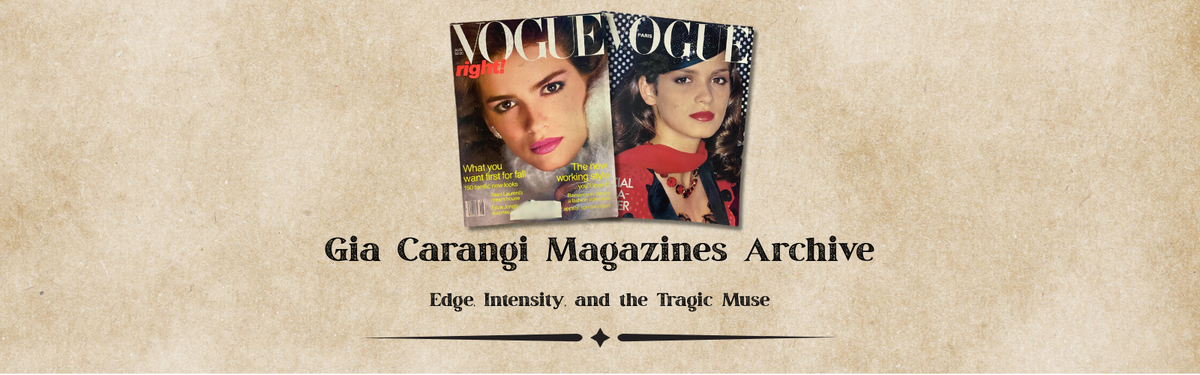
The editorial photography of Gia's era was a deliberate art form — heavily lit, emotionally charged, and shot by a generation of photographers who treated their subjects as collaborators rather than commodities. Publications like Vogue — both its American and international editions — were her most natural habitat, commissioning sprawling, cinematic spreads that showcased her extraordinary ability to transform in front of a lens: vulnerable in one frame, ferocious in the next. Cosmopolitan, at the peak of its cultural relevance under Helen Gurley Brown, also featured her prominently, presenting her as the embodiment of a new, unapologetic femininity. The trade bible Women's Wear Daily captured her ascent through the industry's insider lens, chronicling runway appearances and the professional mythology that was building around her name in real time. The editorial tone across these publications ranged from breathlessly celebratory to coolly authoritative — but the underlying current was always the same: here was someone the camera had chosen, and the printed page was where that covenant was made permanent.
Curator's Checklist: Highlights Often Include
- Major Vogue editorial spreads (1978–1982) featuring her signature high-contrast, emotionally raw fashion photography, often shot by legends such as Francesco Scavullo and Chris von Wangenheim
- Cosmopolitan covers and features from her peak commercial years, representing her crossover appeal beyond strictly high-fashion circles into mainstream American culture
- Trade and industry coverage in Women's Wear Daily documenting runway seasons, designer collaborations, and her professional standing during the height of the late-Studio 54 fashion epoch
- European and international fashion titles from French, Italian, and German markets, where she worked extensively and where the editorial vision was often bolder and more experimental than its American counterparts
- Later retrospective and memorial coverage from the mid-to-late 1980s, which takes on profound historical weight as among the earliest mainstream print documentation of the AIDS crisis and its human cost
The Collector's Value
To hold one of these issues today is to hold something irreplaceable — not a scan, not a reprint, but the actual artifact that a reader pulled from a rack in 1980, its paper stock still carrying that distinctive weight of quality offset printing, the ink bearing a faint, specific perfume of age that no digital archive can approximate. The surrounding advertisements alone — for Halston, for Charlie perfume, for the automobiles and cigarettes and luxury goods of a vanished America — reconstruct an entire cultural world that contextualizes her image with a richness no cropped online photograph ever could. These are primary sources in the truest sense: documents of how a generation actually saw her, styled and sequenced and printed for mass consumption, before mythology had time to soften the edges. For collectors of vintage fashion history, the cultural legacy of the AIDS crisis, or the golden age of American and European editorial photography, these publications offer an irreplaceable window into one of the most luminous and heartbreaking stories the fashion world has ever produced. Browse the current available inventory below and discover what the archive holds today.


