




Description
Collector's Note – Why This Issue Matters
The April 1978 issue of Good Housekeeping, featuring Marie Osmond and Princess Grace on its cover, is a primary document of American popular culture at a specific and revealing moment in both subjects' public lives — a pairing that reflects the particular editorial intelligence of a women's service magazine that understood, better than most of its contemporaries, how to use celebrity adjacency to speak to its readership's aspirations about femininity, family, and public grace. Marie Osmond in April 1978 was twenty-one years old and at the specific peak of her early solo career, having transitioned from the family act that had made her a household name through the Donny & Marie television variety show — which had debuted in 1976 and was, in the spring of 1978, in its third and most commercially successful season. Her specific cultural position in April 1978 was that of the most visible young female entertainer in mainstream American television, a figure whose combination of wholesome appeal, professional competence, and carefully managed public image made her both commercially dominant and editorially useful for publications whose readership valued exactly those qualities. Princess Grace — Grace Kelly, who had left Hollywood for Monaco in 1956 following her marriage to Prince Rainier III — was in 1978 in the mature phase of her public role as Princess of Monaco, twenty-two years into a life that had produced three children and a sustained public presence that drew on both her Hollywood legacy and her European royal identity. For collectors building a serious archive of Marie Osmond magazine covers across her career, this April 1978 Good Housekeeping represents one of her most significant mainstream women's magazine appearances — a cover whose pairing with Princess Grace signals the specific aspirational register in which the most authoritative American women's service publication was positioning her at the peak of her early career.
The specific pairing of Marie Osmond and Princess Grace on a single April 1978 Good Housekeeping cover is an editorial decision that carries more historical meaning than either subject alone would generate. The women's service magazine cover in the late 1970s was a carefully constructed cultural statement about the values and aspirations the publication believed its readership held or wished to hold — and the combination of a twenty-one-year-old American entertainment phenomenon and a fifty-year-old American-born European princess was a pairing whose logic was grounded in the specific cultural values that Good Housekeeping was addressing in April 1978. Both women represented versions of a particular feminine ideal that the publication's readership recognized and valued: youth, beauty, family commitment, professional accomplishment achieved without apparent sacrifice of feminine propriety, and a specific quality of public grace that was simultaneously natural and cultivated. The late 1970s — the specific cultural atmosphere of the Carter era, the post-feminist backlash years in which women's service magazines were navigating complex terrain between traditional domestic values and the new expectations that the women's movement had introduced — gave this particular cover pairing a cultural specificity that makes it a primary document of how mainstream American women's publishing was understanding and representing femininity in the spring of 1978. Collectors focused on vintage Good Housekeeping magazine issues from the publication's most culturally revealing decades will find this cover providing primary evidence of the specific editorial values and aspirational register that defined the publication's approach to celebrity at a historically consequential moment in American women's culture.
The broader context of April 1978 American popular culture gives this issue a further historical dimension worth noting for collectors approaching it as a period document. Princess Grace would die in September 1982 following a car accident on the road above Monaco — making the 1978 period of her public life part of the final four years of her existence, and giving any publication from this window a retrospective poignancy that was not available to its original readership. The Donny & Marie show would be cancelled in 1979, ending the specific phase of Marie Osmond's career that had produced her highest television profile, and her subsequent career trajectory — through acting, solo recording, talk television, and eventual Broadway — would take her into very different public territory from the variety show phenomenon of the late 1970s. An April 1978 Good Housekeeping cover therefore documents both women at specific and historically bounded moments in their public lives: Princess Grace in the late phase of a European royal identity whose American roots gave her a unique transatlantic cultural position, and Marie Osmond at the absolute peak of the mainstream American television career that the following year would begin to transition. Among magazines from 1978, covers that document this specific cultural moment through the lens of the women's service press provide some of the most revealing primary evidence of mainstream American femininity's aspirational landscape in the late 1970s.
About the Publication
Good Housekeeping was founded in 1885 and by April 1978 had established itself as one of the most widely read and editorially influential women's service magazines in the United States, with a readership measured in millions and a cultural authority derived from decades of engagement with the practical, domestic, and aspirational dimensions of American women's lives. Its editorial formula — combining practical household and cooking guidance with celebrity profiles, fiction, health content, and the cultural coverage that made it a barometer of mainstream American feminine values — gave it a specific and durable position in the women's magazine market that distinguished it from the more fashion-forward titles at one end of the spectrum and the more explicitly feminist publications at the other. By 1978 it was operating in the specific cultural atmosphere of the late 1970s women's magazine market, navigating the post-feminist cultural landscape with an editorial approach that was simultaneously responsive to changing expectations and committed to the domestic and family values that had defined its readership for generations. The Good Housekeeping Seal — its product endorsement program — gave the publication a commercial authority that extended beyond its editorial content and reinforced its position as the most trusted mainstream voice in American women's publishing.
Key Highlights Inside
- Marie Osmond and Princess Grace cover — April 1978 — A primary Good Housekeeping document pairing the most visible young female entertainer in mainstream American television — at the peak of the Donny & Marie variety show's third and most commercially successful season — with the American-born Princess of Monaco in the final years of her public life, producing a cover whose specific aspirational pairing reflects the editorial values and feminine ideals that the most authoritative American women's service magazine was addressing in the spring of 1978.
- Late-1970s women's service magazine content — confirmed historical context — Editorial and practical content consistent with Good Housekeeping's April 1978 format, reflecting the specific cultural atmosphere of the late Carter era in which mainstream American women's publishing was navigating between traditional domestic values and the changing expectations that the women's movement had introduced — making this issue a primary document of that editorial negotiation at one of its most culturally revealing annual moments.
- Marie Osmond at peak Donny & Marie career — confirmed historical period — Coverage of Osmond at the specific moment of her highest mainstream television profile, one year before the variety show's 1979 cancellation would begin the career transition that would take her into acting, solo recording, and talk television — documenting her public image and cultural position at the precise peak of the entertainment phenomenon that made her one of the most recognizable young women in American popular culture.
- Princess Grace in late-life public profile — confirmed historical context — Documentation of Grace Kelly in the mature phase of her Princess of Monaco identity, four years before her September 1982 death, providing a primary record of her specific public presence during a period that retrospective awareness has made historically significant within the arc of one of the most documented transatlantic celebrity lives of the twentieth century.
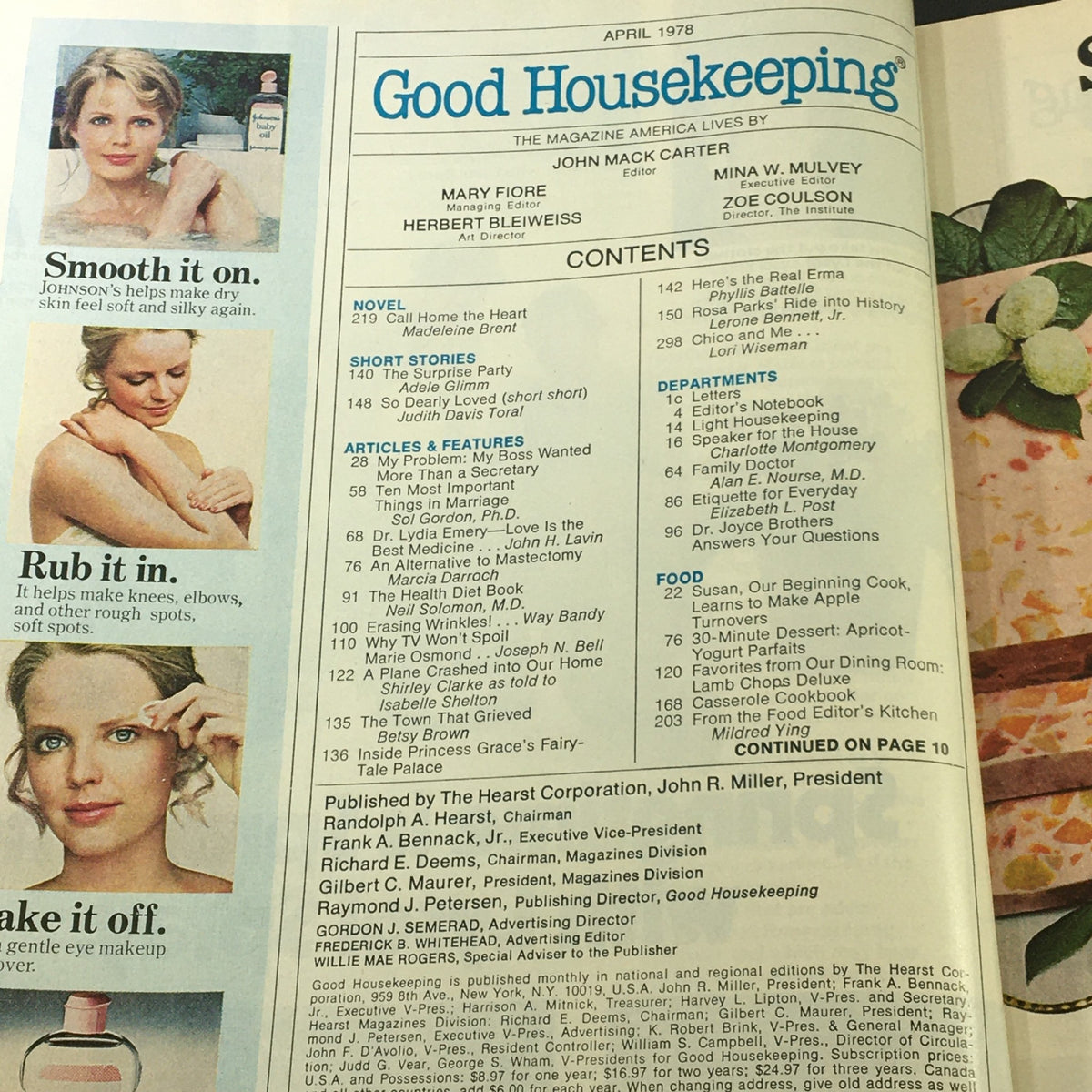
- Note: Specific interior article titles, additional confirmed features, and editorial content beyond the cover subjects have not been independently verified for this issue. The above reflects documented cover content and the publication's known editorial format and historical context for this period rather than comprehensive table-of-contents information.
Condition & Rarity
Surviving copies of this issue described as being in good condition with minor edge wear and small rips or marks consistent with age occupy a solid and collectible position within the collector grading spectrum for a forty-seven-year-old women's service magazine — condition attributes that experienced collectors of late-1970s Good Housekeeping understand as characteristic of honest survival across nearly five decades rather than as meaningful detractions from historical or collecting value. The newsstand origin designation — confirmed by the absence of a mailing label — places surviving copies in the provenance category that collectors of this publication specifically prioritize, as subscription labels on issues of this era were applied directly to the cover in positions that affect the primary cover photography of Osmond and Princess Grace, and whose removal from publications of this age frequently causes surface damage that cannot be remediated. A protective plastic covering applied during preservation indicates deliberate archival handling that has helped maintain cover surface integrity and limit further deterioration. Good Housekeeping in 1978 was printed on coated stock for cover pages with standard interior magazine paper — a construction that typically preserves cover color and photographic fidelity better than interior page content of equivalent age, making the cover's visual condition and the two subjects' cover image preservation the primary display-quality variables for collectors whose interest in this issue is primarily driven by its cover subjects and the cultural statement their pairing represents.
Looking for More Issues Like This?
An April 1978 Good Housekeeping with the Marie Osmond and Princess Grace cover — documenting both women at historically specific and bounded moments in their public lives, and providing primary evidence of the aspirational feminine values that the most authoritative American women's service magazine was addressing at the peak of the late-1970s mainstream entertainment era — is a historically layered and purposeful collecting target for serious students of American women's publishing, late-1970s popular culture, and the careers of both cover subjects. For collectors tracing Osmond's magazine presence across her career, the Marie Osmond magazine collection at OriginalMagazines.com is the most focused resource for her cover appearances across publications and eras. The complete Good Housekeeping archive covers the publication's full run for collectors building a comprehensive picture of the magazine's editorial history and cultural coverage, and the 1978 magazine collection provides the wider late-1970s cultural context for anyone approaching this issue as part of a broader era-focused archive.