
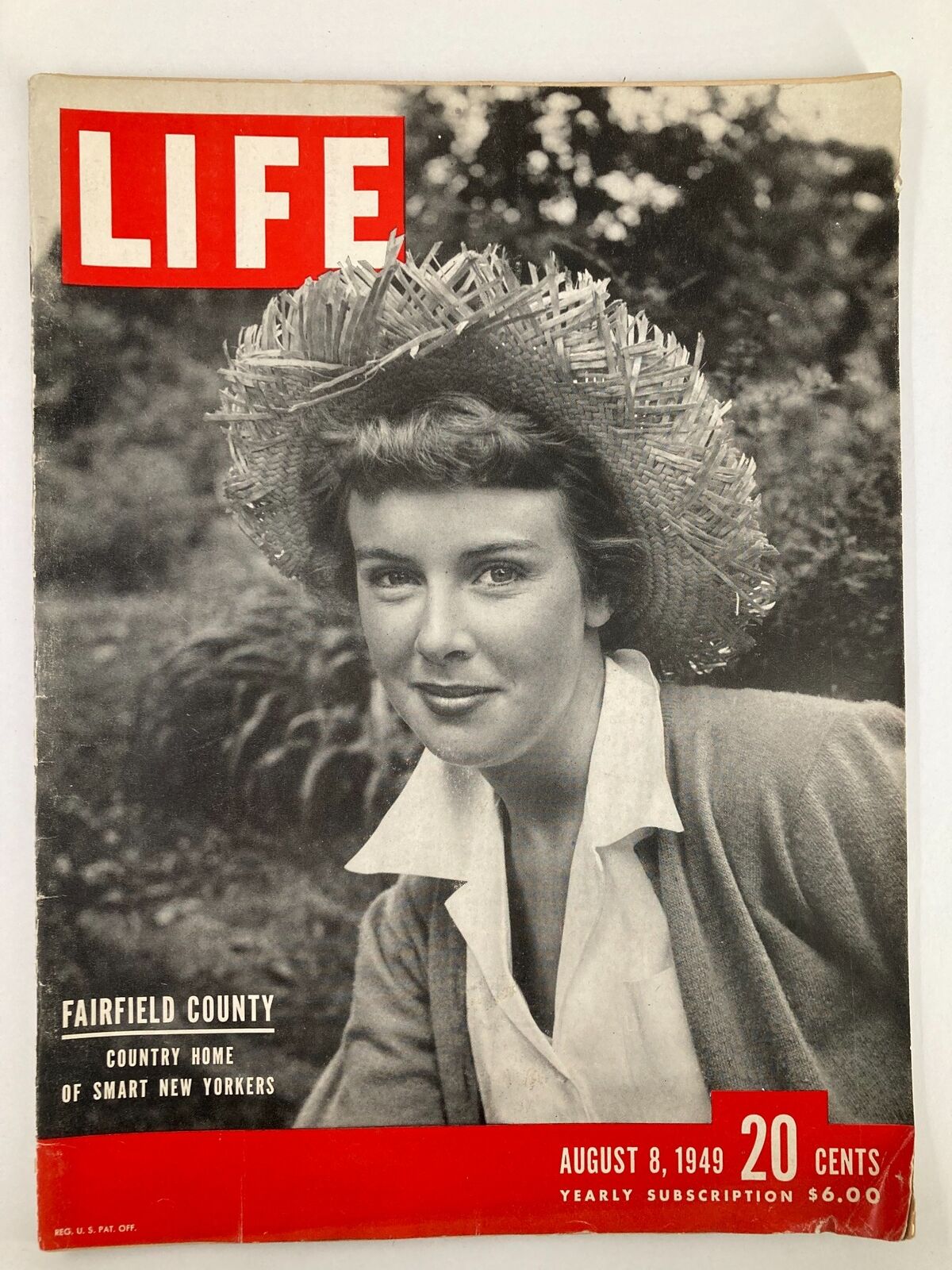


Description
Collector's Note – Why This Issue Matters
Life Magazine's August 8, 1949 issue, featuring Fairfield County as "the Home of New Yorkers," is a document of a specific and historically revealing American moment. The postwar suburban migration was underway in earnest by 1949, and Fairfield County — the southwestern Connecticut corridor hugging the New York border, encompassing towns like Greenwich, Westport, Darien, and New Canaan — was one of its most visible expressions. Manhattan executives and professionals were moving their families to the Connecticut commuter belt in significant numbers, drawn by new housing, better schools, and the promise of a domestic life that the city could not provide. Life's decision to devote a feature to this phenomenon in August 1949 reflects the magazine's characteristic instinct for capturing the emerging patterns of American life before they had fully hardened into settled sociology. The story of the New York City professional's relationship with the Connecticut suburbs is a story that would define the next three decades of American middle-class aspiration, and this issue documents it at its inception. Collectors building a thematic run of vintage Life Magazine issues focused on postwar American social history will find this issue a particularly clean primary source.
August 1949 is worth placing in its broader context. The war had been over for four years. The GI Bill had sent a generation to college and into homeownership. The baby boom was fully underway. The Cold War was sharpening — the Soviet Union would test its first atomic bomb just weeks after this issue appeared, in late August 1949 — and the desire for domestic stability and suburban sanctuary was both a genuine social aspiration and a response to anxieties that rarely spoke their name in the mainstream press. A Life feature on the affluent New Yorkers transplanting themselves to Fairfield County captures the optimistic surface of that moment: the houses, the commutes, the community life, the sense of a particular American version of the good life being constructed in real time. For collectors assembling a 1949 magazine archive, this issue offers a specifically American domestic story told at the precise moment it was becoming the dominant cultural narrative of the postwar era.
About the Publication
Life Magazine was launched on November 23, 1936 by Henry Luce under Time Inc. as a large-format weekly photojournalism magazine built on the principle that photography was primary narrative. By 1949 it had a readership estimated at well over 20 million and was the most widely circulated weekly magazine in the United States. Its editorial format combined photographic essays, news coverage, cultural features, arts journalism, and the kind of social documentation — portraits of American life in its regional and demographic variety — that made it a genuine record of mid-century America across its full breadth. The postwar years of the late 1940s represent one of Life's most editorially diverse and documentarily rich periods, as the magazine turned its attention from the war to the society the war had produced.
Key Highlights Inside
- Feature on Fairfield County, Connecticut — documenting the postwar migration of New York City professionals to the Connecticut suburbs at the moment that migration was establishing the patterns that would define American commuter culture for decades.
- Published August 8, 1949 — weeks before the Soviet Union's first atomic bomb test in late August, placing the issue at the precise hinge between postwar optimism and the onset of Cold War anxiety.
- No subscription label present, confirming newsstand origin and preserving the full cover image without defacement — the preferred state for display-focused Life collectors.
- Note: Specific interior articles, additional features, photography credits, and supporting content beyond the Fairfield County cover story have not been independently confirmed from the listing and are not detailed here.
Condition & Rarity
This issue presents in Good condition, with wear on the binding, creases at corners, minor surface abrasions, and subtle marks on the cover — consistent findings for a magazine now seventy-five years old that has had some handling over its life. The absence of a subscription label confirms newsstand origin, preserving the full cover design without the defacement common to mailed subscriber copies; for a postwar Life issue, label-free copies are preferred for display and represent a meaningful distinction in the collector market. A protective plastic sleeve has been applied, appropriate for long-term preservation. Life's coated stock holds up better than newsprint-based publications of the same era, but corner creasing and binding wear are typical at this age, particularly in copies that experienced active use before entering any preservation environment. Condition is best assessed from the photographs provided with the listing, as the specific distribution of wear determines display suitability more precisely than a general grade alone.
Looking for More Issues Like This?
Postwar Life issues from the late 1940s documenting American domestic and social life are among the most rewarding entries in the magazine's archive for collectors interested in mid-century American history beyond the war years themselves. The broader Life Magazine collection at OriginalMagazines.com covers the full weekly run from 1936 through 1972, making it the most comprehensive place to explore what's available across every era. Collectors focused specifically on the postwar period will find the 1949 magazine collection worth browsing for a wider view of the year's American cultural and social landscape as documented across multiple publications.