
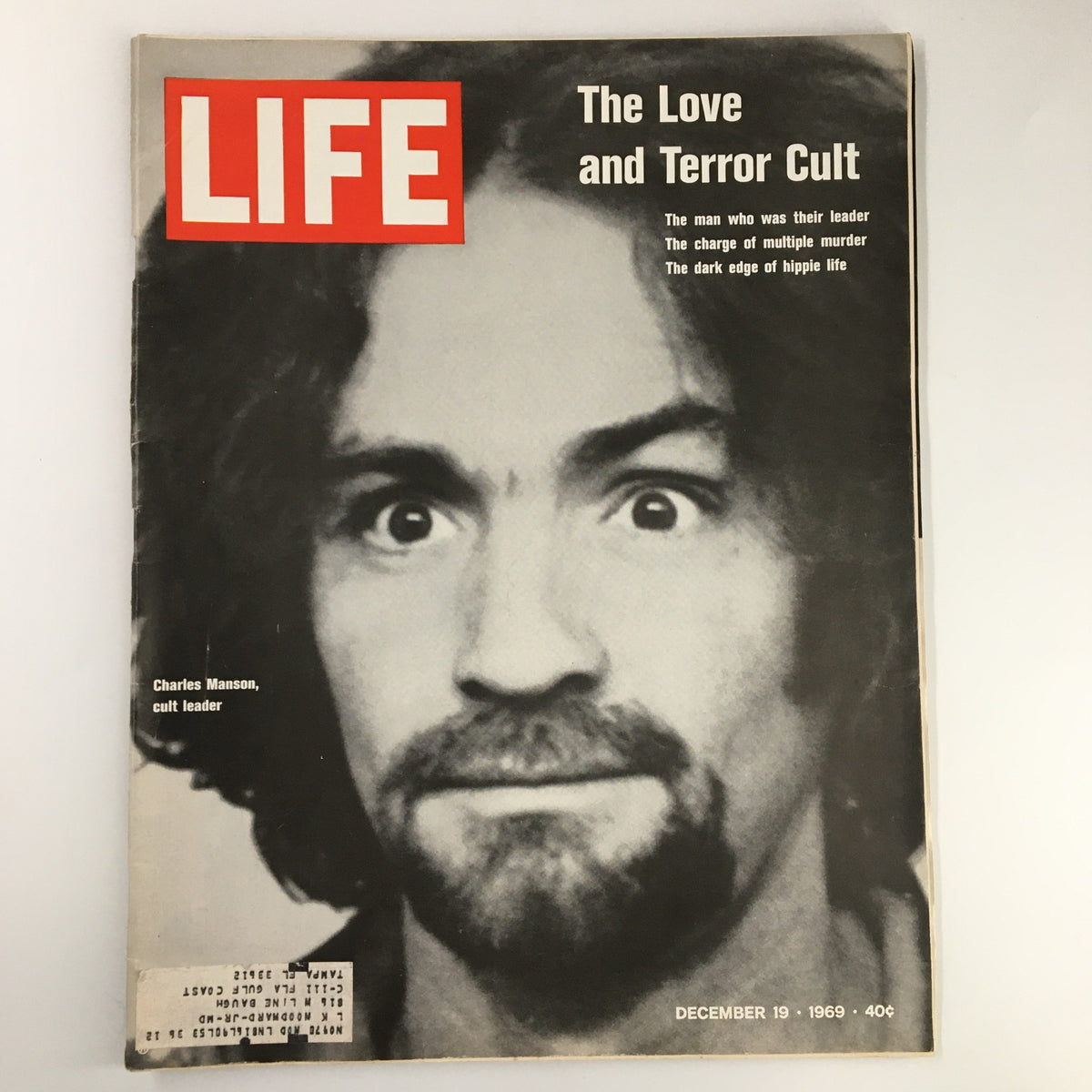
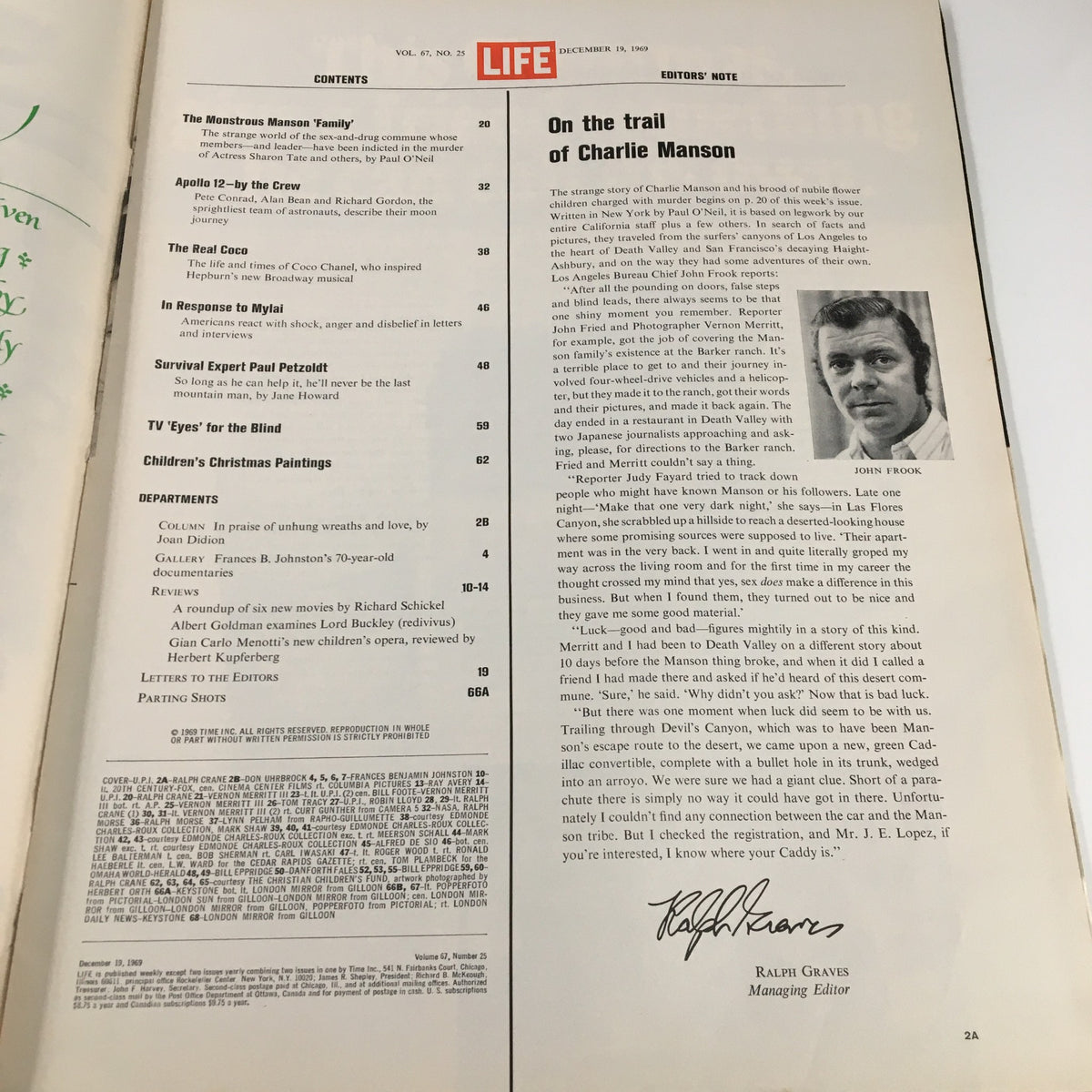


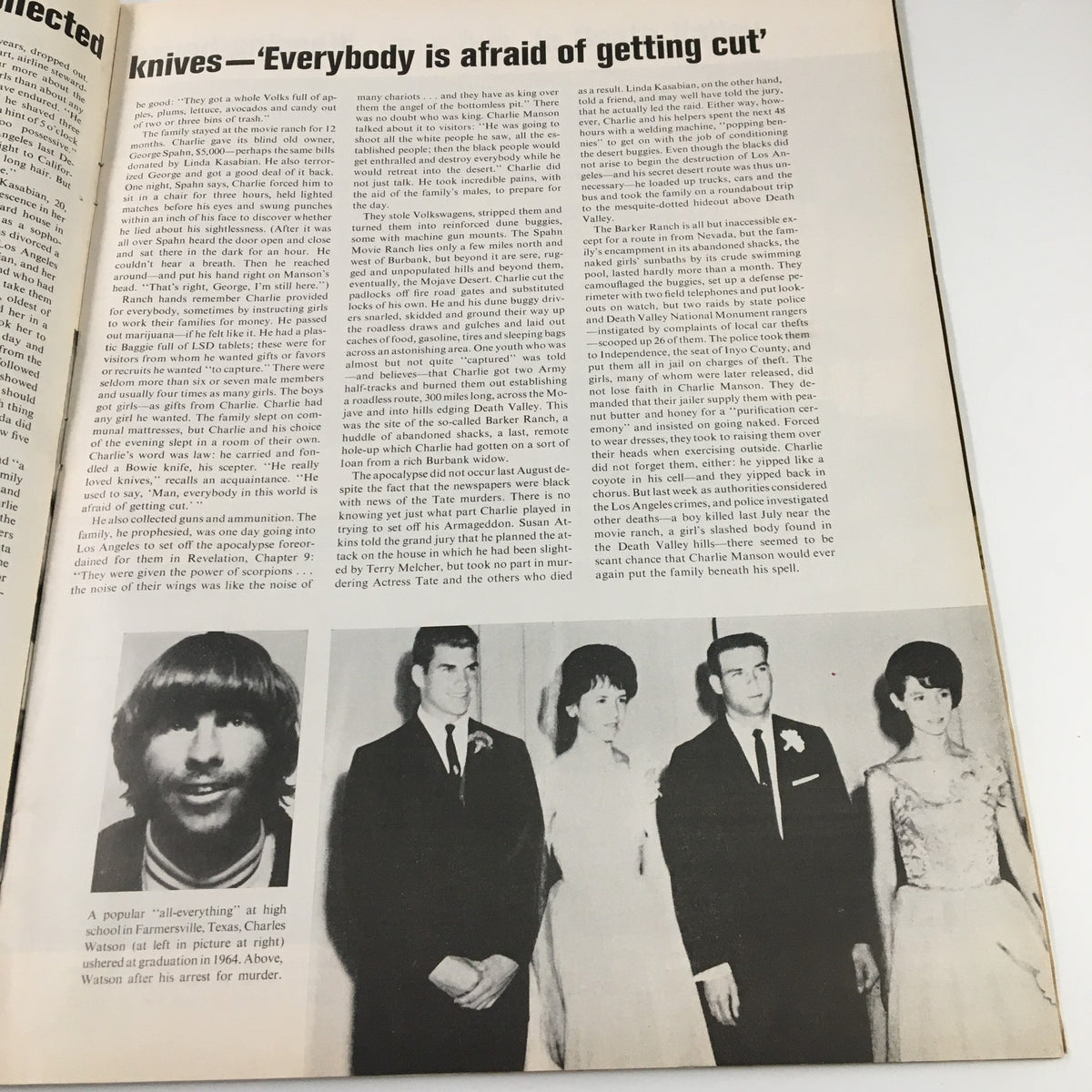


Description
Collector's Note – Why This Issue Matters
The December 19, 1969 issue of Life magazine featuring coverage of Charles Manson and the Manson Family is one of the most historically significant American magazine issues of the entire postwar era — and its timing is as precisely charged as any cover story the publication produced in its long history. The Tate and LaBianca murders had occurred on the nights of August 8–9 and 9–10, 1969. The arrests of Manson and his followers came in late November and early December 1969, with the Los Angeles District Attorney's office formally charging Manson and four others with the Tate murders on December 8, 1969 — just eleven days before this issue's publication date. The Life cover story therefore appeared at the precise moment when the full scope of what had happened was first becoming public knowledge: the connection between the August murders, the desert commune, and the specific individuals involved had only been publicly established days earlier. This issue was the mainstream American media's first sustained attempt to explain Charles Manson, his followers, and the psychological and social conditions that had produced them to a national mass audience. For collectors who pursue Charles Manson magazine coverage, this December 1969 Life is the foundational document — the primary contemporaneous record of the story breaking at the national level.
The historical weight of this issue extends well beyond the crime story itself. The Manson murders and their December 1969 revelation arrived as a kind of punctuation mark at the end of the 1960s — coming just four months after Woodstock and in the same year as Altamont, they were immediately absorbed into the cultural narrative of the decade's collapse. Manson had been embedded in the counterculture's peripheral spaces — the Haight-Ashbury scene, the Spahn Ranch commune, the fringes of the music industry — and the revelation of what had been happening in those spaces produced a cultural shock that reverberated through American society far beyond the specific crimes. Life's December 1969 coverage was the mainstream media's first systematic attempt to explain that shock, and it shaped the framework through which the American public initially understood the story. The issue documents the Manson Family not just as a crime story but as a cultural phenomenon — what the listing's description calls the "love and terror cult" — in a way that established the interpretive categories that subsequent journalism, books, and films would continue to use for decades. The full context of this extraordinary year — from the moon landing to Woodstock to Altamont to the Manson revelations — is documented across the 1969 magazine archive, and this December issue sits at the end of that sequence as one of its defining final documents.
The specific framing of the Life coverage — focused on the psychological aspects of the cult and its hold over its members — reflects the specific intellectual concerns of the moment. By late 1969, the question of how a charismatic figure could command such absolute loyalty from young people who had been drawn into the counterculture was not merely a criminological question but a social one, directly connected to the broader anxieties about cult dynamics, youth radicalization, and the dark edges of the counterculture that were reshaping American cultural conversation at the decade's end. A Life cover story addressing those questions in December 1969, with full photojournalistic resources behind it, is a primary source of extraordinary specificity for researchers working on the history of the period, and its place in the broader Life magazine archive is among the most historically freighted of the publication's entire run.
About the Publication
Life magazine, relaunched by Henry Luce in November 1936 as a large-format weekly photojournalism publication, was by December 1969 still one of the most widely read magazines in the United States, though the combination of television's rise and increasing production costs was beginning to pressure the weekly format that would lead to the magazine's conversion to monthly publication in 1972. Its large-format photojournalism remained the most powerful visual documentation tool in American print journalism, and its coverage of major cultural and criminal stories in this period carried an authority and reach that no other print publication could match. The December 1969 Manson coverage deployed those resources at one of the most consequential moments in late-1960s American social history.
Key Highlights Inside
- Charles Manson and the Manson Family cover story — The first major national magazine treatment of the Manson murders, published eleven days after formal charges were filed and at the precise moment when the full scope of the story was first becoming public knowledge, establishing the interpretive framework the American public would use to understand the case for decades.
- Psychological analysis of cult dynamics — The coverage focuses specifically on the psychological mechanisms by which Manson commanded absolute loyalty from his followers, placing the crimes within the broader 1969 cultural conversation about charismatic authority, youth radicalization, and the counterculture's dark periphery.
- Contemporaneous documentation at the moment of revelation — Unlike retrospective accounts, this issue captures the story in the days immediately following the arrests and charges, when the facts were still being established and the cultural shock was immediate and unprocessed.
- December 1969 cultural context — Published at the literal end of the 1960s, four months after Woodstock and in the same year as Altamont, this issue documents the moment when the decade's counterculture narrative reached its most disturbing and consequential conclusion.
- Subscription address label present on front cover — A common condition attribute for this title; the label placement relative to the cover image is worth examining in the accompanying photographs for collectors who prioritize display presentation.
Condition & Rarity
Surviving copies of this issue in good condition with minor wear and a subscription address label on the front cover represent a solid collector grade for a fifty-five-year-old large-format weekly magazine. Life's oversized format creates specific structural vulnerabilities — spine stress, corner wear, and cover attachment at the staple points — that are characteristic of issues of this age and size rather than exceptional defects. Minor wear throughout is expected for a publication of this vintage that has passed through active readership and storage over more than five decades. The subscription label on the front cover affects the visual presentation of what is a historically significant cover image; label placement and condition relative to the key cover elements is worth examining in the accompanying photographs. The protective plastic sleeve is appropriate current storage for large-format coated and newsprint magazines of this age. For any surviving copy of this issue, the condition of the cover image and the integrity of the Manson Family feature pages — including any photographs — are the primary collector evaluation variables, given the cover story's status as one of the most historically significant pieces of journalism the magazine published in its final years as a weekly.
Looking for More Issues Like This?
The December 19, 1969 Life Manson cover is one of the most historically specific and actively sought issues in the magazine's late-1960s run, drawing sustained interest from true crime researchers, cultural historians, and collectors of significant American journalism alike. If this issue has already moved on, the Charles Manson magazine collection at OriginalMagazines.com is the best place to explore related coverage across multiple titles. The full Life magazine archive is the most comprehensive place to browse what's available across the publication's history, and the 1969 magazine collection places this issue within the full documentary record of one of the most consequential years of the twentieth century.