




Description
Collector's Note – Why This Issue Matters
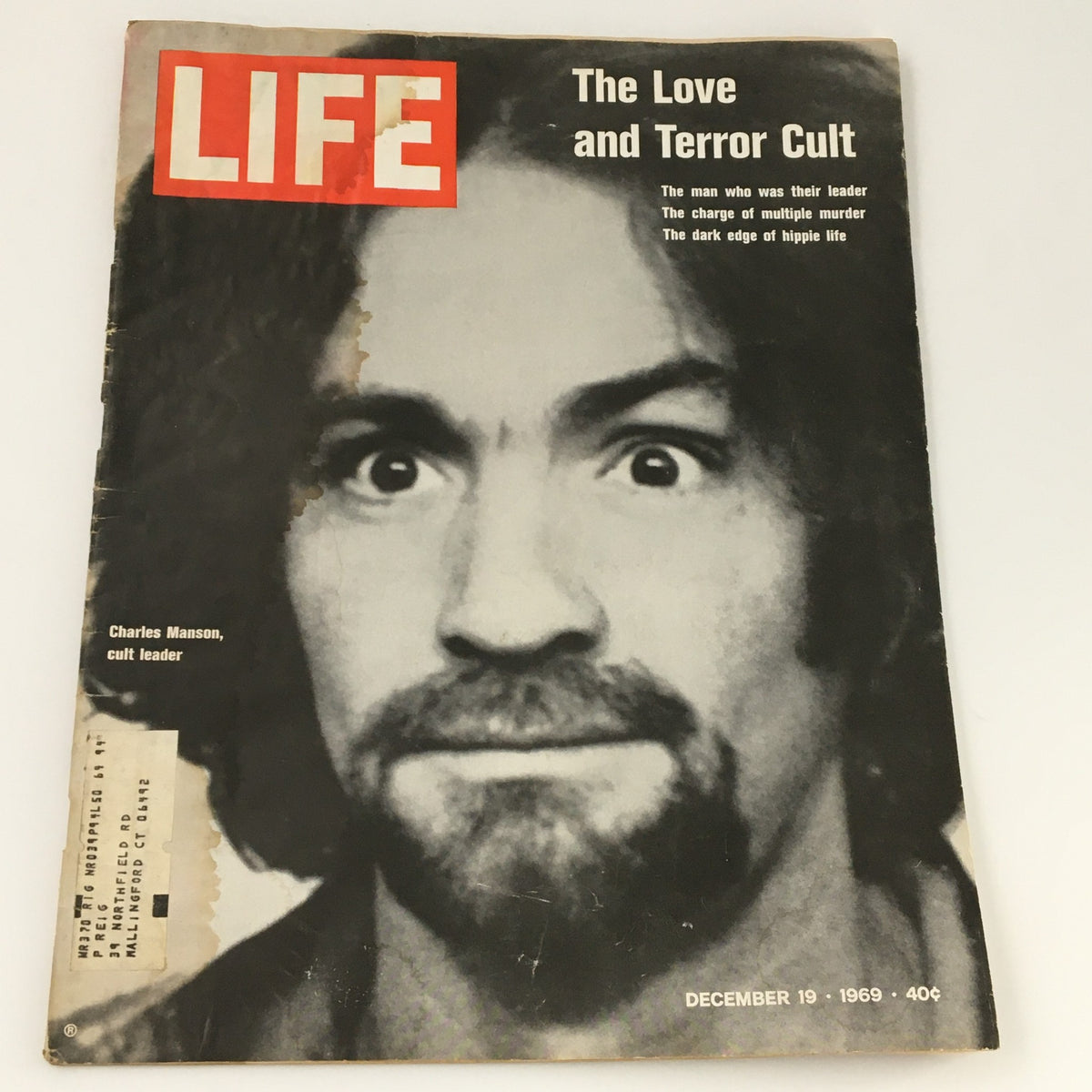
The December 19, 1969 issue of Life magazine featuring Charles Manson on the cover is one of the most historically significant and most widely discussed magazine covers of the entire postwar era — a document of the precise moment when American mainstream media was confronting the full horror and cultural implications of the Tate-LaBianca murders of August 1969 and the arrest and identification of the Manson Family as their perpetrators. The murders had occurred in early August, but it was not until November and December 1969 that the full scope of what had happened — the deliberate, ritualistic nature of the killings, the cultlike structure of the group that had carried them out, and the identity of the man at its center — became public knowledge. The Los Angeles Police Department announced the arrests on December 1, 1969, and the Life cover of December 19 appeared just eighteen days later, representing one of the fastest and most authoritative mainstream media responses to a criminal revelation in American journalistic history. The cover photograph of Manson — his eyes wide, his expression radiating the combination of charisma and menace that would become one of the defining images of the era — was immediately and permanently iconic, not merely as true crime documentation but as a symbol of the moment when the idealism of the 1960s counterculture met its darkest possible inversion. Collectors building a focused archive of Manson-related press documentation will find the Charles Manson magazines collection at OriginalMagazines.com the most comprehensive resource for press coverage across publications and decades.
To fully appreciate what the December 19, 1969 Life cover represented as a cultural event, it is necessary to understand the specific psychological and social atmosphere of late 1969 America. The year had begun with the inauguration of Richard Nixon, continued through the Apollo 11 moon landing in July — one of the transcendent achievements of the American century — and had included Woodstock in August, the same month as the Manson murders. The discovery in November and December that members of a communal group living on the fringes of the counterculture had carried out a systematic murder campaign in the hills of Los Angeles produced a cultural shock that went far beyond the horror of the crimes themselves. It suggested, to many Americans who had been watching the counterculture with a mixture of anxiety and fascination, that the decade's rejection of conventional social structures had produced not liberation but pathology — that the communes, the gurus, the dropping-out from mainstream society that had characterized the late 1960s could, in its most extreme form, produce exactly the kind of violence and nihilism that its critics had always feared. The Manson case became, almost immediately, the symbolic end of the 1960s — the event that allowed a culture to locate its disillusionment in a single figure and a single set of crimes. A Life cover in December 1969 was the mainstream media's formal inscription of that cultural moment, which is why the issue is collected not only as true crime memorabilia but as a primary document of the decade's psychological close. The Life magazine collection at OriginalMagazines.com provides the broader archive of the publication's coverage across this extraordinary period.
The cover photograph itself has had an extraordinary afterlife in American visual culture that gives this issue a significance beyond its immediate journalistic function. The image of Manson — taken by Bill Ray for Life — became one of the most reproduced photographs in the history of American crime journalism and one of the most discussed photographs in the broader history of celebrity and notoriety in American media. Its appearance on the December 19, 1969 cover of a magazine with Life's circulation and cultural authority guaranteed that it would be the defining image of Manson for the American public, and it has remained so for more than five decades. For collectors who approach magazine covers as primary visual documents of cultural history rather than merely as dated artifacts, this issue occupies a position of unique importance — it is the original publication context of one of the most consequential news photographs of the postwar era. The 1969 magazines collection at OriginalMagazines.com gathers publications from one of the most turbulent and historically consequential years in postwar American history.
About the Publication
Life magazine was founded in its modern incarnation in 1936 by Henry Luce and had established itself by 1969 as the most widely read general-interest weekly in the United States, with a circulation of several million copies and a readership estimated at several times that number. Its editorial identity was built around photojournalism of exceptional quality — Life had done more than any other American publication to establish photography as the primary language of mass media, and its cover photographs were produced with the deliberate intention of creating images that would be as visually authoritative as they were journalistically significant. By December 1969, the magazine was in the late phase of its weekly run — it would cease weekly publication in 1972 — but still commanding the kind of readership and cultural authority that made a cover photograph equivalent to an official entry into the visual canon of American public life. The Manson cover of December 19, 1969 is one of the most consequential images the magazine ever published, and the issue that contained it is accordingly one of the most historically significant in its long run.
Key Highlights Inside
- Charles Manson cover photograph — the defining mainstream media image of Manson, published eighteen days after the LAPD announced arrests in the Tate-LaBianca murders, representing one of the most consequential news photographs in the history of American crime journalism and one of the primary visual documents of the cultural close of the 1960s.
- First major mainstream media treatment of the Manson case — appearing just weeks after the November-December 1969 arrest announcements, this issue represents the American mainstream press's first full, authoritative engagement with the Manson case at the moment of maximum public shock, before the subsequent decades of books, films, and cultural analysis had transformed the subject into the well-documented phenomenon it later became.
- Cultural symbol of the decade's psychological close — the Manson case and this cover's role in defining its public image gave the December 19, 1969 issue a significance extending far beyond crime journalism: it is widely recognized as a primary document of the moment when American culture located its disillusionment with the 1960s counterculture in a single figure and a single set of crimes.
- December 1969 — end of the decade documentation — published in the final weeks of the most turbulent decade in postwar American history, this issue arrives at the cultural close of the 1960s, just weeks after the Altamont concert of December 6, 1969 had provided another symbolic end-of-era event, and in the same month that the decade's hopes and horrors were being simultaneously processed by a stunned American public.
- Address label on front — confirmed subscriber copy — the address label on the front cover confirms subscriber rather than newsstand origin, a condition attribute that collectors will factor into assessment, particularly for a cover whose visual impact and historical significance are directly related to the legibility and presence of the Manson photograph.
Condition & Rarity
The condition disclosures for this issue are specific and require honest assessment: the listing notes acceptable condition with wear throughout, rips, marks, discoloring, possible missing pages, some water damage, and an address label on the front cover. For a magazine of this historical significance, condition assessment must engage directly with these specifics rather than treating them as abstract deductions from collector value. The most consequential condition factors are the integrity of the cover photograph — whether the Manson image retains sufficient visual quality and completeness to function as the primary document it represents, and whether the water damage or rips intersect the cover image directly — and the completeness of the interior, specifically whether the core feature content of the Manson story is present and legible. The note that pages may be missing is the most significant structural concern for any prospective collector, as missing interior pages in a feature-documented issue fundamentally affect its function as a historical document. The address label on the front cover affects display value in ways that depend on its position relative to the cover photograph. The plastic protective covering indicates preservation effort. For a cover and story of this specific historical and cultural magnitude, even copies showing significant honest wear retain genuine documentary significance — but the condition specifics noted here should be assessed carefully against the photographs before any collector evaluation is finalized.
Looking for More Issues Like This?
The December 19, 1969 Life magazine Manson cover is one of the most sought and most historically discussed newsweekly covers in American publishing history, and finding a copy in any condition takes patience — it remains one of the most actively collected issues in the true crime and 1960s history collecting categories. For collectors building a focused archive of press documentation related to the Manson case, the Charles Manson magazines collection at OriginalMagazines.com is the most comprehensive place to explore what's currently available. Those interested in the broader sweep of Life's extraordinary late 1960s photojournalism will find the Life magazine collection equally rewarding, and the 1969 magazines collection offers essential context from one of the most turbulent and historically significant years in postwar American history.