
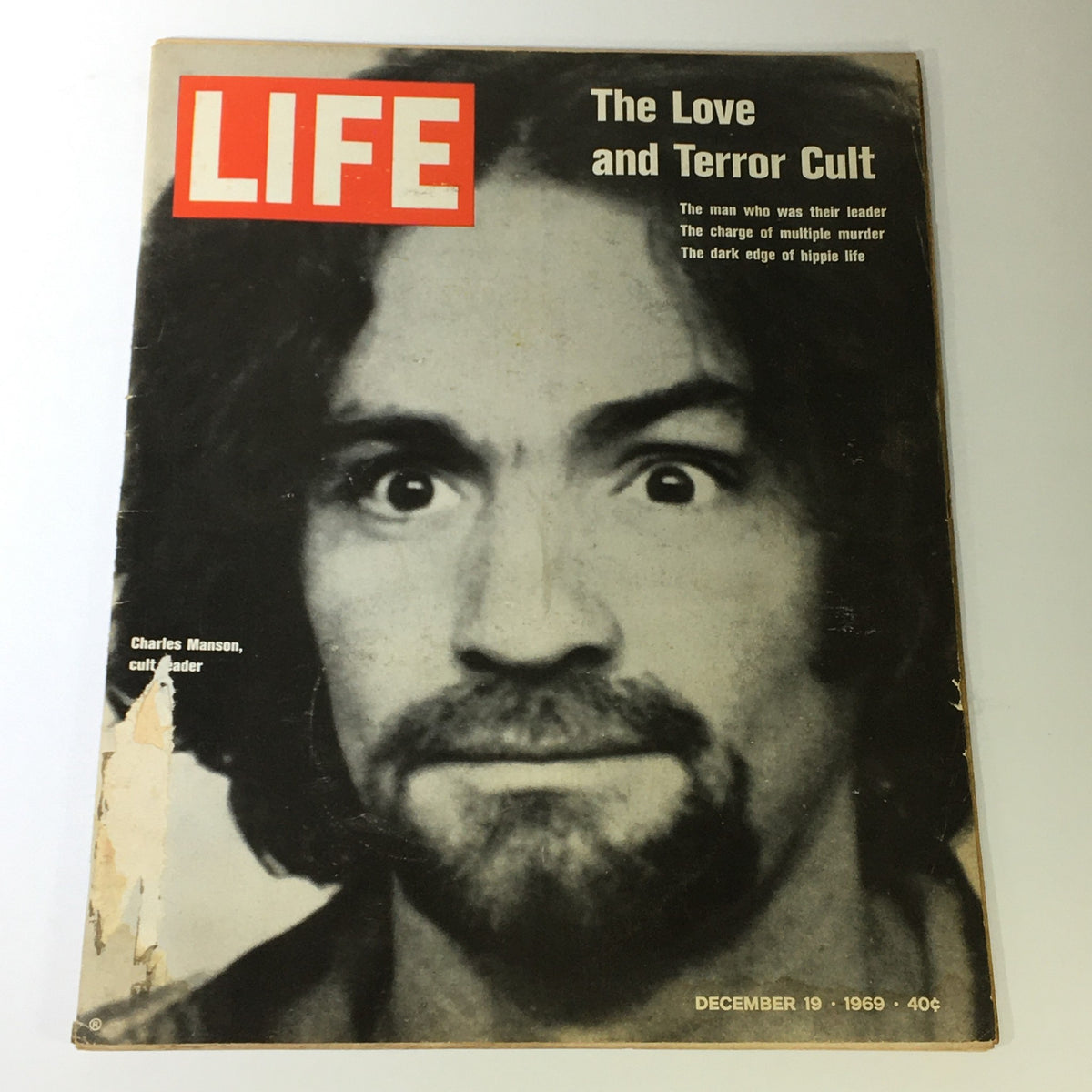

Description
Collector's Note – Why This Issue Matters
This issue of Life magazine, dated December 19, 1969, documents one of the most consequential criminal cases in modern American history at the precise moment it was breaking into national consciousness. Published only months after the Tate–LaBianca murders in Los Angeles, the issue arrived as investigators and the public were still piecing together who Charles Manson was and what the group around him, often referred to in press coverage of the time as "the Family," had done. Life's cover treatment, built around the now widely recognized photograph of Manson with the headline "The Love and Terror Cult," became one of the defining images associated with the case, and it remains instantly recognizable to anyone familiar with the era's true crime coverage. Researchers exploring the broader Charles Manson magazine coverage from this period will find this issue cited repeatedly as one of the earliest and most influential mainstream press accounts of the case. Its significance lies not in any sensational framing but in its role as a primary documentary record of how the murders and their perpetrators were first explained to a national audience. For collectors of true crime and 1960s history alike, that timing is central to the issue's importance.
The interior reporting in this issue, a twelve-page photo-illustrated feature, was substantial by the standards of the magazine's news coverage, reflecting how seriously the case was being treated within weeks of the arrests becoming public. The murders themselves, carried out in August 1969 and only connected to Manson and his followers in the weeks that followed, had already begun reshaping public perceptions of the counterculture movement more broadly, and this issue sits at the exact moment that shift was taking hold in the national press. Coverage of this kind did more than report facts; it shaped how an entire decade's countercultural movements would be remembered and discussed for years afterward. That dual role, as both news record and cultural turning point, is part of why this specific issue continues to draw serious interest from historians as well as collectors. It stands as a documentary artifact of a moment when American attitudes toward the counterculture were shifting in real time. Few single magazine issues from the era carry that same weight of historical consequence.
Beyond the Manson feature, this issue also reflects the broader editorial range Life was known for at the close of the 1960s, reportedly including coverage of public reaction to the My Lai massacre, the Apollo 12 mission, and a feature on designer Coco Chanel. That combination underscores how a single issue of the magazine could hold space for war, space exploration, fashion, and violent crime within the same set of pages, a format that defined Life's approach to the news throughout this period. Readers exploring the wider 1969 magazines collection will find that range typical of how major news weeklies covered an unusually eventful year. It's worth understanding this issue within that fuller editorial context, rather than only through its most famous cover story.
About the Publication
Life was an American weekly news and photojournalism magazine founded by Henry Luce and launched in November 1936. By the late 1960s, it remained one of the most widely read magazines in the United States, having built its reputation over more than three decades on the strength of its photography and its willingness to devote extended page counts to single, in-depth stories. Its audience was broad and largely middle-class, and its editorial format combined hard news coverage with feature-length photo essays on science, culture, and current events, often within the same issue. By this point in its history, Life had covered nearly every major American news event of the postwar era, from World War II through the space race, and had developed a reputation for treating significant stories with substantial visual and editorial depth rather than brief news items. The magazine's willingness to commit twelve pages to a single unfolding criminal case, as it did here, was consistent with that established editorial approach.
Key Highlights Inside
- A twelve-page photo-illustrated feature on Charles Manson and his followers, reported under the title "The Wreck of a Monstrous 'Family,'" featuring numerous photographs of Manson, his followers, and the Spahn Ranch property where the group had been based. The depth of this feature reflects how quickly the case had escalated into a major national story within weeks of the arrests. It remains one of the most frequently cited early press accounts of the case among historians and collectors.
- The widely recognized cover photograph of Manson, credited to photographer Laurence Merrick, paired with the "Love and Terror Cult" headline that would go on to become one of the most referenced images associated with the case. This cover has been referenced and parodied in other media in the decades since, including on a 1970 album cover. Its visual recognition today exceeds that of most other magazine covers from the same year.
- Reported coverage of public reaction to the My Lai massacre, reflecting the ongoing national reckoning with reporting on the Vietnam War during this period. This places the issue within the broader context of a turbulent news year rather than treating the Manson story in isolation.
- Reported feature coverage of the Apollo 12 mission, spanning several pages, reflecting Life's continued strong interest in the space program following the Apollo 11 moon landing earlier that same year.
- Reported feature on designer Coco Chanel, spanning several pages, illustrating the magazine's characteristic range across hard news, science, and culture within a single issue.
Condition & Rarity
This issue is described as good and used, with minor wear, slight edge fraying, and some minor marks or small rips, though the main editorial content remains intact and readable. That grading is consistent with a periodical of this age that has been read and handled rather than kept in untouched condition, which is typical for surviving copies of high-demand news issues from this era. The issue carries an address label on the front cover, indicating it was originally distributed as a subscription copy rather than sold on newsstands; while collectors often prefer newsstand copies without a label for the cleanest possible cover presentation, subscription copies with labels remain commonly available and collectible, particularly for a widely circulated title like this one. The accompanying plastic protective covering reflects standard preservation practice for vintage periodicals, helping guard against further handling wear and environmental damage over time. Given the historical significance of this particular issue, demand among collectors tends to remain strong across a range of condition grades, since completeness of the twelve-page feature and overall page integrity matter more to most collectors than pristine cosmetic condition. Surviving copies of this specific issue are notable in the collector market less for physical scarcity and more for the enduring historical weight of their subject matter.
Looking for More Issues Like This?
Issues documenting major true crime stories of this caliber are always in steady demand, so if this particular printing isn't available, the Charles Manson magazine collection is a good place to continue researching other period coverage of the case. The broader Life magazine collection is also worth exploring for readers interested in the publication's wider history of in-depth news coverage throughout the 1960s and beyond. For those more focused on the year itself, the 1969 magazines collection offers useful context, as OriginalMagazines.com maintains year-by-year collections spanning 1900 through 2009. Each of these paths offers a different way into the same eventful period of American history. Researchers and collectors alike often find that cross-referencing coverage across multiple publications from the same year provides a fuller picture of how a story like this one was reported in real time.