


Description
Collector's Note – Why This Issue Matters
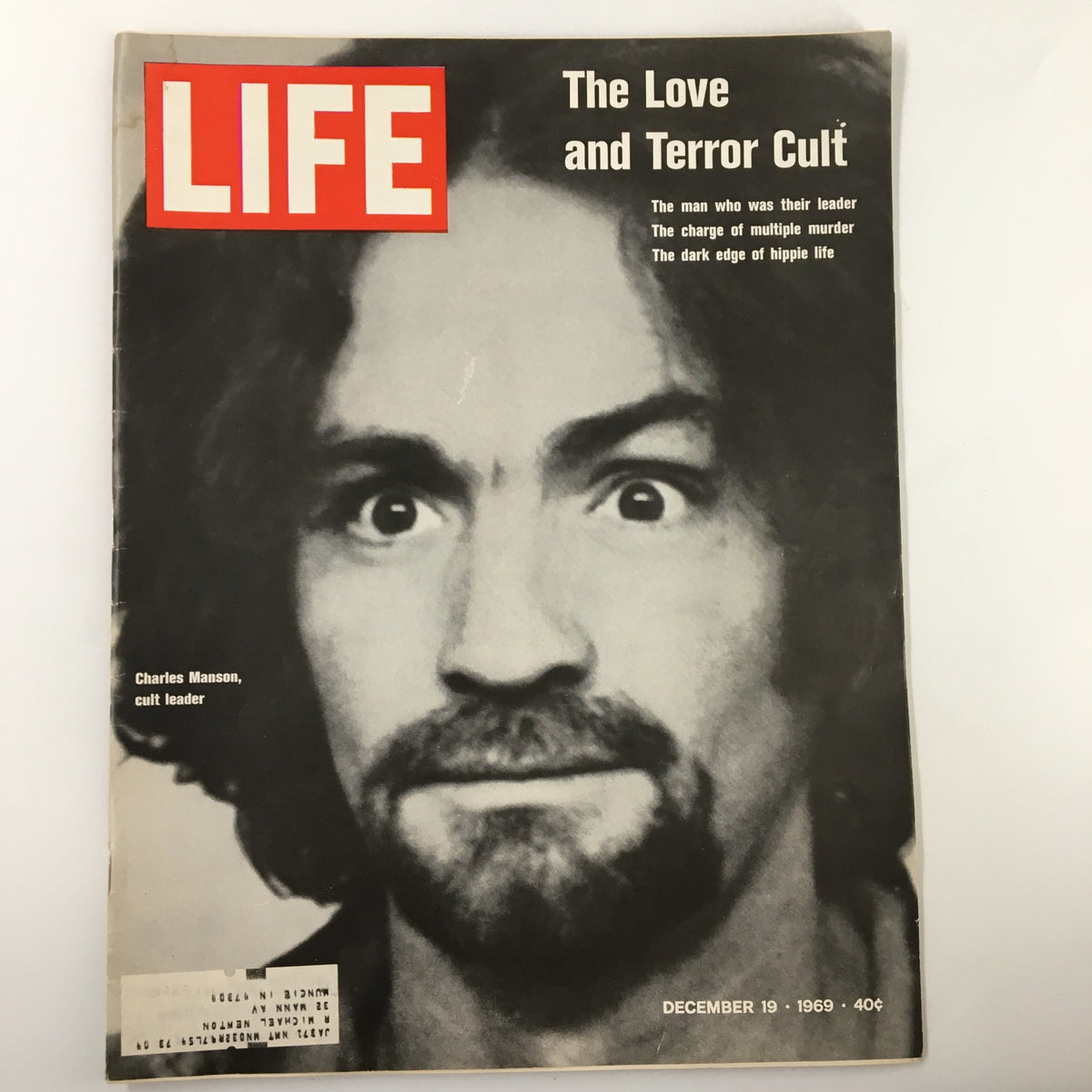
The December 19, 1969 issue of Life magazine — with its cover story "The Love and Terror Cult of Charles Manson" — is one of the most historically significant and widely recognized issues in the publication's entire run. It arrived on newsstands at a precise and extraordinary moment: the Tate-LaBianca murders had occurred in August 1969, the Manson Family members had been arrested in October and November, and the formal indictments had come down in early December. This issue represents the American mainstream press's first major, comprehensive attempt to explain to a mass audience who Charles Manson was, how the Family had formed around him, and what the murders meant for the broader cultural moment of the late sixties. For collectors building documentary archives of Charles Manson magazine coverage, this Life issue is the foundational piece — the first major national magazine treatment of the case, published before the trial began, that shaped how millions of Americans initially understood what had happened.
The timing of the cover story within the arc of 1969 gives it a cultural weight that extends well beyond true crime documentation. The Manson murders are widely regarded by historians and cultural critics as one of the events that marked the symbolic end of the 1960s counterculture — a violent inversion of the decade's idealism that arrived just months after Woodstock and just weeks before Altamont. Life's decision to devote its December cover to Manson was an editorial reckoning with that collapse, an attempt to make sense of how a decade that had begun with such apparent idealism had arrived at this particular darkness. The magazine was the dominant photojournalism weekly in the United States, with a readership in the tens of millions, and its framing of Manson and the Family in this issue substantially influenced the initial public narrative around the case. Collectors of vintage Life magazine issues will recognize this cover as one of the handful that genuinely shaped American public consciousness rather than merely reflecting it. The issue also sits within the remarkable final months of a decade that 1969 magazines document with unusual intensity across virtually every title that was publishing at the time.
The December 19, 1969 issue has retained its historical relevance and collector interest across the decades since publication in a way that few crime-related magazine covers manage. It is reproduced in documentaries, cited in academic studies of the case and of 1960s American culture, and referenced in nearly every serious retrospective treatment of the Manson Family and their cultural impact. As a physical artifact of the moment when America first confronted the full dimensions of what had happened, it occupies a place in the documentary record that no subsequent coverage can replicate.
About the Publication
Life magazine, relaunched by Henry Luce and Time Inc. in November 1936, was by December 1969 in the later years of its original weekly run — it would cease weekly publication in 1972 before being revived as a monthly in 1978. At its peak the magazine reached an estimated readership of over 13 million per issue, making it one of the most widely read English-language publications in history. Its editorial formula combined long-form photojournalism with personality profiles, cultural commentary, and the kind of documentary photography that brought major events — wars, social upheavals, cultural transformations — into American living rooms with a visual immediacy that no other medium could match in the pre-television-news era. By December 1969 its cultural authority remained enormous even as television was beginning to erode the dominance of the weekly photo magazine, and a Life cover story on a subject as charged as Manson carried the full weight of that authority.
Key Highlights Inside
- "The Love and Terror Cult of Charles Manson" cover feature — The first major national magazine investigation of the Manson Family, published in the weeks immediately following the indictments and before the trial began, representing the American mainstream press's initial comprehensive attempt to explain Manson, the Family's formation, and the cultural conditions that produced them.
- Photography documenting the case and its principals — True to Life's editorial strengths, the feature would have been accompanied by photographic documentation of Manson, Family members, and the circumstances of the case, providing visual context that shaped the initial public image of the principals in a way that influenced coverage for decades.
- Late-1969 cultural context — As a December 1969 issue, the broader editorial content reflects the final weeks of a year that had encompassed the moon landing, Woodstock, Altamont, and the Manson murders — arguably the most compressed sequence of historically significant events in any single calendar year of the postwar era.
- Subscription label on front cover — The noted front label identifies this as a mailed subscriber copy, partially obscuring the lower cover in the manner standard to addressed subscription editions — a condition factor relevant to collectors evaluating cover presentation quality.
Condition & Rarity
The December 19, 1969 Life is among the most actively sought single issues in the magazine's entire run, and condition distinctions carry meaningful weight in collector evaluation. The subscription address label on the front cover is a permanent feature that partially obscures the lower cover image — collectors prioritizing display quality consistently seek label-free newsstand copies of high-demand covers like this one, which are less common and typically command a premium. Minor wear throughout is standard and expected for a fifty-five-year-old weekly newsprint periodical and does not diminish the issue's research or reading value. The plastic protective covering indicates deliberate preservation and generally correlates with stable interior page condition. For Life issues from this era, the key structural points to confirm in any surviving copy are spine integrity along the staple binding and the completeness of any full-page photographic spreads within the Manson feature, as these were typically the sections most handled by original readers.
Looking for More Issues Like This?
The December 19, 1969 Life is one of those covers that serious collectors and true crime historians pursue with real intention, and finding a clean, label-free newsstand copy in solid condition requires genuine patience. The dedicated Charles Manson magazine collection at OriginalMagazines.com is the most direct place to search for this and related issues covering the case and its aftermath. The broader Life magazine archive and the complete 1969 collection are both worth exploring for other issues that document the remarkable and turbulent final year of the decade.