


Description
Collector's Note – Why This Issue Matters
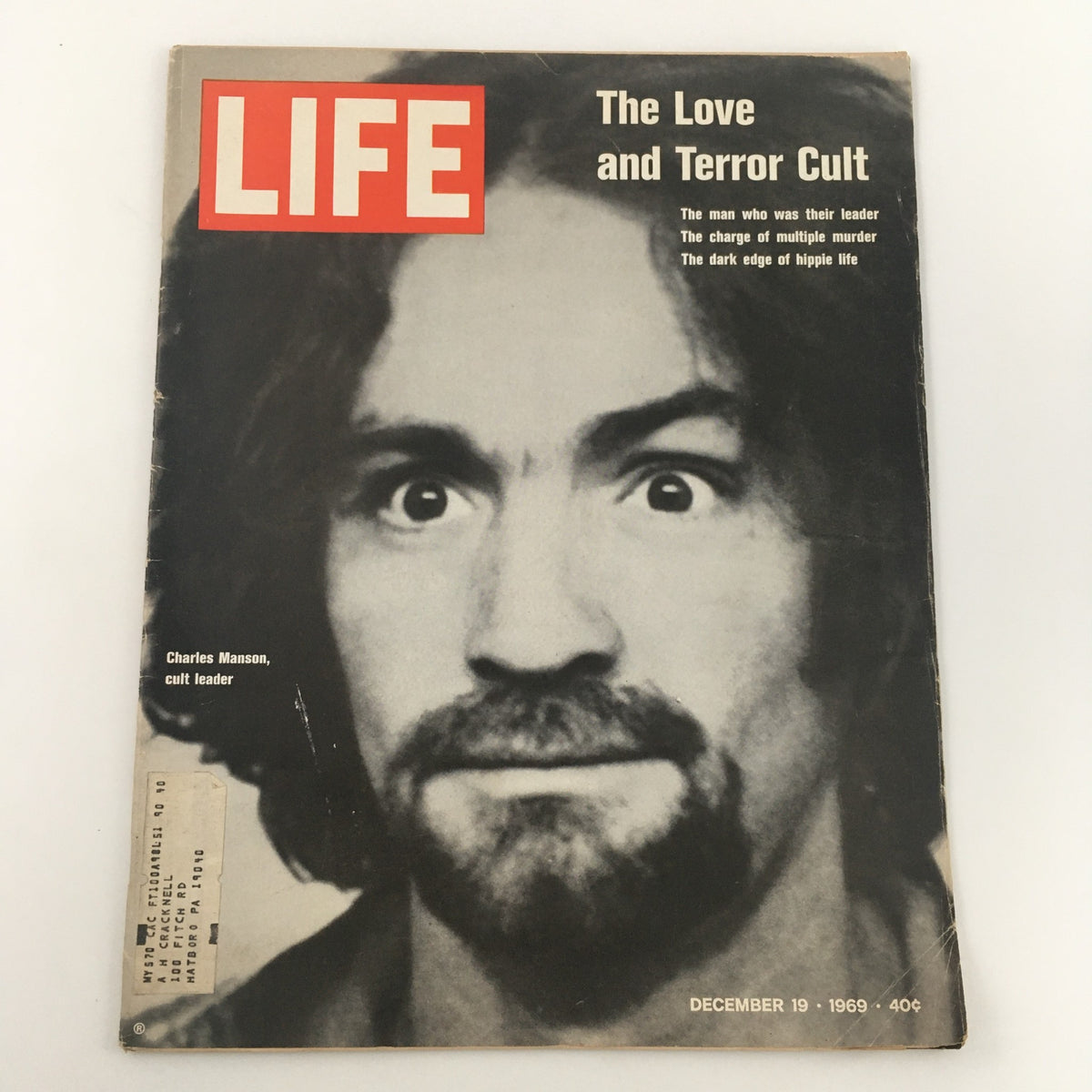
The December 19, 1969 issue of Life Magazine — cover story "The Love and Terror Cult of Charles Manson" — is one of the most historically significant and widely recognized magazine covers of the twentieth century. The timing is precise and consequential: the Tate-LaBianca murders had occurred in August 1969, Manson and his associates had been arrested in October, and by December the full scope of what had happened was becoming visible to the American public in real time. Life's December 19 cover story arrived during the preliminary hearing phase of what would become the most sensational criminal trial in American history, and it functioned as the mainstream media's definitive early framing of the Manson Family — the document through which millions of Americans first encountered the full dimensions of what had occurred in the hills above Los Angeles that summer. The cover image of Manson himself, with his intense gaze and the X carved into his forehead, became one of the most reproduced and recognized photographs of the era, and its first mass-circulation appearance in this issue gives surviving copies an artifact status that transcends ordinary magazine collecting.
The cultural weight of this cover cannot be overstated. The Manson murders did not merely shock Americans; they shattered a specific set of assumptions about the counterculture, about communal living, about the generation that had promised peace and love, and about the safety of the society the 1960s had been trying to transform. Sharon Tate's murder in particular — she was eight and a half months pregnant — struck American consciousness at a visceral level that made abstract anxieties suddenly concrete. Life's framing of Manson as the leader of a "love and terror cult" was an editorial interpretation that acknowledged both the countercultural language the Family had deployed and the violence it had produced, capturing the specific and terrible paradox that made the story so culturally disorienting. For collectors who focus on Life's long history of documenting America's defining moments, the Life Magazine archive at OriginalMagazines.com provides the full context of the publication's most consequential cover choices across its publishing history.
This issue also functions as a document of December 1969 specifically — the final weeks of the decade that had promised transformation and delivered something far more complicated. The Summer of Love was two and a half years in the past. Woodstock had occurred in August, the same month as the murders. Altamont was just days away. The Manson story, breaking into full public consciousness in December 1969, became retrospectively inseparable from the decade's reckoning with itself — a symbol deployed by cultural commentators on all sides of the 1960s debate for years afterward. A surviving copy of this Life issue is not merely a piece of true crime history; it is a primary document of the moment when one of the most significant cultural narratives of the twentieth century was first fully articulated for a mass audience. For collectors focused on the decade's closing months, the complete 1969 magazine archive at OriginalMagazines.com and the Charles Manson magazine collection both provide essential surrounding context.
About the Publication
Life Magazine was an American general-interest weekly founded by Henry Luce in 1936 and published in its original weekly format until 1972, reaching peak circulations that made it one of the most widely read publications in the world. Built around large-format photojournalism, it defined the visual language of mid-century American culture more than any other single publication. By December 1969 it was still operating at the height of its authority — the magazine that Americans turned to for the definitive visual and narrative treatment of the events that mattered most. Its choice to devote a cover to the Manson story in December 1969 was a statement that this was not merely a crime story but a cultural event of the first order, and the quality and depth of its photojournalistic treatment gave the issue a documentary weight that distinguished it from newspaper coverage of the same events.
Key Highlights Inside
- Cover story "The Love and Terror Cult of Charles Manson" — the mainstream American media's most comprehensive early treatment of the Manson Family, published during the preliminary hearing phase of the case and functioning as the document through which millions of Americans first encountered the full dimensions of what had occurred in August 1969.
- The cover photograph of Charles Manson — one of the most recognized and reproduced images of the late 1960s, appearing here in its first major mass-circulation context and giving this issue a photographic significance that transcends the category of ordinary magazine covers.
- Photojournalistic documentation consistent with Life's large-format visual approach, almost certainly including images of the crime scenes, Family members, and the Spahn Ranch commune that provided Americans their first comprehensive visual understanding of the world Manson had constructed.
- The broader editorial context of a December 1969 Life issue — the closing weeks of the 1960s, a cultural moment dense with retrospective significance that the Manson story crystallized and intensified in ways that would be analyzed and debated for decades afterward.
- Period advertising throughout, capturing the consumer culture of late-1969 America in the secondary documentary layer that serious Life collectors consistently find as historically revealing as the editorial content — the ordinary commercial world continuing alongside the extraordinary events the cover story documented.
- Note: Specific interior article titles and full feature details beyond the Manson cover story are unconfirmed for this issue. The above reflects what can be responsibly attributed based on the cover subject, publication format, date, and Life's well-documented photojournalistic practices of the era.
Condition & Rarity
Surviving copies of this issue are described as carrying an address label on the front cover, in good and used condition with very minor edge wear, possible minor marks or rips, and one bent crease on the front — an honest and accurate condition assessment for a publication now more than fifty-five years old that was actively read and handled at the time of its distribution. The address label affects the visual presentation of the Manson cover image and is a relevant factor in collector grade assessment; label-free newsstand copies of this specific issue are consistently preferred by collectors for whom the cover photograph's full visual integrity is the primary consideration, and they are correspondingly harder to locate. The bent crease on the front noted in the listing is a specific condition detail that collectors should evaluate against the photographs to determine its extent and placement relative to the cover image. The protective plastic covering reflects deliberate preservation. When evaluating any surviving copy of this issue, collectors should assess the extent of label adhesion and associated surface damage, the placement and depth of any creases on the cover, the completeness of all interior pages, and the overall integrity of the binding — the combination of factors that determines where a given copy falls within the collectible range for one of the most historically significant Life covers ever published.
Looking for More Issues Like This?
The December 19, 1969 Life Manson cover is one of the most historically recognized magazine covers of the entire postwar era, and clean surviving copies — with or without labels — command consistent collector attention whenever they surface. If this issue has already found its home, the Charles Manson magazine collection at OriginalMagazines.com is the most focused starting point for related material. The Life Magazine archive documents the publication's full run of historically consequential covers, and the 1969 magazines collection brings together material from across the American press during one of the most turbulent closing years of any decade in modern history.