
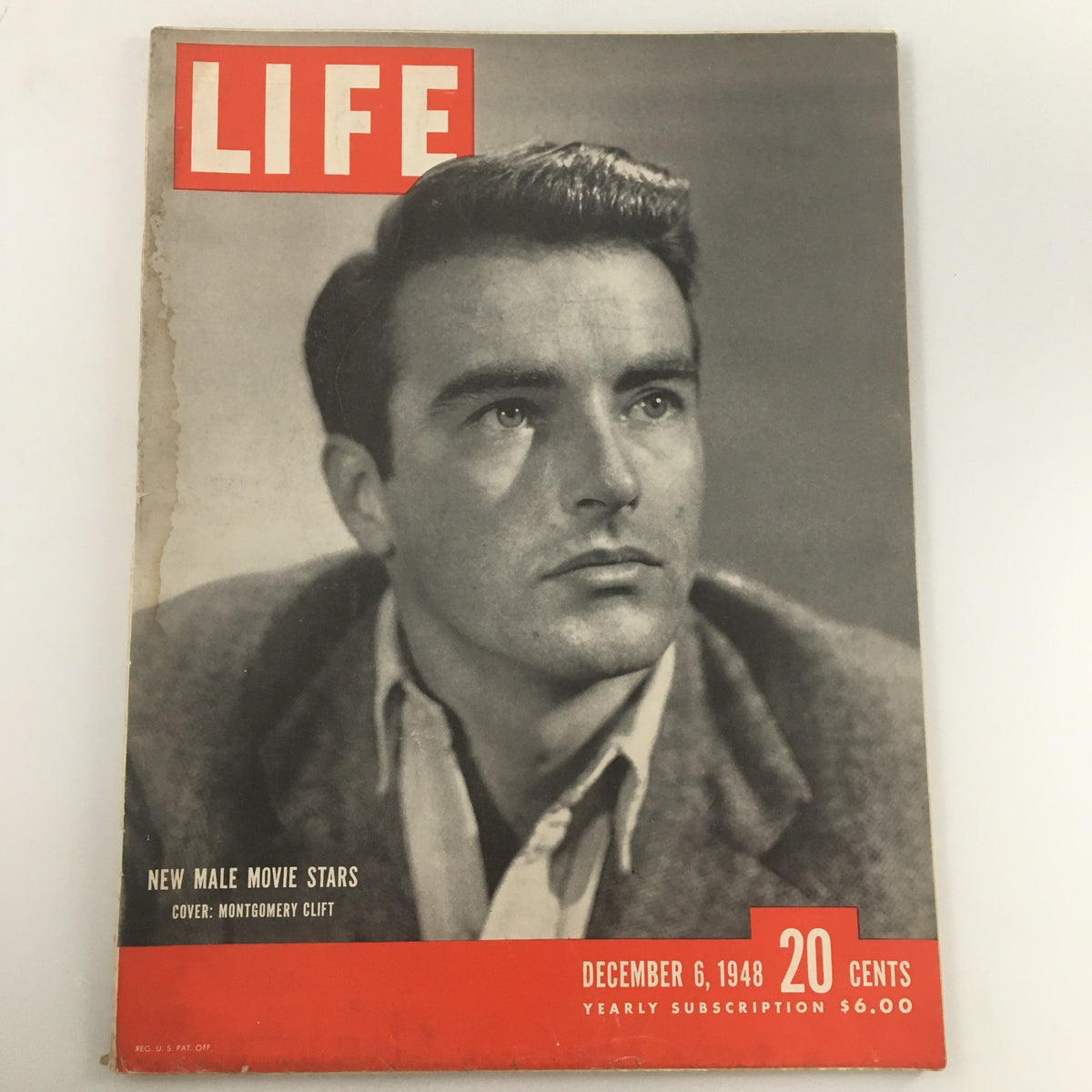


Description
Collector's Note – Why This Issue Matters
The December 6, 1948 issue of Life magazine featuring Montgomery Clift on its cover arrives at one of the most consequential moments in the history of American cinema — the debut of a new kind of screen actor whose influence would reshape what Hollywood leading men could be and do. Clift had appeared in two films by the time this cover was published: Howard Hawks's Red River, released in September 1948, and Fred Zinnemann's The Search, released earlier that year. Both films had established him immediately as a performer of unusual psychological depth and physical intensity — qualities that were recognizably different from the heroic confidence of the established Hollywood male stars who had dominated the previous decade. The Search had earned him his first Academy Award nomination for Best Actor, an extraordinary recognition for a debut film performance, and Red River had demonstrated that his introspective, emotionally complex approach could hold its own against John Wayne in a major commercial western. A Life cover in December 1948 was the definitive mainstream confirmation of that arrival. For collectors who focus on vintage magazines featuring Montgomery Clift, this is the most significant and historically important cover appearance of his career — the moment his cultural prominence was made fully public and permanent.
The significance of this cover extends well beyond Clift's individual career to encompass what he represented for American film and culture at the end of the 1940s. He was, along with Marlon Brando and James Dean — both of whom would follow him into prominence in the early 1950s — part of a generational shift in screen acting that drew heavily on the psychological naturalism of the Method tradition and the emotional authenticity that Stanislavski-influenced training at institutions like the Actors Studio encouraged. Clift had been a successful stage actor in New York before coming to Hollywood, and he brought to film a theatrical seriousness and emotional vulnerability that was genuinely new in the context of the Hollywood star system. The December 1948 Life cover captures him at the precise moment before that transformation had fully registered with the American public — when he was still a novelty, a beautiful and intense young man whose two films had generated the kind of critical and popular attention that suggested something genuinely new was entering the cultural landscape. Collectors building archives around vintage Life magazine issues from the Hollywood golden age will find this cover one of the most significant and precisely timed celebrity appearances in the publication's remarkable run of mid-century film coverage.
The December 1948 date places this issue at a specific and resonant cultural crossroads. The postwar Hollywood that Clift was entering was itself in a period of significant transition: the studio system that had defined American filmmaking for two decades was under pressure from antitrust litigation, the blacklist, and the early threat of television; a generation of directors and writers were beginning to push against the constraints of the Production Code; and the cultural mood of postwar America — anxious, prosperous, uncertain about its own identity after the upheavals of depression and war — was creating an audience hungry for the kind of psychological complexity and emotional honesty that Clift's performances provided. A Life cover placing his face at the center of America's visual culture in December 1948 is a document of that hunger being recognized and met. For collectors focused on the magazines of 1948 — a year already distinguished by extraordinary historical density — this issue adds the dimension of cultural and cinematic history to a collecting category that tends to be dominated by political and geopolitical subjects.
About the Publication
Life magazine, founded by Henry Luce in 1936 and published weekly until 1972, was the most widely read and visually influential general-interest magazine in the United States at its mid-century peak — a publication whose photojournalism, celebrity portraiture, and visual storytelling reached a weekly audience of millions and shaped how Americans understood their world and their culture across three and a half decades of continuous publication. Its Hollywood coverage was particularly consequential: Life's photographers and editors had developed a visual language for depicting film stardom that combined technical sophistication with genuine editorial intelligence, and its celebrity covers were among the most carefully produced and widely viewed images in American popular culture. A Life cover in December 1948 was not simply a magazine feature — it was a cultural event, a public declaration that the subject had achieved a level of American prominence that demanded the attention of the most widely read publication in the country. The magazine's audience encompassed virtually the full spectrum of literate American adults, and its reach and influence in this period were without parallel in the magazine publishing world.
Key Highlights Inside
- A cover feature on Montgomery Clift arriving at the moment of his definitive Hollywood breakthrough — following his Academy Award-nominated performance in The Search and his critically acclaimed turn opposite John Wayne in Red River, both released in 1948, and establishing him as the most significant new presence in American film of the postwar period.
- Photography almost certainly drawing on Life's considerable resources for celebrity portraiture — the magazine's Hollywood coverage in this era featured some of the most technically accomplished and visually memorable film star photography in American publishing, and a Clift cover feature would have been treated as a significant visual assignment.
- Editorial framing that positioned Clift within the context of postwar Hollywood and the emerging generation of film actors whose psychological naturalism and emotional authenticity were beginning to challenge the conventions of the studio-era leading man — a story that Life's editors would have recognized as culturally significant even at this early stage of his career.
- Standard Life photojournalism and feature content covering the full breadth of American life, culture, and international affairs in the first week of December 1948 — a moment that included the aftermath of Truman's historic election victory, the ongoing Berlin Airlift, and the cultural and social landscape of a country still processing the psychological legacies of the war years.
- Advertising content representing the full spectrum of late-1940s American consumer culture — the advertisements that appeared in a December Life targeted the magazine's enormous general readership with the consumer goods, entertainment, and aspirational products of the postwar economic boom, and constitute a significant secondary document of the era's commercial aesthetics and social values.
Note: Specific interior article titles, bylines, and additional feature details beyond the cover subject are unconfirmed for this issue from available sources. The highlights above reflect verifiable historical context drawn from the cover subject, publication date, and the well-documented editorial character of Life magazine during this period.
Condition & Rarity
This copy is identified as an original newsstand edition without a mailing label — the preferred provenance for serious Life magazine collectors — meaning it entered circulation through retail distribution rather than the subscription fulfillment system, arriving flat, unlabeled, and without the postal handling wear that characterizes mailed copies. On a magazine now approaching eighty years of age, the absence of a label is a substantive condition attribute that distinguishes surviving newsstand copies from the more commonly encountered subscription-processed examples, and is particularly meaningful for a Life cover of this visual significance, since the cover photography is the primary display and collectible element. The noted minor wear — small rips, edge wear, creases, and light marks — is consistent with a newsstand copy of this vintage that has been stored rather than actively handled, and falls within the expected range for good condition without compromising the structural integrity or readability of the issue. Collectors should examine the provided photographs closely to assess the specific location and extent of any wear relative to the cover image and their display priorities. The plastic protective sleeve indicates deliberate preservation, which generally correlates with better interior page condition and reduced ongoing degradation. For a Montgomery Clift Life cover from his career-defining debut year, a no-label newsstand copy in good condition with an intact, displayable cover represents a meaningful and historically significant preservation outcome.
Looking for More Issues Like This?
A Montgomery Clift Life cover from his 1948 Hollywood breakthrough is the most historically significant magazine appearance of his career, and no-label newsstand copies in good condition are actively sought by collectors at the intersection of classic Hollywood memorabilia and vintage periodical collecting — if this December 1948 issue has already found a home, the dedicated Montgomery Clift magazine collection at OriginalMagazines.com is the natural first resource for tracking down other significant appearances across his career. The broader vintage Life magazine collection is an excellent resource for other landmark Hollywood and celebrity covers from the publication's remarkable mid-century run, and collectors focused on the specific cultural and cinematic richness of the immediate postwar years will find it well worth exploring the full 1948 magazine archive — a year whose combination of political drama, Cold War formation, and Hollywood golden age stardom makes it one of the most rewarding and actively collected in the publication's history.