




Description
Collector's Note – Why This Issue Matters
The February 21, 1964 issue of Life magazine featuring Lee Harvey Oswald on its cover is one of the most historically charged and most actively collected single issues in the publication's entire thirty-five-year run. John F. Kennedy had been assassinated in Dallas, Texas on November 22, 1963 — just three months before this issue's publication date — and Oswald himself had been murdered by Jack Ruby two days after the assassination, before he could be tried or could testify publicly about his actions and motivations. The Warren Commission, established by President Lyndon Johnson to investigate the assassination, was actively conducting its inquiry in February 1964 and would not publish its report until September of that year. The country was therefore in a specific and historically unrepeatable phase of its relationship with the assassination — the raw grief was still very recent, the official investigation was underway but unresolved, and the questions about Oswald's identity, motivations, and possible connections were being actively examined without having yet received any official answer. A Life magazine cover feature on Lee Harvey Oswald in February 1964 arrives at the exact moment when American journalism was attempting to construct the fullest possible public portrait of the man who had killed the president — an exercise in biographical and historical documentation that was simultaneously serving the needs of a grieving public, contributing to the ongoing investigative record, and establishing the primary journalistic account of one of the most consequential individuals in modern American history. For collectors who focus on vintage magazines featuring Lee Harvey Oswald, this February 1964 Life cover is a primary document of the assassination's immediate documentary aftermath.
Life's specific role in the Kennedy assassination's visual and journalistic record gives this February 1964 issue additional historical weight that extends well beyond the cover story alone. The magazine had published the Zapruder film frames in its November 29, 1963 issue — just one week after the assassination — in an act of journalistic decision-making whose consequences would extend for decades, as the magazine held the rights to the film throughout the 1960s and its editorial choices about which frames to publish and how to sequence them shaped the public's visual understanding of the assassination in ways that remained controversial. A February 1964 Life feature on Oswald arrives within this context — the publication was not merely reporting on the assassination but was itself a primary actor in the historical record, making its Oswald coverage a document of unusual journalistic weight and historical consequence. Collectors building archives around vintage Life magazine issues from the Kennedy assassination era will find this February 1964 Oswald cover one of the essential documents of the publication's most historically significant and most publicly consequential journalistic moment.
The broader significance of this issue for collectors who understand the full scope of the Kennedy assassination's documentary history extends to the specific timing of its February 1964 publication within the Warren Commission's ongoing investigation. The Commission had been hearing testimony and gathering evidence since early January 1964, and the public's hunger for information about Oswald's identity, background, and motivations was intense and unsatisfied. A major Life feature on Oswald in February 1964 was engaging with that hunger directly — attempting to construct a biographical portrait of a man who had died before he could provide his own account, drawing on the investigative journalism that Life's considerable resources made possible in the years before the Commission's own findings were public. That document, produced in the specific historical gap between the assassination and the Commission's report, is a primary record of how America's most important pictorial magazine understood and presented the most important unsolved questions of the era to its enormous readership. Collectors building archives around the magazines of 1964 will find this February issue one of the essential documents of the year.
About the Publication
Life magazine, founded by Henry Luce in 1936 and published weekly until December 1972, had by February 1964 accumulated twenty-eight years of cultural authority as the most important pictorial journalism publication in the United States — a magazine whose visual documentation of American and world events, whose photojournalistic resources, and whose editorial ambition had made it the primary visual record of American life and its most consequential moments. Its Kennedy assassination coverage — from the November 22, 1963 issue through the ongoing documentary follow-up in early 1964 — was among the most historically significant journalism the publication produced in its entire run, and individual issues from this documentary aftermath period are among the most actively collected in its entire archive.
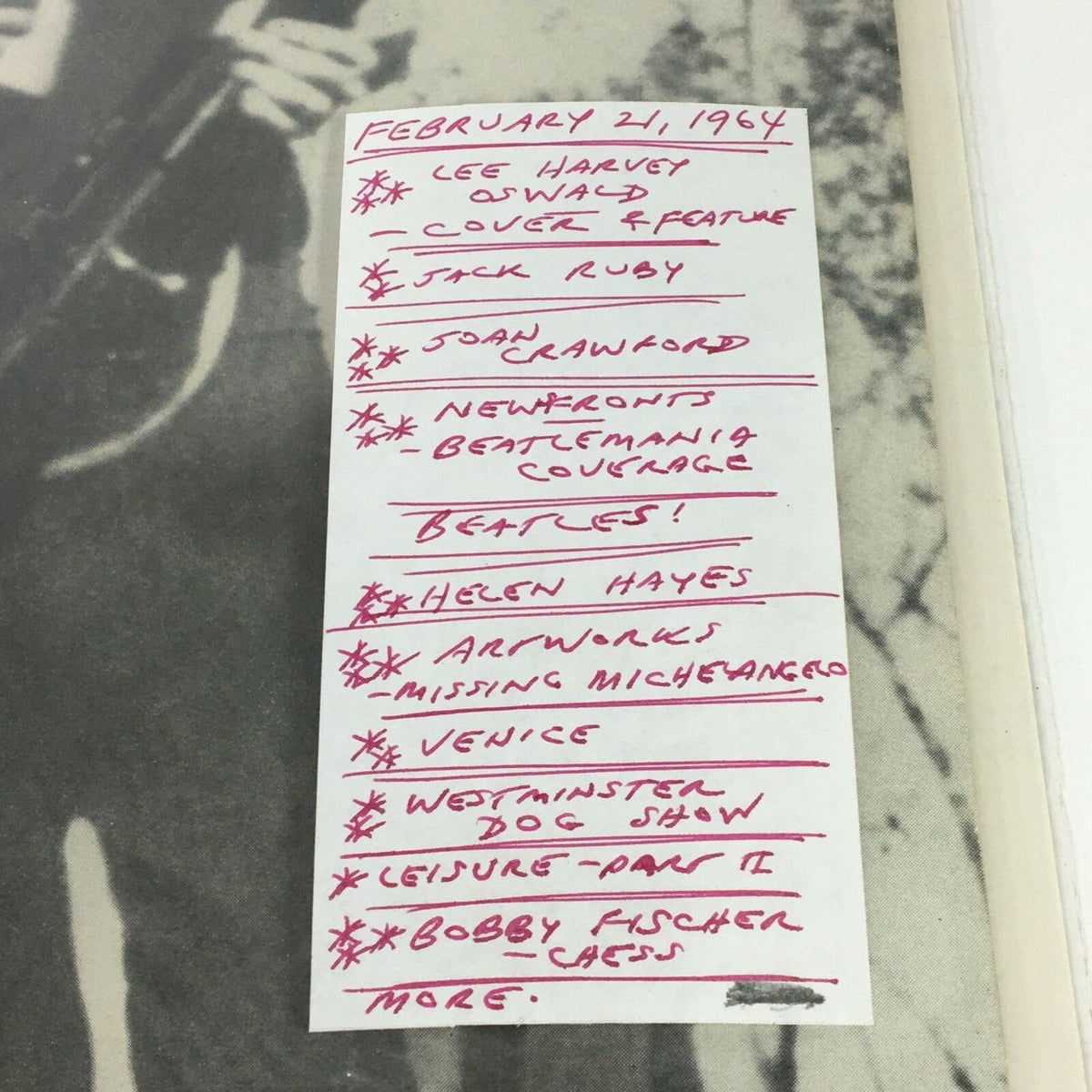
Key Highlights Inside
- A major cover feature on Lee Harvey Oswald — the accused assassin of President Kennedy, killed by Jack Ruby before he could be tried, documented in February 1964 in the specific historical gap between the assassination and the Warren Commission's official findings, when American journalism was attempting to construct the fullest possible public biographical portrait of the man at the center of the most consequential act of political violence in modern American history.
- Biographical and investigative coverage engaging with Oswald's background, identity, and motivations — drawing on Life's considerable journalistic resources to document the defection to the Soviet Union, the return to the United States, the Fair Play for Cuba activities, and the other biographical details that were being scrutinized by the Warren Commission and by journalists across the country in the investigation's active phase.
- Photography and visual documentation consistent with Life's approach to the Kennedy assassination's journalistic aftermath — the publication's photographic resources and its established role as the primary visual record of the assassination gave its Oswald coverage a documentary authority and visual completeness that no competitor could match.
- Editorial content reflecting the specific cultural and investigative atmosphere of February 1964 — a country three months past the assassination, with the Warren Commission actively gathering testimony, public questions about Oswald's identity and possible connections still officially unresolved, and the most widely read pictorial magazine in America deploying its full resources on the story that had defined the preceding three months of American public life.
Note: Specific interior article titles, bylines, and additional feature details beyond the Oswald cover story are unconfirmed for this issue from available sources. The highlights above reflect verifiable historical context drawn from the cover subject, publication date, and the well-documented journalistic priorities of Life magazine during the Kennedy assassination's documentary aftermath.
Condition & Rarity
This copy is identified as a newsstand edition in good condition with minor wear throughout, professionally bagged and boarded — the strongest preservation methodology available for large-format magazine publications. The bagged-and-boarded format provides structural board support that prevents spine stress, page warping, and cover bending, while the sealed bag creates a microenvironment that significantly reduces exposure to humidity, dust, and light — the combination represents the most deliberate and comprehensive passive preservation approach available for magazine-format publications. The newsstand provenance and absence of any mention of a subscription label suggest the cover is presented as originally printed without label adhesive damage. The minor wear throughout is consistent with a good-condition copy that has been stored carefully rather than actively handled. For a February 21, 1964 Life featuring a Lee Harvey Oswald cover story — one of the most historically significant and most actively sought issues in the publication's entire Kennedy assassination documentary record — a newsstand copy in good condition with bagged-and-boarded preservation represents a well-maintained and historically purposeful acquisition for serious collectors of assassination history and Kennedy-era American journalism.
Looking for More Issues Like This?
A bagged-and-boarded newsstand Life from February 21, 1964 featuring Lee Harvey Oswald on its cover is among the most actively collected and most historically significant issues in the publication's entire run — a primary document of the assassination's investigative aftermath produced at the exact moment when the questions were most urgent and the answers still officially unresolved. If this issue has already found a home, the dedicated Lee Harvey Oswald magazine collection at OriginalMagazines.com is the natural first resource for other significant assassination-era covers and documentary issues. The broader vintage Life magazine collection is worth exploring for other significant Kennedy assassination-era and early-1960s covers, and collectors focused on the full historical landscape of 1964 will find it rewarding to browse the full 1964 magazine archive for publications from one of the most historically consequential years of the postwar era.