


Description
Collector's Note – Why This Issue Matters
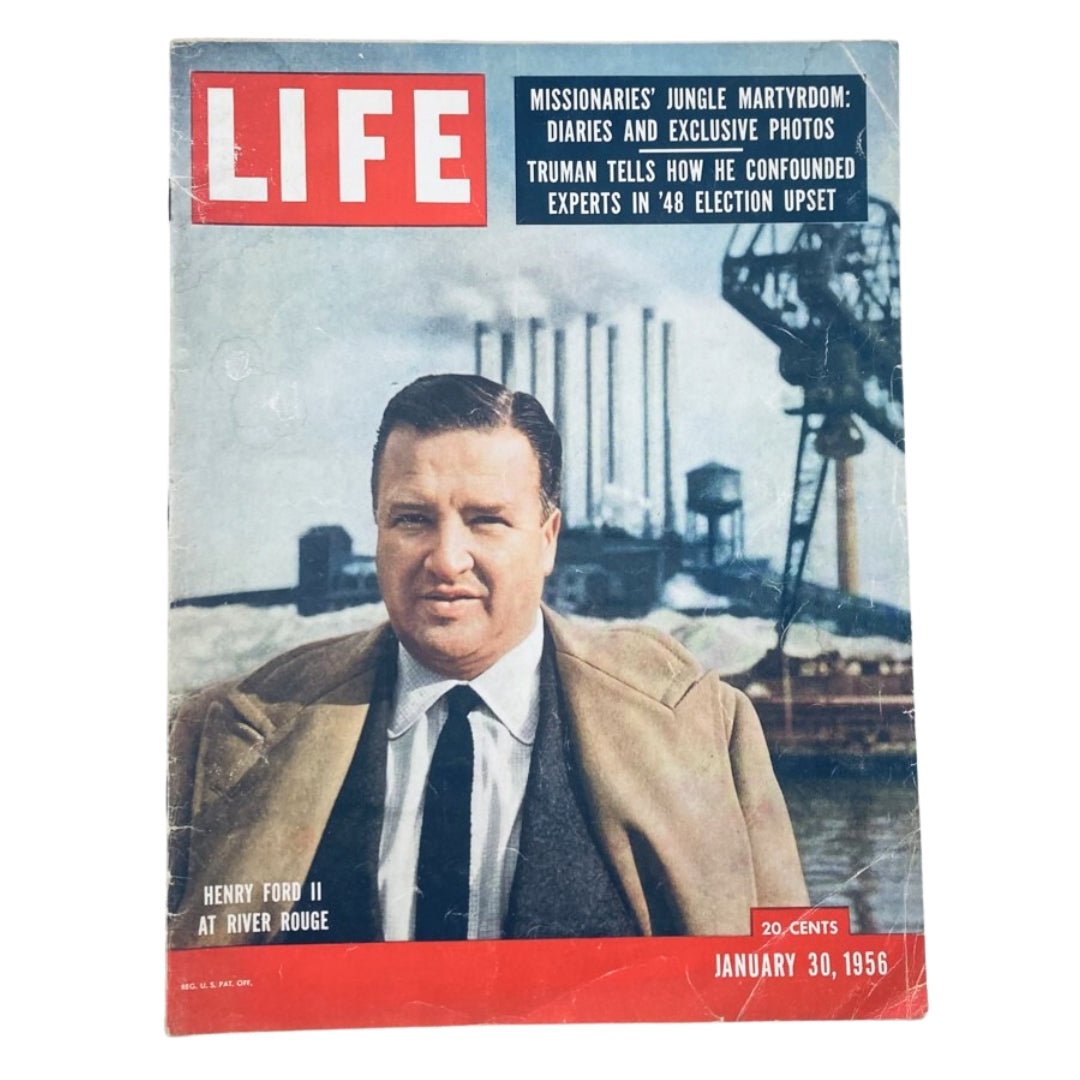
The January 30, 1956 issue of Life magazine places Henry Ford II at the River Rouge complex at one of the most consequential moments in American industrial history. The Rouge — as it was known — was not simply a factory. It was the largest integrated manufacturing complex in the world, a miles-wide organism along the Rouge River in Dearborn, Michigan, where raw materials entered one end and finished automobiles emerged from the other. Henry Ford I had conceived it as the ultimate expression of vertical integration, and by 1956 his grandson was presiding over it during a period of profound transformation. The postwar American economy was at full force, automobile ownership was expanding faster than at any point in history, and Ford Motor Company was in the midst of a competitive resurgence against General Motors that would define the decade. Henry Ford II — known within the industry as "Hank the Deuce" — had taken control of the company in 1945 at age twenty-eight, rescued it from near-collapse, and rebuilt it into a modern corporation. A Life cover at the Rouge in early 1956 was a portrait of American industrial power at its most confident. Collectors researching Henry Ford magazines and vintage automotive history publications consistently identify mid-1950s coverage of the Ford family and the Rouge complex as primary documents of the American industrial apex.
January 1956 carries specific automotive significance beyond Ford's general postwar dominance. The 1956 model year had introduced meaningful safety innovations across the industry — Ford itself had made a notable push around safety features in its 1956 lineup, including seat belts as an option, in a campaign that represented one of the first serious attempts by a major automaker to market safety to consumers. The River Rouge setting for this cover is not incidental; it was a deliberate visual argument about the scale, permanence, and confidence of American manufacturing at the height of the postwar boom. For collectors assembling an archive around vintage Life magazine issues that document American industrial and corporate history, this cover stands among the more visually and historically specific of the decade's business-focused issues. The Rouge plant itself has since been substantially transformed — portions repurposed, the iconic smokestacks reduced — making photographic documents of it at full mid-century operational capacity genuinely valuable as industrial history.
The broader editorial content of a January 1956 Life would have reflected a country in confident mid-decade stride: Eisenhower was in the White House, the interstate highway system was being legislated into existence, and American consumer culture was expanding at a pace that seemed, in that moment, simply natural. Henry Ford II on the cover of the nation's most widely read general interest magazine, standing at the plant his grandfather built, was an image that resonated far beyond automotive enthusiasts. It was a statement about American industrial civilization itself. Anyone building a research collection around magazines from 1956 will find this issue a particularly direct document of the decade's defining economic confidence.
About the Publication
Life, founded by Henry Luce in 1936 as a weekly photojournalism magazine, was by the mid-1950s the most widely circulated magazine in the United States, with a readership that cut across class, region, and education level in ways no other publication could match. Its format centered on large-format photography — the magazine's generous page size was designed specifically to showcase photographic essays — combined with reporting on news, culture, science, sports, and American life. By 1956 Life had refined its cover formula to a reliable index of national preoccupations: whoever or whatever appeared on its cover in a given week was, by definition, something that mainstream America was being asked to pay attention to. Its audience was the American middle class in full, and its editorial voice reflected the optimistic, forward-looking consensus of postwar American culture at its most cohesive.
Key Highlights Inside
- Cover photograph of Henry Ford II at the River Rouge complex — a visual document of the world's largest integrated manufacturing facility at the height of its mid-century operational capacity, with one of America's most powerful industrialists as its human anchor.
- Coverage contextualized within the 1956 model year, a period when Ford Motor Company was making its notable push toward consumer safety features including optional seat belts — one of the first major automaker safety marketing campaigns in American history.
- Issue dated January 30, 1956, placing it within the first weeks of an election year and the height of the Eisenhower-era economic expansion, providing editorial context across news, advertising, and feature content that reflects mid-decade American confidence at its peak.
- Note: Specific interior article titles and additional features beyond the cover story are unconfirmed for this issue. The above reflects what is verifiable from the cover, date, named subject, and the publication's documented editorial format for this period. Photos accompanying the listing serve as the authoritative reference for the full contents.
Condition & Rarity
Copies of this issue described as label-free and in good condition represent a solid baseline for mid-1950s Life collecting. Subscriber copies — which constituted the majority of Life's enormous circulation — typically arrived with address labels affixed to the cover, and finding a clean newsstand copy without label adhesive residue or label ghosting on the cover is a meaningful provenance distinction. The plastic protective covering indicates deliberate archival storage at some point in the magazine's history, slowing the acid-driven toning and surface oxidation that affect unprotected newsprint and coated stock over time. Good condition with age-consistent wear is an honest and representative grade for a nearly seventy-year-old weekly publication printed on paper stock not designed for long-term preservation. Cover photography clarity and page integrity across the full interior — Life's large-format issues were substantial objects — are the primary criteria collectors apply when evaluating surviving copies of this era.
Looking for More Issues Like This?
Henry Ford II cover appearances in major American weeklies from the postwar industrial era are among the more historically specific finds in vintage magazine collecting, and the River Rouge setting gives this particular issue an additional layer of documentary significance that serious collectors of automotive and industrial history will recognize immediately. If this issue is no longer available, the Henry Ford magazine archive is the most focused place to continue the search for related coverage. The broader vintage Life magazine collection spans decades of American history through the magazine's unmatched photojournalism, and the complete 1956 magazine archive offers collectors a full range of contemporaneous titles documenting that pivotal mid-decade year.