


Description
Collector's Note – Why This Issue Matters
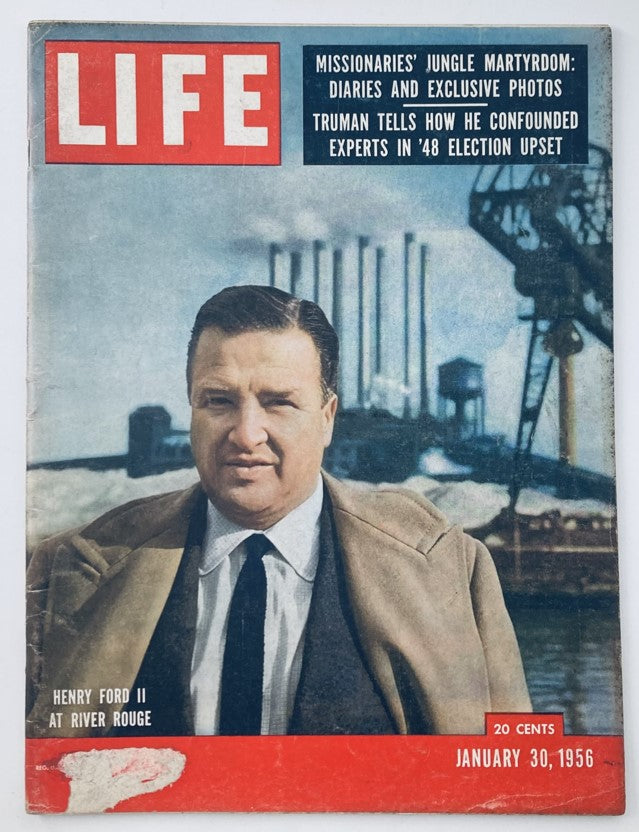
January 30, 1956 was no ordinary week in American industry. Henry Ford II — known widely as "Hank the Deuce" — had by that point already spent a decade reshaping one of the most consequential companies in modern economic history. When his grandfather Henry Ford handed over a near-bankrupt Ford Motor Company in 1945, the younger Ford inherited an institution in crisis. By 1956, the turnaround was complete and the dynasty was ascendant. His appearance on the cover of Life that January placed him squarely in the cultural mainstream at a pivotal corporate moment: Ford Motor Company went public on January 17, 1956 — just days before this issue hit newsstands — in what remains one of the most significant initial public offerings in American financial history. Over 10 million shares were sold to more than 250,000 investors, democratizing ownership of an American icon. This issue exists at the exact intersection of family legacy, industrial power, and postwar capitalism. For collectors interested in Henry Ford and the Ford Motor legacy in vintage magazines, this cover date is among the most historically loaded of the era.
Henry Ford II was not simply an executive — he was a symbol. In the mid-1950s, American manufacturing confidence was at its peak, and Ford was its embodiment. He had recruited the famous "Whiz Kids," modernized management, launched the Thunderbird in 1955, and was preparing to unveil the ill-fated Edsel project. A Life cover in early 1956 captured him at the height of his influence and public prestige, before the controversies of later decades complicated his legacy. For anyone building a serious collection of 1956 magazines — a year defined by Eisenhower's reelection, the Suez Crisis, and the dawn of the Interstate Highway System — this issue represents one of the defining American business portraits of the decade.
The significance of a Life cover should not be understated. In 1956, Life had a readership in the tens of millions and its covers functioned as a kind of national consensus — a shorthand for who and what mattered most. To be placed on that cover was to be declared, by the editors of America's most-read general interest magazine, a figure of genuine national importance. Henry Ford II earned that placement in the same week his family's company entered the public market. The timing is remarkable, and the issue is a primary document of postwar American commercial culture.
About the Publication
Life magazine, published by Time Inc., was the dominant American photojournalism weekly from its relaunch in 1936 through its conversion to a monthly in 1972. At its peak circulation in the 1950s and 1960s, it reached an estimated 8 to 10 million subscribers per issue, with total readership far exceeding that figure as copies passed through households, waiting rooms, and libraries. The magazine's editorial identity was built on large-format photography, long-form narrative features, and a deliberate effort to document American life — and American power — in real time. Its audience was broad and middle-American, but its subject matter ranged from celebrity portraiture to Cold War geopolitics to corporate profiles of the kind that would have surrounded Henry Ford II's cover appearance. The Life magazine archive represents one of the most complete photographic records of twentieth-century American culture available to collectors today.
Key Highlights Inside
- Henry Ford II cover portrait: The cover image itself is the primary artifact — a formal portrait of Ford at the moment his company's public offering made headlines nationwide.
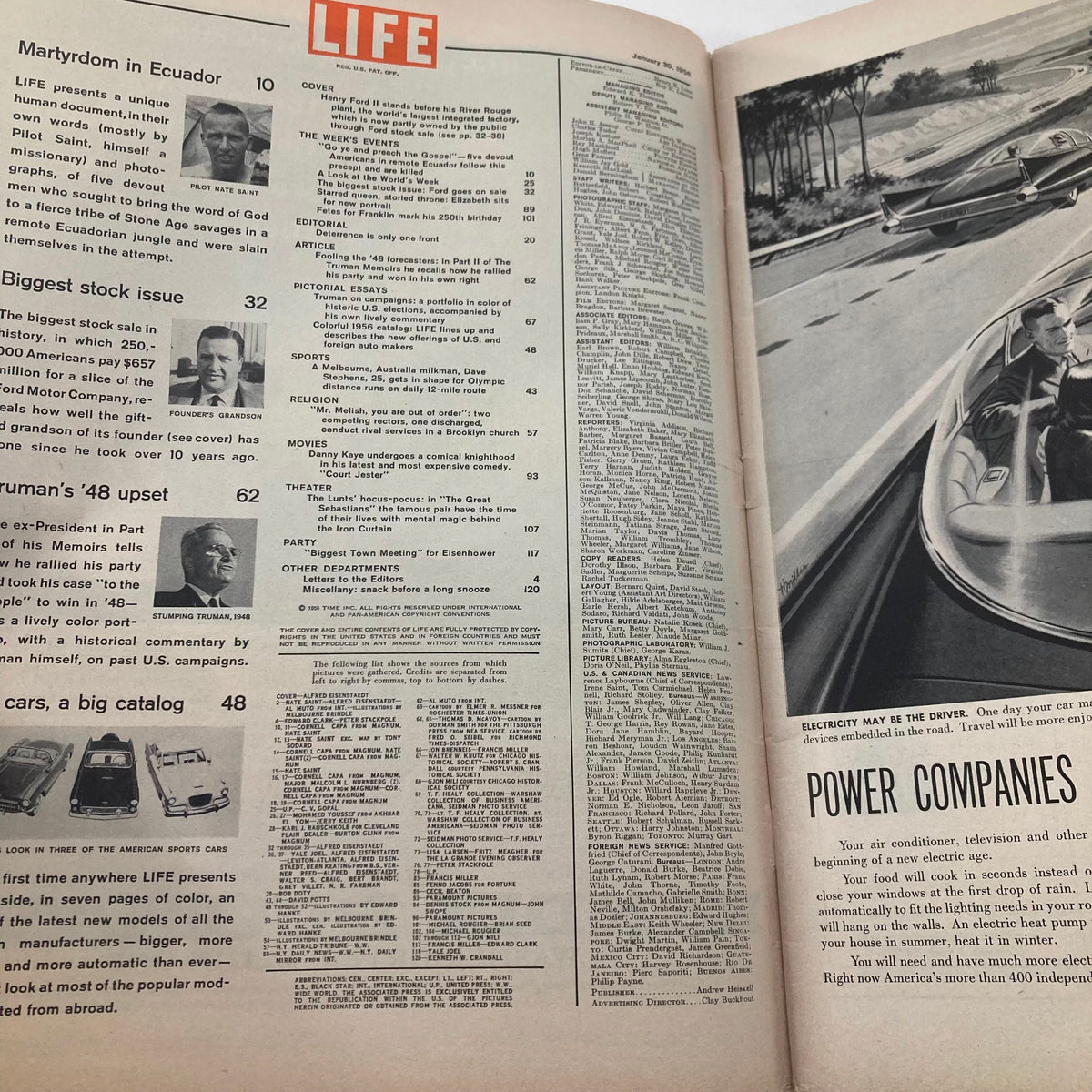
- Ford Motor Company IPO context: Given the issue's January 30 date, editorial coverage almost certainly engaged with the historic public stock offering of January 17, 1956, one of the largest in U.S. history at the time.
- Postwar American industry: Mid-decade issues of Life routinely featured photographic essays on manufacturing, suburban expansion, and consumer culture — the visual vocabulary of 1950s prosperity.
- Note on interior content: Specific article titles and interior features for this issue have not been independently confirmed from the available listing information. The cover subject and date are verified; interior editorial details should be confirmed against a physical examination of the issue.
Condition & Rarity
The listing notes that the address label has been ripped from the front cover — a common attribute of newsstand and subscriber copies that circulated through households in the 1950s. In the collector market, label removal is evaluated carefully: a clean removal with minimal paper loss is generally preferable to an intact label, which tends to obscure cover artwork and often carries personal subscriber information. Ripped removal, as noted here, falls in the middle of that spectrum and should be assessed visually for the extent of surface damage to the cover stock. The presence of a plastic protective covering indicates the issue has been stored with at least some archival intention, which tends to correlate with better page integrity and reduced toning. Any surviving copy of this issue should be evaluated for spine integrity, page completeness, and the degree of cover image preservation around the label removal area — these are the factors that most directly determine collector grade for Life issues of this vintage. Intact 1950s Life covers featuring major industrial figures are not commonly encountered in high-grade condition; most copies of mass-circulation weeklies from this era show wear consistent with active household reading.
Looking for More Issues Like This?
This particular issue is a difficult find given its historical significance — the Ford IPO cover date is one collectors actively seek, and clean copies surface infrequently. If you're building out a Ford family research collection, browsing the full Henry Ford magazine archive is a strong starting point for related covers and features. The broader Life magazine collection offers decades of comparable coverage, and the 1956 issues collection is worth exploring for anyone documenting that pivotal mid-decade year in full.