
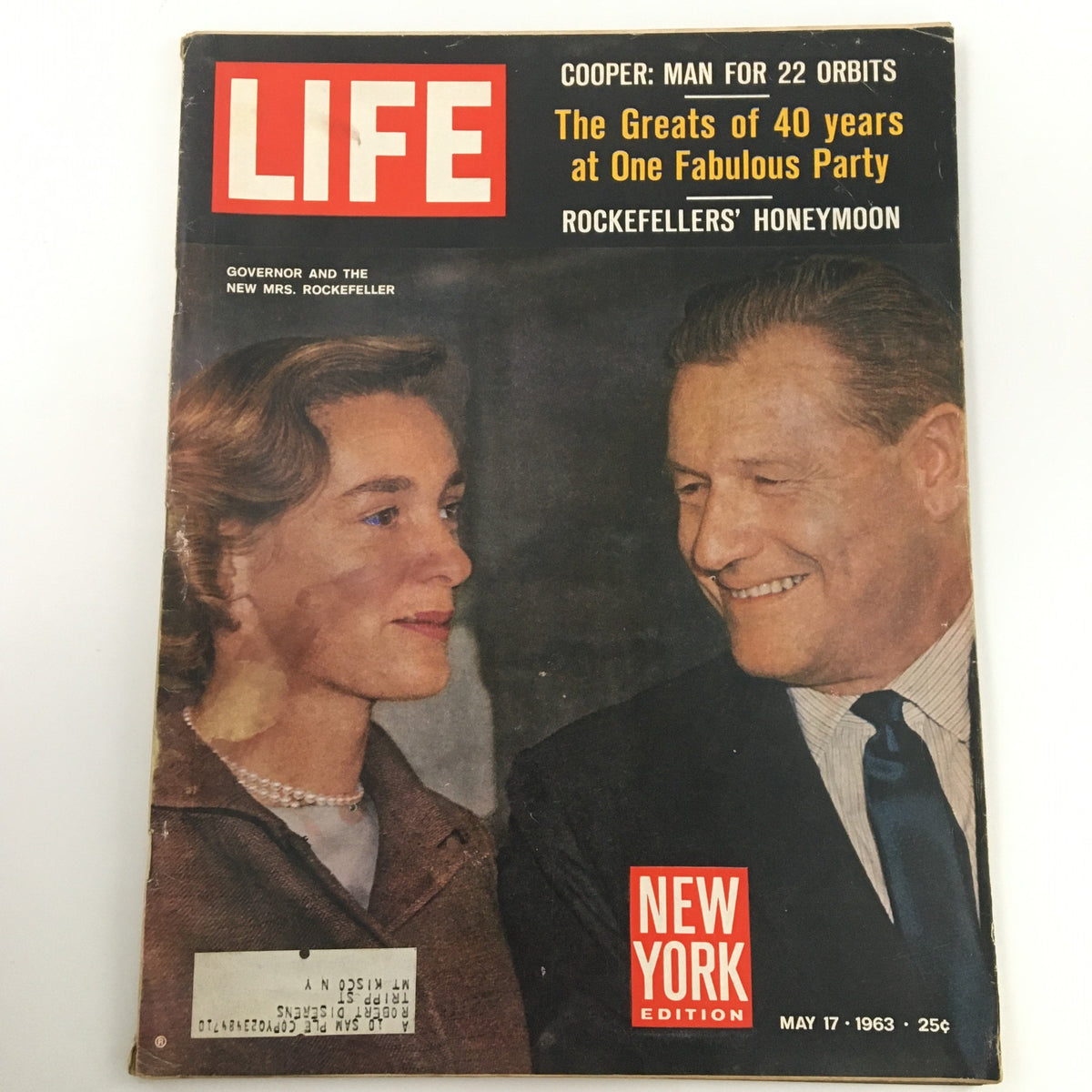


Description
Collector's Note – Why This Issue Matters
The May 17, 1963 issue of Life Magazine featuring Governor Nelson Rockefeller and his new wife Happy Rockefeller on the cover documents one of the most consequential personal and political moments in Nelson Rockefeller's career — and one that would fundamentally alter the trajectory of American presidential politics. Nelson Rockefeller had divorced his first wife Mary in March 1963 and married Margaretta "Happy" Fitler Murphy on May 4, 1963 — just thirteen days before this issue's cover date. The marriage generated enormous controversy: Rockefeller was a leading candidate for the 1964 Republican presidential nomination, and the divorce and remarriage — particularly the fact that Happy had also recently divorced and had children — was used by his conservative opponents, led by Barry Goldwater's faction, to argue that he lacked the moral character required for the presidency. The political fallout was severe. Rockefeller's poll numbers dropped sharply, and the 1964 Republican nomination eventually went to Goldwater. A Life cover featuring the couple in the immediate aftermath of their May 4 wedding was not merely a celebrity portrait — it was a primary document of a political calculation being made in public, as Rockefeller bet that a high-profile, positive presentation of his new marriage could neutralize the controversy. Collectors who follow Nelson Rockefeller magazine appearances across his career will find the spring 1963 issues the most politically charged in his print legacy.
The broader context of May 1963 in American political history amplifies what this cover represents. The Kennedy administration was at its midpoint, and the 1964 presidential race — still eighteen months away — was already generating intense speculation. Rockefeller had been the moderate Republican establishment's preferred alternative to Kennedy, and his path to the nomination had seemed relatively clear before the divorce and remarriage created the political crisis that this Life cover was attempting to manage. The Civil Rights movement was simultaneously building toward its most confrontational summer: Bull Connor's Birmingham campaign was occurring in the same weeks as this issue's publication, and the country was in a state of profound political and social tension. A Life cover on the Rockefellers in this atmosphere documented a specific and revealing intersection of personal life and political calculation at a moment when both were being conducted under intense public scrutiny. For collectors assembling a picture of 1963 through its print culture, this issue captures American political life at one of its most consequential transitional moments.
About the Publication
Life Magazine, relaunched by Henry Luce's Time Inc. in 1936 as a weekly photojournalism publication, had by 1963 maintained for nearly three decades its position as the most widely read and culturally authoritative magazine in the United States, reaching tens of millions of readers per issue. Its cover choices were understood as editorial statements of cultural significance, and its at-cover celebrity and political profiles were among the most carefully constructed journalistic presentations in American print. A May 1963 cover on the newly married Rockefellers was a deliberate, high-profile platform for a politician attempting to manage a political crisis through public presentation — and Life's decision to provide that platform reflects both the magazine's relationship with the establishment and its understanding of how political narratives were constructed and contested in 1963 America.
Key Highlights Inside
- Nelson and Happy Rockefeller cover — thirteen days after their May 4 wedding: The cover documents the newly married couple at the precise moment Rockefeller was attempting to manage the political fallout from his divorce and remarriage, which had severely damaged his standing in the 1964 Republican presidential race.
- Political crisis documented in real time: The May 1963 date places this coverage between the controversial March 1963 divorce and the 1964 Republican primary season that would ultimately deny Rockefeller the nomination — a primary document of the political calculation at its most active stage.
- Broader May 1963 editorial content: As with all Life weekly issues, additional photographic essays and features would have reflected the full cultural and political landscape of mid-May 1963 — including the Civil Rights movement's Birmingham campaign that was occurring simultaneously. Specific additional interior content beyond the Rockefeller cover story is unconfirmed in the listing.
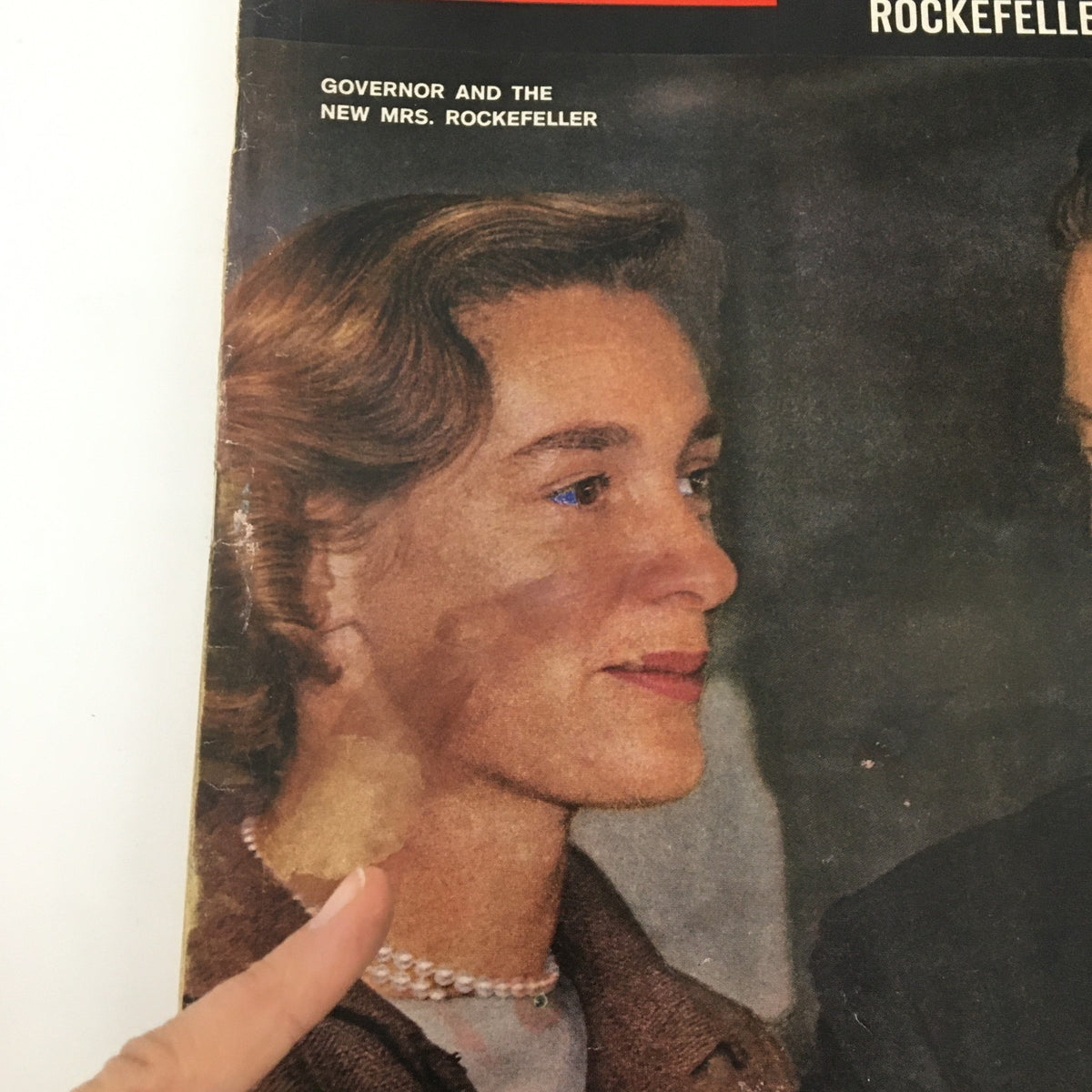
- Address label on front cover: The subscriber label identifies standard provenance for surviving Life copies from this era; its placement relative to the Rockefeller cover imagery is the primary visual condition variable for this issue.
Condition & Rarity
Good used condition with minor edge wear, possible marks and rips, and an address label on the front cover represents an honestly graded subscriber copy of a sixty-year-old weekly magazine. The address label is the standard condition reality for surviving Life issues from this period — the magazine's enormous subscriber base means that clean, label-free newsstand copies are proportionally less common. The label's placement relative to the Rockefeller cover portrait and the extent of any rips or marks should be assessed directly from the provided photographs. The protective plastic covering indicates deliberate subsequent preservation. When evaluating any surviving copy of this issue, cover integrity around the central Rockefeller imagery and label placement are the primary grading considerations, followed by interior page stability and the completeness of any editorial features. Life's coated photographic stock ages well under average conditions, but covers show color shift and surface wear more visibly than interior pages over sixty years.
Looking for More Issues Like This?
Spring 1963 Life covers featuring Nelson Rockefeller at the most politically charged moment of his career are a specific and historically significant category — they document an American political crisis being managed through public presentation in the most powerful print platform of the era. If this issue has already found a home, the dedicated archive of Nelson Rockefeller magazine appearances is the best starting point for collectors tracking his political legacy across the full arc of his career. The full Life Magazine collection covers landmark issues across the publication's remarkable run, and the 1963 magazine archive is worth exploring for anyone building a broader documentary picture of that pivotal year in American political and social history.