




Description
Collector’s Note – Why This Issue Matters
The October 9, 1951 issue of Look Magazine, Volume 15, Number 21, features actress Jane Russell in a vivid color cover portrait. Printed cover text connects Russell with Robert Mitchum and their 1951 motion picture His Kind of Woman, placing the image within a specific moment in her Hollywood career. Russell had become one of the most recognizable screen personalities of the 1940s and early 1950s, and her appearance reflects Look’s close attention to movie stars and popular entertainment. The cover presents her through the polished visual language of mid-century celebrity photography, with carefully arranged clothing, makeup, pose, and color. Smaller panels introduce additional subjects involving General Hoyt S. Vandenberg, Ginger Rogers, and baseball player Ted Williams. This multi-feature layout allowed Look to combine Hollywood glamour with military affairs, beauty guidance, sports, and social reporting on a single cover. As a dated visual artifact, the issue records how entertainment personalities and national concerns were presented together for a broad American readership.
Jane Russell’s cover presence is especially meaningful because it demonstrates how Look used film stars as gateways into a wider editorial package. The issue’s entertainment department includes “The Hollywood Kiss” by producer Jerry Wald and screenwriter Norman Krasna, bringing industry participants directly into its discussion of screen romance and filmmaking conventions. A separate entertainment feature reports on a benefit associated with the Damon Runyon Fund, showing the magazine’s interest in the relationship between celebrity culture and public causes. Russell’s portrait also appears beside fashion and beauty features concerning outerwear, underwear-inspired design, poodle cloth, and suggested hairstyles for Ginger Rogers. These subjects reveal how celebrity images could intersect with contemporary discussions of appearance, clothing, femininity, and personal presentation. The supplied contents do not identify a separate Jane Russell profile, so the cover should not be used as evidence for an unconfirmed interior interview or biographical article. Within an archive of magazines featuring Jane Russell, this edition remains significant for its clear association with her 1951 film work and the visual culture surrounding her public image.
The issue’s documentary importance extends well beyond Hollywood through its substantial mixture of national affairs, foreign policy, science, health, sports, art, fashion, and home living. Senator Estes Kefauver contributes a critique of American peace policy, while General Hoyt S. Vandenberg examines the strategic role of air power in Europe. Other reports address juvenile behavior, public leadership, family health, a child named Freddie, college football, and the selection of an all-star baseball team. The topics reflect a society balancing postwar domestic life with the military and diplomatic demands of the early Cold War. Articles about clothing, hairstyles, tea, modern art, and entertainment preserve a parallel record of consumer interests and everyday cultural habits. Regular departments involving reader letters, photography, commendations, and crime imagery further demonstrate the breadth of the magazine’s picture-oriented format. Considered with other historical Look Magazine issues and the broader collection of magazines published in 1951, this edition offers a layered view of American public life during the opening years of the decade.
About the Publication
Look was a large-format American general-interest magazine founded by Gardner Cowles Jr. and associated with the Cowles publishing organization. It began publication in 1937 and developed into a prominent biweekly picture magazine. Photography and visually organized storytelling formed the foundation of its editorial identity. Its pages combined national affairs, international reporting, entertainment, sports, science, health, fashion, family subjects, and human-interest features. Large photographs were frequently arranged with captions and concise text so that readers could follow stories through both words and images. The magazine’s broad subject range placed movie stars and athletes beside politicians, military leaders, scientists, workers, and ordinary families. Look also became an important platform for photographers whose assignments documented American communities, institutions, social customs, and public figures. By the early 1950s, it competed within a crowded market of illustrated magazines seeking to interpret contemporary life for a mass audience. Its cover layouts often promoted several unrelated stories rather than concentrating exclusively on the central photograph. This method made each cover a compact preview of the entertainment, political, social, and practical material inside. Advertising was another major visual component, preserving period approaches to automobiles, food, fashion, beauty products, household goods, and leisure. Surviving issues now function as primary sources for studying photojournalism, consumer culture, celebrity imagery, graphic design, and the changing social concerns of mid-century America.
Key Highlights Inside
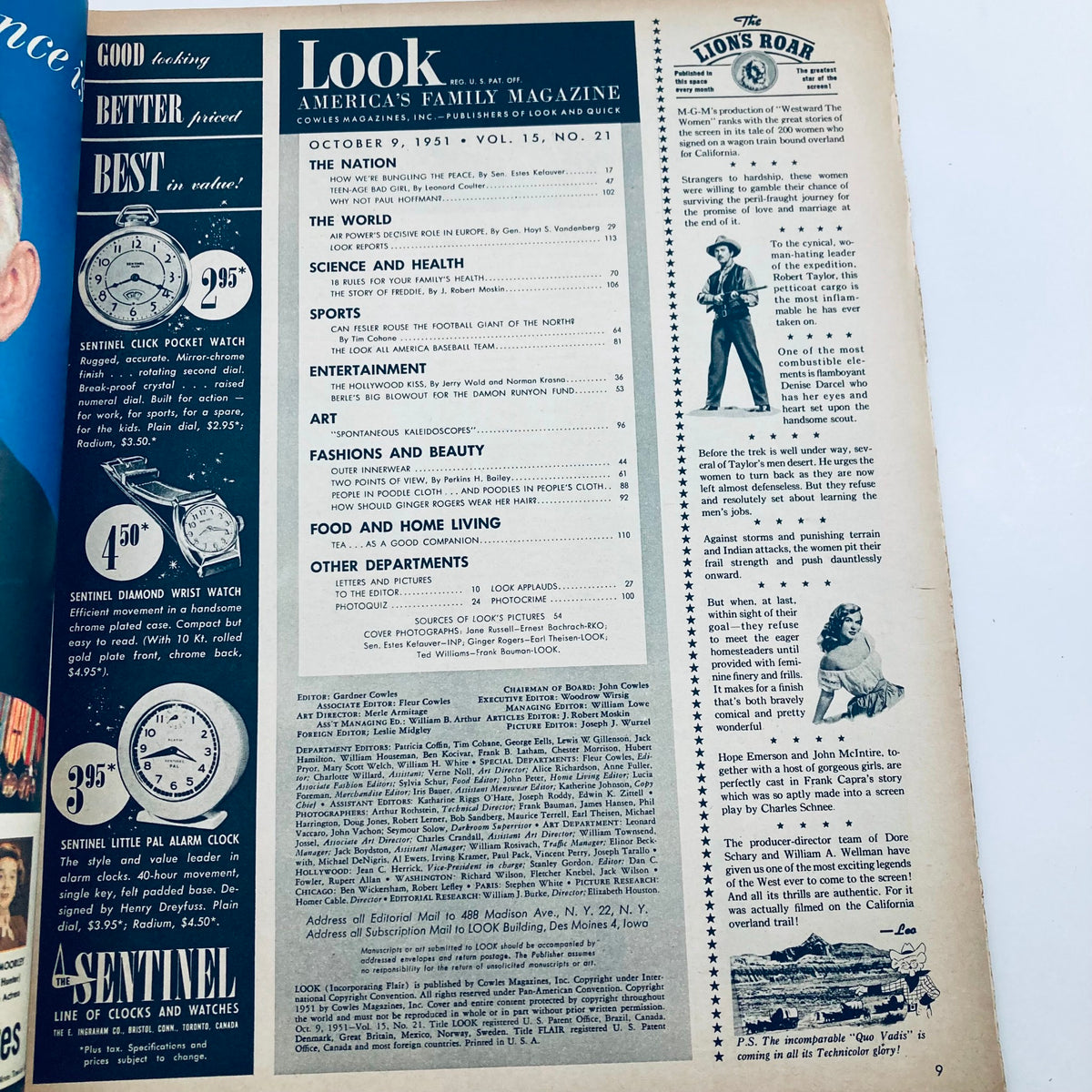
- Jane Russell occupies the principal cover image, with printed text connecting her to Robert Mitchum and the motion picture His Kind of Woman. The presentation captures Russell during an important period of her screen career and demonstrates Look’s reliance on Hollywood personalities as highly visible cover subjects. No separate interior interview with Russell is identified in the supplied table of contents, so one should not be assumed.
- Senator Estes Kefauver contributes “How We’re Bungling the Peace” in the magazine’s national-affairs section. The title indicates a critical examination of American policy during a period shaped by the Korean War, Cold War rivalry, and continuing uncertainty about the postwar international order. The precise policies, countries, and recommendations discussed must be determined from the original article rather than inferred beyond its title.
- Leonard Cottler’s “Teen-Age Bad Girl” addresses a young person whose behavior was considered socially troubling by contemporary standards. The feature can be studied as evidence of how mass-circulation magazines framed juvenile misconduct, family responsibility, and public anxiety about teenagers. Its complete circumstances and conclusions should be taken from the photographed article rather than reconstructed from the provocative headline alone.
- General Hoyt S. Vandenberg writes about “Air Power’s Decisive Role in Europe” in the international section. His contribution places military aviation and European defense among the issue’s most important strategic concerns. The article reflects the period’s intense attention to deterrence, alliance planning, and the role of air forces in any possible confrontation with the Soviet bloc.
- The science and health department presents “18 Rules for Your Family’s Health” and “The Story of Freddie” by J. Robert Moskin. These features bring practical health instruction together with a more personal narrative centered on an individual child. Their pairing reflects Look’s practice of explaining medical and family subjects through both structured advice and human-interest storytelling.
- Sports coverage includes Tim Cohane’s “Can Fesler Rouse the Football Giant of the North?” and the Look All-America Baseball Team. The first feature concerns the challenge facing a prominent football program under coach Wes Fesler, while the second recognizes leading baseball players selected by the magazine. Together, they document the importance of college football and professional baseball within American popular culture in 1951.
- “The Hollywood Kiss” by Jerry Wald and Norman Krasna examines a familiar convention of motion-picture romance from the perspective of established Hollywood filmmakers. The entertainment section also includes a report on a large event benefiting the Damon Runyon Fund. These features connect the movie industry’s storytelling practices with the charitable and public activities surrounding celebrity culture.
- The fashion and beauty department includes “Outer Innerwear,” “Two Points of View” by Perkins H. Bailey, and a feature pairing people in poodle cloth with poodles in clothing inspired by people. Another article considers how Ginger Rogers should wear her hair, making a well-known performer the focus of contemporary beauty advice. These features preserve the playful language, visual experimentation, and celebrity influence found in early-1950s fashion journalism.
- “Tea . . . As a Good Companion” represents the issue’s food and home-living material. The feature places a familiar beverage within the routines of hospitality, relaxation, or household life promoted to the magazine’s readers. Its exact recipes, serving suggestions, and social context remain dependent on the original pages.
- The art feature “Spontaneous Kaleidoscopes” introduces readers to a visual subject presented through the magazine’s image-centered format. Regular departments include Letters and Pictures to the Editor, Photoquiz, Look Applauds, and Photocrime. These recurring sections invited reader participation while combining photography, observation, public recognition, and crime-related visual storytelling.
Condition & Rarity
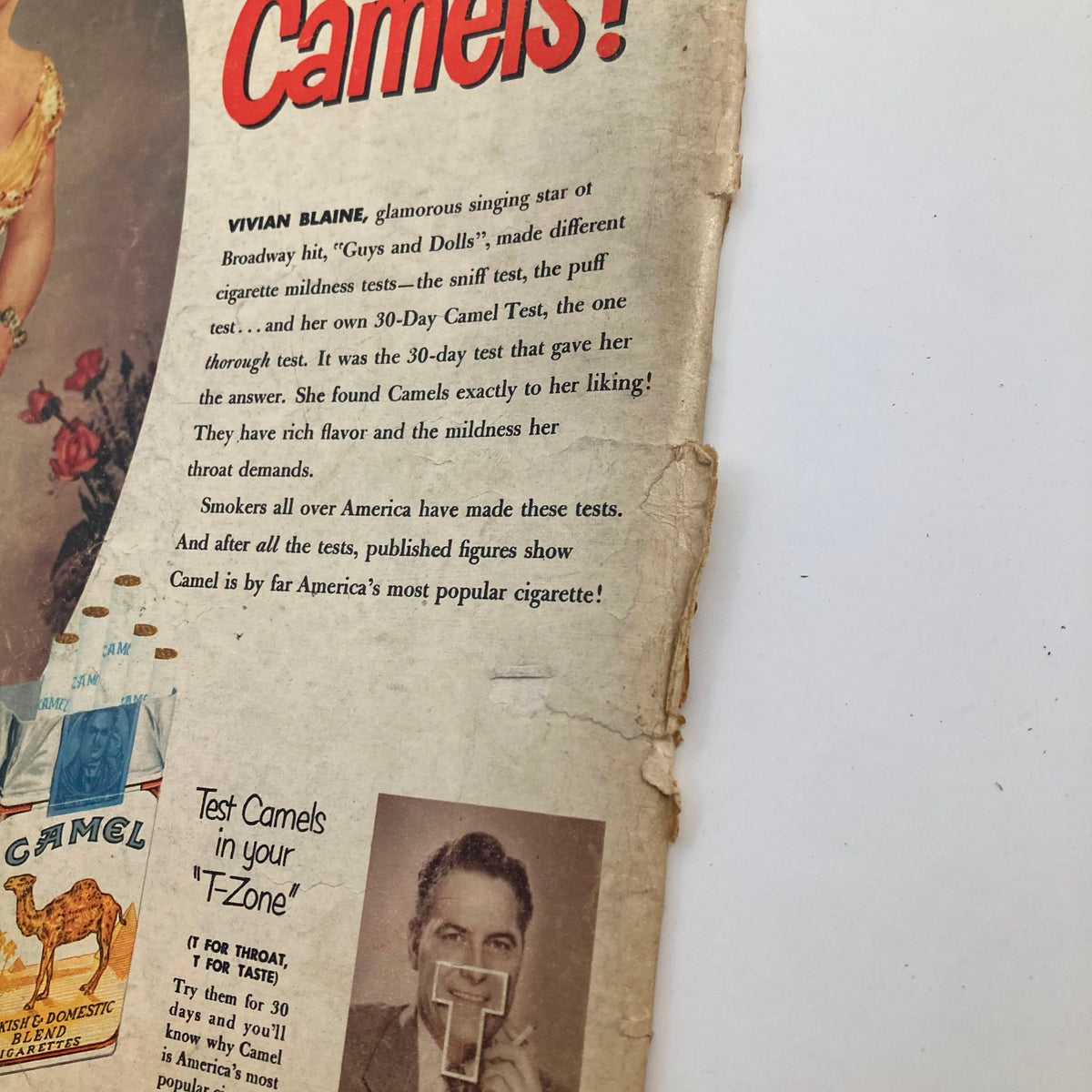
The supplied description does not assign this October 9, 1951 issue a formal numerical or letter grade. Instead, the photographs are identified as the primary reference for evaluating its physical condition. The pictured magazine is described as the same example represented by the original listing rather than a generic image of the date. No specific written defects such as tears, creases, stains, spine separation, clipping, or missing pages are reported. Their absence from the description should not be treated as proof that none are present. The cover is described as having no subscriber mailing label, allowing Jane Russell’s portrait and the surrounding feature panels to remain unobstructed by an address block. A no-label format does not independently establish that the magazine was originally purchased from a newsstand. The issue is also reported to come with a plastic protective covering intended to reduce exposure to dust and unnecessary handling. This covering is a later storage accessory and was not part of the original 1951 publication. Close attention should be given to the cover edges, spine, corners, internal binding, and completeness of the large-format pages when assessing the issue. Look was widely circulated during its publishing life, so historical and collector interest in this date is better connected with the Jane Russell cover, its film association, documented editorial contents, no-label presentation, and actual physical condition than with unsupported claims of extreme rarity.
Looking for More Issues Like This?
Additional cover appearances can be studied through the Jane Russell magazine collection. Comparing her appearances across different publications can reveal how studios, photographers, editors, and designers shaped her image at various stages of her career. Some covers emphasize film promotion, while others may focus more strongly on fashion, personality, or Hollywood glamour. The wider Look Magazine archive provides further examples of the publication’s distinctive combination of photojournalism and general-interest reporting. Consecutive issues can show how Look moved between politics, international affairs, sports, entertainment, science, fashion, and family life. They also allow researchers to compare changing cover layouts, photographic techniques, typography, advertising, and editorial priorities. The 1951 magazine archive offers a broader view of the same historical year through publications created for different readerships. News magazines may emphasize foreign policy and military developments, while entertainment and household titles document movies, clothing, food, consumer products, and domestic expectations. Studying these categories together helps reveal how Cold War concerns existed alongside postwar prosperity and rapidly expanding popular culture. The October 9 Look issue is particularly useful because it places Jane Russell’s Hollywood image beside military strategy, public policy, family health, fashion, art, football, and baseball. Its cover and contents therefore preserve a wide-ranging portrait of American interests during the autumn of 1951.