
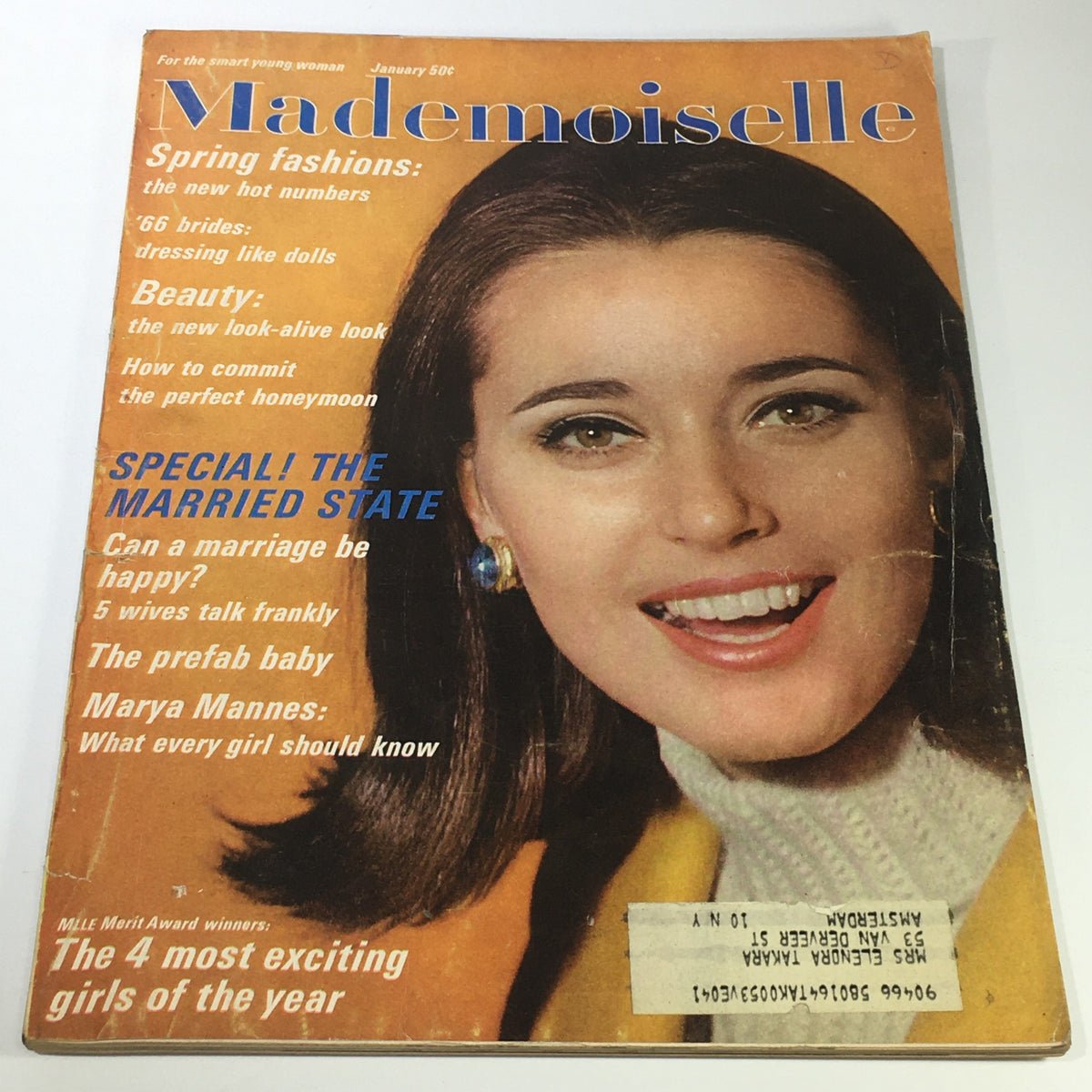

Description
Collector's Note – Why This Issue Matters
January 1966 is a deceptively rich moment to examine through the lens of a women's fashion magazine. The mid-sixties represented the absolute apex of the decade's optimism — the social upheaval that would define 1968 was still two years away, and the cultural energy of the era was expressing itself most visibly through fashion, design, and a new kind of youthful confidence in American public life. A January issue carried a particular editorial charge: it was the year-opening statement, the forward-looking declaration of what the coming seasons would bring, and pairing that with a spring fashion and beauty preview gave this issue a double sense of anticipation and possibility. For collectors interested in how mainstream women's publishing navigated the mid-sixties cultural moment, the 1966 magazine archive provides an invaluable cross-section of how multiple titles were simultaneously processing the same period of rapid change.
The presence of Marya Mannes as a named contributor elevates this issue considerably above the standard fashion monthly. Mannes was one of the most respected and intellectually formidable journalists and essayists working in American media during the postwar decades — a critic, poet, and cultural commentator whose writing for publications including The Reporter, McCall's, and The New York Times was characterized by a sharp, sometimes acerbic intelligence and a willingness to take unpopular positions on social and cultural questions. Her 1964 book But Will It Sell? had established her as a significant voice in American cultural criticism, and her 1968 work on aging and death, Last Rights, would later bring her renewed attention. Finding her byline in a January 1966 issue of Mademoiselle is entirely consistent with the magazine's longstanding practice of publishing serious literary and journalistic voices alongside its fashion content — but it also signals that this particular issue carried editorial ambitions beyond the seasonal fashion preview. The full scope of the magazine's commitment to that balance across its publishing history is visible in the Mademoiselle magazine collection, which documents how consistently the title pursued that dual identity.
The spring fashion and beauty content in a mid-sixties Mademoiselle is itself a primary document of considerable visual and historical interest. By January 1966, the mod aesthetic that had originated in London was fully integrated into American mainstream fashion, hemlines were actively rising, and the color and graphic sensibility of the era was at its most confident and distinctive. A spring preview published in this context was not simply a shopping guide — it was a declaration of where the culture was pointing, expressed through clothes, photography, and the particular visual language that mid-sixties fashion magazines had developed to speak to a young, educated, style-conscious audience. These pages are among the most studied by fashion historians and designers working to understand the period, and surviving copies of issues from this season in good condition are correspondingly valued.
About the Publication
Mademoiselle was a Condé Nast publication founded in 1935 and directed at young, educated American women — college students, recent graduates, and young urban professionals navigating fashion, careers, and an increasingly complex social landscape. Its editorial formula distinguished it from competitors through a sustained commitment to literary and journalistic quality alongside its fashion and beauty content, publishing significant early or notable work from writers including Sylvia Plath, Truman Capote, Joyce Carol Oates, and Cynthia Ozick over the course of its run. By January 1966 the magazine was three decades into its publishing history and had long since established itself as the thinking woman's fashion magazine — a title that took its readers seriously as intellectuals and cultural participants, not merely as consumers of style. Its mid-sixties issues are among the most actively collected, reflecting both the visual richness of the era's fashion photography and the editorial seriousness that set Mademoiselle apart within the crowded women's magazine market of the period.
Key Highlights Inside
- Articles by Marya Mannes — contributions from one of the most respected cultural critics and essayists in mid-century American journalism, whose presence in a fashion magazine reflects Mademoiselle's consistent editorial ambition to engage its readers on questions beyond style and beauty.
- Spring Fashion and Beauty preview — a visual and editorial document of where American women's fashion was pointing in early 1966, at the height of the mod era and amid one of the most photographically distinctive periods in twentieth-century fashion history.
- Editorial content consistent with Mademoiselle's January format — the year-opening issue typically combined forward-looking fashion and beauty coverage with cultural and lifestyle features aimed at the college-educated young woman navigating mid-sixties American life.
- Note: Specific additional article titles, fiction contributors, and further interior features beyond those named in the listing have not been confirmed from available sources. The highlights above reflect what is documented in the listing and Mademoiselle's well-established editorial format for this period.
Condition & Rarity
Surviving copies of the January 1966 issue show the characteristic condition profile of a subscription-origin periodical that has passed through six decades without archival preservation. Minor edge wear, small rips or marks, and the presence of an address label on the front cover are all expected and honest attributes of an original, unrestored magazine from this vintage. The address label is worth noting specifically in collector evaluation: subscription copies were mailed directly to readers and carry the label as a permanent feature, which distinguishes them from newsstand copies that were sold without labeling. For display purposes, the label partially obscures the original cover design, which is why label-free newsstand copies of the same issue tend to command a premium in the collector market. The label's presence here does not diminish the magazine's value as an artifact or research document — it simply marks it as a different category of surviving copy. The protective plastic sleeve on preserved copies is the appropriate conservation measure for a magazine of this age and paper stock, preventing further deterioration from handling and environmental exposure without altering the original item.
Looking for More Issues Like This?
Mid-sixties issues of Mademoiselle with notable contributor bylines are among the more rewarding finds in the magazine's long run, and January issues with their year-opening editorial ambition tend to be particularly substantial. If this specific issue is no longer available, the full Mademoiselle magazine collection at OriginalMagazines.com is the most comprehensive source for exploring other issues across the title's publishing history, with strong representation in the sixties decades that collectors and fashion researchers prize most. For anyone assembling a broader picture of the mid-sixties cultural moment across multiple titles, the complete 1966 magazine archive brings together fashion, news, culture, and lifestyle publications from a year that sits at the creative and social peak of one of the most visually distinctive decades in American history.