
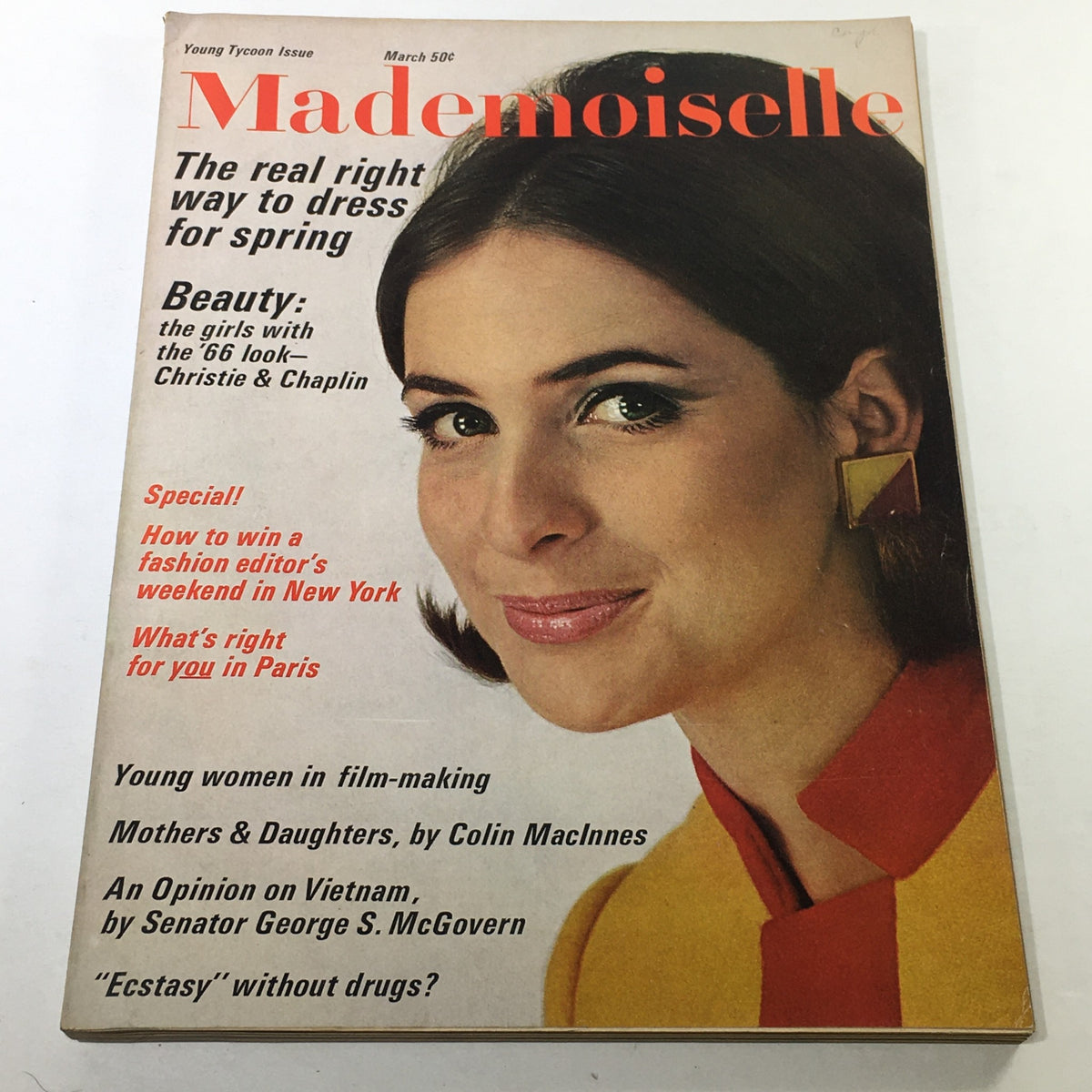

Description
Collector's Note – Why This Issue Matters
March 1966 is one of the most visually and culturally charged dates in the history of American fashion magazine publishing, and a spring Mademoiselle from this specific month captures the decade's aesthetic revolution at the precise moment of its maximum energy and confidence. By the spring of 1966, the mod revolution that had originated in London had fully crossed the Atlantic and was transforming American mainstream fashion with a speed and completeness that had no precedent in the postwar period. Hemlines were rising dramatically, the geometric and graphic design sensibility of the era was at its most boldly expressed, and the color palette and photographic vocabulary of fashion imagery were undergoing the transformation that would make mid-sixties fashion photography among the most immediately recognizable and widely studied visual material of the twentieth century. A March spring issue of Mademoiselle in 1966 was the seasonal statement of a magazine whose editorial identity was perfectly aligned with its readership's position at the center of all these changes — young, college-educated, fashion-conscious, and living through a cultural moment that was reshaping every assumption about how women should look, dress, and present themselves. The full arc of the magazine's engagement with the decade's aesthetic revolution is traceable across the Mademoiselle magazine collection, which allows collectors to follow that visual and editorial evolution year by year through the sixties.
The cover model identified as "Christy" places this issue within a specific and interesting category of mid-sixties fashion magazine documentation. Without additional identifying information — last name, agency, or biographical detail — the listing's cover designation as simply "Christy" reflects how major fashion models of the period were often known by a single name, particularly those whose look was distinctive enough to be recognized without further identification by the magazine's regular readership. Mid-sixties Mademoiselle covers consistently featured models whose specific visual qualities embodied the decade's evolving beauty standards — the shift from the early-sixties ideal toward something more angular, more dramatic, and more explicitly associated with the London-influenced mod aesthetic that was dominating fashion photography by 1966. Collectors and researchers working to identify specific models from this period will find that the cover photograph itself is the primary source, and the label-free newsstand origin of this issue ensures that cover image is fully intact and undisturbed, exactly as it was designed to be seen on a spring 1966 newsstand. For collectors building a broader archive of this pivotal year, the 1966 magazine collection provides cross-title context for the larger visual and cultural conversation that this issue was part of.
March 1966 was also a moment of significant cultural transition beyond the fashion world — the civil rights movement was entering a new and more contested phase, the antiwar movement was building toward its first major escalations, and the women's liberation movement was coalescing in ways that would make 1966 a pivotal year in its institutional history. The young, college-educated women reading a spring Mademoiselle in March 1966 were navigating all of that alongside the fashion revolution, and the magazine's editorial choices — what to address, what to celebrate, what to show them about the world they were inhabiting — make a spring 1966 issue a richer historical document than its surface content alone would suggest. The gap between the aspirational world of spring fashion and the turbulent reality of mid-sixties America is one of the defining tensions that makes sixties women's magazine collecting so historically rewarding.
About the Publication
Mademoiselle was a Condé Nast publication founded in 1935 and directed consistently at young, educated American women — college students, recent graduates, and young urban professionals for whom fashion was one dimension of a broader, intellectually engaged life. Its editorial identity distinguished it from competitors through a sustained commitment to literary quality alongside fashion and beauty content, with a publishing history that included notable early or significant work from writers including Sylvia Plath, Truman Capote, Joyce Carol Oates, and Cynthia Ozick. By March 1966 it was thirty-one years into its publishing history and navigating the most aesthetically and culturally dynamic period of its mid-century run with the confidence of a publication whose editorial voice was particularly well-aligned with its readership's moment. Its mid-sixties issues are among the most actively collected in its entire run, valued both for their extraordinary visual richness and for their record of how a serious women's magazine was speaking to women at one of the most consequential moments in twentieth-century American cultural history.
Key Highlights Inside
- "Christy" spring 1966 cover — a primary document of mid-sixties fashion magazine cover aesthetics at the height of the mod revolution's impact on American fashion photography, the model's specific visual qualities and the cover's graphic design embodying the aesthetic values that made 1966 one of the most visually distinctive seasons in the decade's fashion history, preserved in label-free newsstand condition exactly as designed.
- Spring 1966 fashion editorial content — the silhouettes, hemlines, colors, fabrics, and styling approaches that defined the mid-sixties aesthetic at its most boldly expressed and confidently realized, capturing the precise moment when the mod revolution had fully transformed American mainstream fashion and the decade's visual language was at its most inventive and energetic.
- Beauty content consistent with Mademoiselle's March 1966 spring format — the hair, makeup, and beauty directions that reflected the mid-sixties transformation of beauty standards, from the graphic eye makeup and pale lips of the mod aesthetic to the Vidal Sassoon-influenced geometric haircut sensibility that was beginning to cross from London to American mainstream consciousness.
- Period advertising pages representing the fashion, beauty, and lifestyle brands marketing to young American women in the spring of 1966 — a cross-section of mid-sixties consumer culture at the height of the decade's creative energy that functions today as its own primary document alongside the editorial content it surrounded.
- Note: Specific article titles, bylines, fiction contributors, and additional named interior features beyond those indicated in the listing have not been confirmed from available sources. The highlights above reflect what is documented in the listing and Mademoiselle's well-established editorial format for this period.
Condition & Rarity
Surviving copies of the March 1966 Mademoiselle display the characteristic condition profile of a newsstand-origin periodical that has passed through six decades without institutional preservation. Edge and binding wear, marks, and rips are expected and honest attributes of an original, unrestored magazine from this vintage — they identify an authentic artifact rather than a reproduction, and experienced collectors evaluate them as the natural patina of nearly sixty years of existence rather than as disqualifying defects. The absence of a subscriber address label is a genuine positive in collector evaluation: the "Christy" cover image survives fully intact as designed and printed, without the adhesive marks or obscured photography that subscription labels permanently introduce — a particularly meaningful distinction for a cover where the model's visual presence and the graphic design of the spring 1966 issue are primary reasons for collecting. The protective plastic sleeve on preserved copies is the correct conservation measure for a magazine of this age and paper stock, stabilizing further deterioration from handling and environmental exposure without requiring any alteration to the original item.
Looking for More Issues Like This?
A no-label newsstand copy of Mademoiselle's March 1966 spring issue in good condition is the kind of mid-sixties fashion document that serious collectors of the decade's visual culture recognize and seek out — the combination of label-free cover integrity, spring fashion content at the height of the mod revolution, and the specific historical weight of March 1966 makes it a more substantial find than its surface appearance might initially suggest. If this particular issue is no longer available, the full Mademoiselle magazine collection at OriginalMagazines.com is the most comprehensive source for exploring other issues across the title's long publishing history, with strong representation in the sixties decades that collectors and fashion researchers prioritize most highly. For anyone building a broader archive of the mid-sixties cultural moment, the complete 1966 magazine collection brings together fashion, culture, news, and lifestyle titles from one of the most visually and culturally distinctive years of the twentieth century.