



Description
Collector's Note – Why This Issue Matters
June 23, 1986 lands at one of the most charged moments in the modern history of American organized crime. Just months earlier, in March 1986, Paul Castellano's successor at the head of the Gambino crime family had consolidated his position following the notorious December 1985 assassination outside Sparks Steak House in Midtown Manhattan — a brazen public killing that announced a new chapter in New York mob history. By the summer of 1986, John Gotti was not yet the "Teflon Don" of tabloid legend, but he was rapidly becoming a figure of intense public fascination: flamboyant, media-savvy, and apparently untouchable in a city that had grown accustomed to believing organized crime operated in the shadows. New York Magazine putting Gotti on its cover in June 1986 was a cultural event as much as a journalistic one — it marked the moment mainstream print media acknowledged that this particular figure had crossed from criminal record into cultural phenomenon.
The timing of this cover story also intersects with a broader civic moment in New York City. The mid-1980s were years of intense federal pressure on the Five Families — the Mafia Commission Trial, prosecuted under RICO statutes, was underway in 1986 and would result in landmark convictions that autumn. Gotti was operating against that backdrop, simultaneously under scrutiny and ascending. A John Gotti magazine cover from this precise window — before his first federal acquittal in 1987, before the "Teflon Don" nickname fully calcified — documents a man whose mythology was still being written in real time. That is exactly the kind of historical specificity serious collectors look for.
For anyone building an archive of New York Magazine's coverage of the city's defining personalities and crises, this issue belongs in a category with the publication's most significant cultural journalism. And within the broader landscape of American magazines from 1986, it stands out as a document of a New York that was simultaneously glamorous, dangerous, and utterly riveting to the rest of the country.
About the Publication
New York Magazine was founded in 1968 by editor Clay Felker and illustrator Milton Glaser, emerging initially as a standalone publication after its origins as a supplement to the New York Herald Tribune. By the mid-1980s it had established itself as the essential chronicle of New York City life — ambitious, stylish, and willing to pursue serious journalism alongside its coverage of culture, politics, food, and fashion. Its readership was urban, educated, and broadly professional, and its long-form feature journalism on crime, power, and city politics earned it a reputation well beyond the five boroughs. The magazine's willingness to profile figures like Gotti with depth rather than sensationalism set it apart from tabloid contemporaries covering the same territory.
Key Highlights Inside
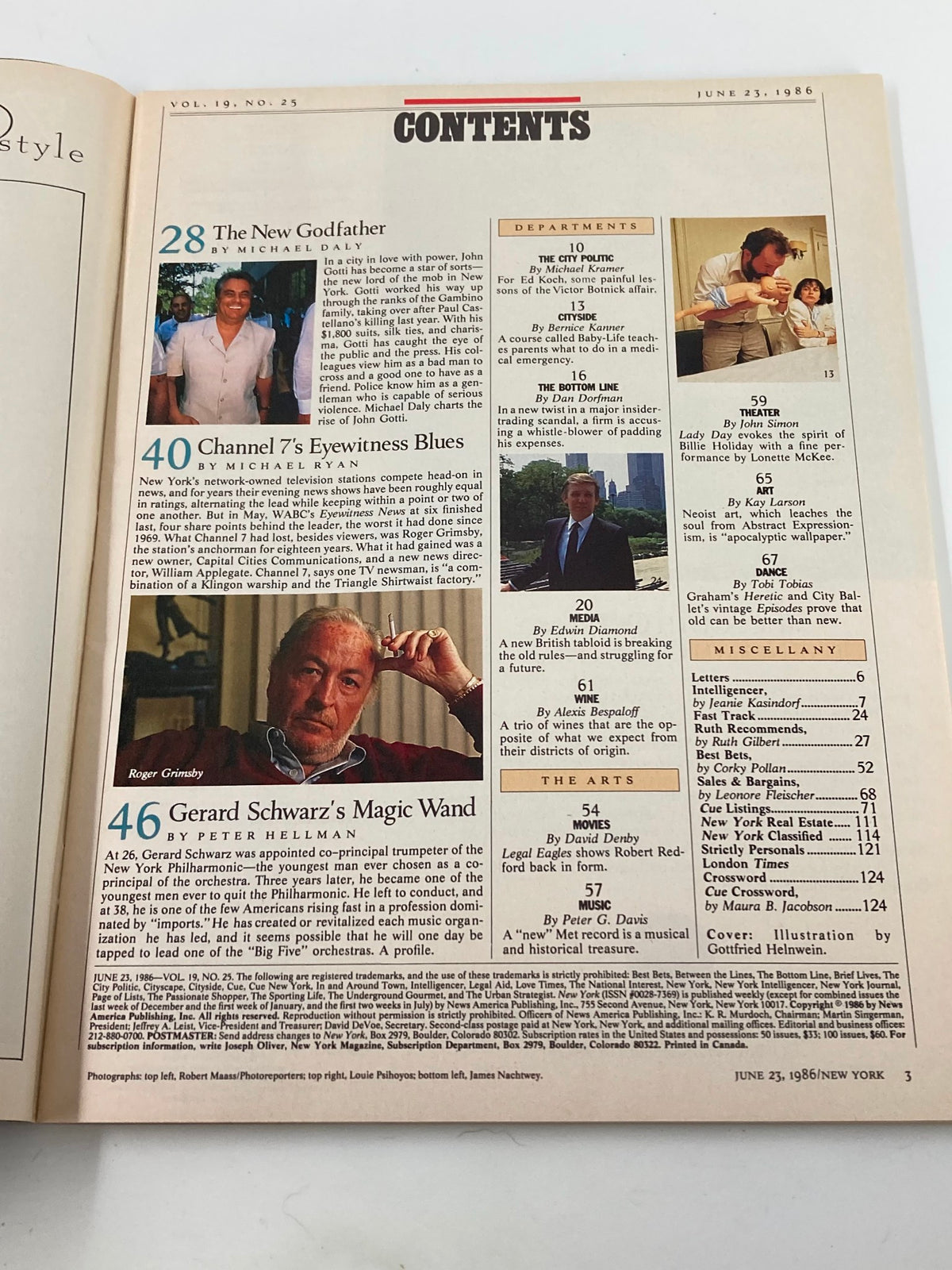
- Cover story on the rise of John Gotti: The listing confirms in-depth coverage of Gotti and the Gambino family's influence in New York — a primary journalistic account written at the moment of his ascent, before the full mythology had been cemented by subsequent trials and acquittals.
- Organized crime in context: The feature would have been researched and published concurrent with the federal Mafia Commission Trial of 1985–86, giving any reporting on Gotti's position an unusually urgent and legally charged backdrop.
- Photography and visual journalism: The listing notes rich visuals and photography typical of the magazine's production values — New York Magazine in this period was known for high-quality photojournalism that treated its subjects with genuine visual seriousness.
- Additional editorial content: Specific articles beyond the Gotti cover story are unconfirmed for this issue, but a standard mid-1986 edition would have included the magazine's characteristic mix of city politics, culture, dining, and arts coverage.
Condition & Rarity
A Very Good grade on a 1986 newsstand magazine carries specific meaning in the collector market. Issues from this era are vulnerable to the standard degradation patterns of coated-stock periodicals approaching their fourth decade: spine rolling from improper storage, moisture-induced waviness, subscription label adhesion damage, and the slow toning of interior pages. The absence of a mailing label — confirmed in the listing — is a meaningful condition attribute, as label removal frequently damages cover stock and obscures artwork. The presence of a plastic protective covering indicates the issue has been stored with collector intent at some point in its history, which correlates with above-average preservation outcomes. When evaluating surviving copies of this issue, the priorities are cover surface integrity around the Gotti imagery, spine tightness, and the absence of any moisture or storage damage to interior pages. Light edge wear consistent with age, without structural compromise, is the expected profile of a well-preserved newsstand copy from this period.
Looking for More Issues Like This?
A label-free, protected copy of this specific Gotti cover in Very Good condition is not something that resurfaces often — it sits at the intersection of true-crime collectibles, New York City history, and 1980s cultural journalism, which gives it appeal well beyond single-subject collectors. If this issue is no longer available, the John Gotti magazine collection at OriginalMagazines.com is the logical next stop, and the full New York Magazine archive spans decades of the city's most consequential cover stories. For collectors focused on the period more broadly, the 1986 magazine collection offers a rich cross-section of American print culture from one of the decade's most eventful years.