
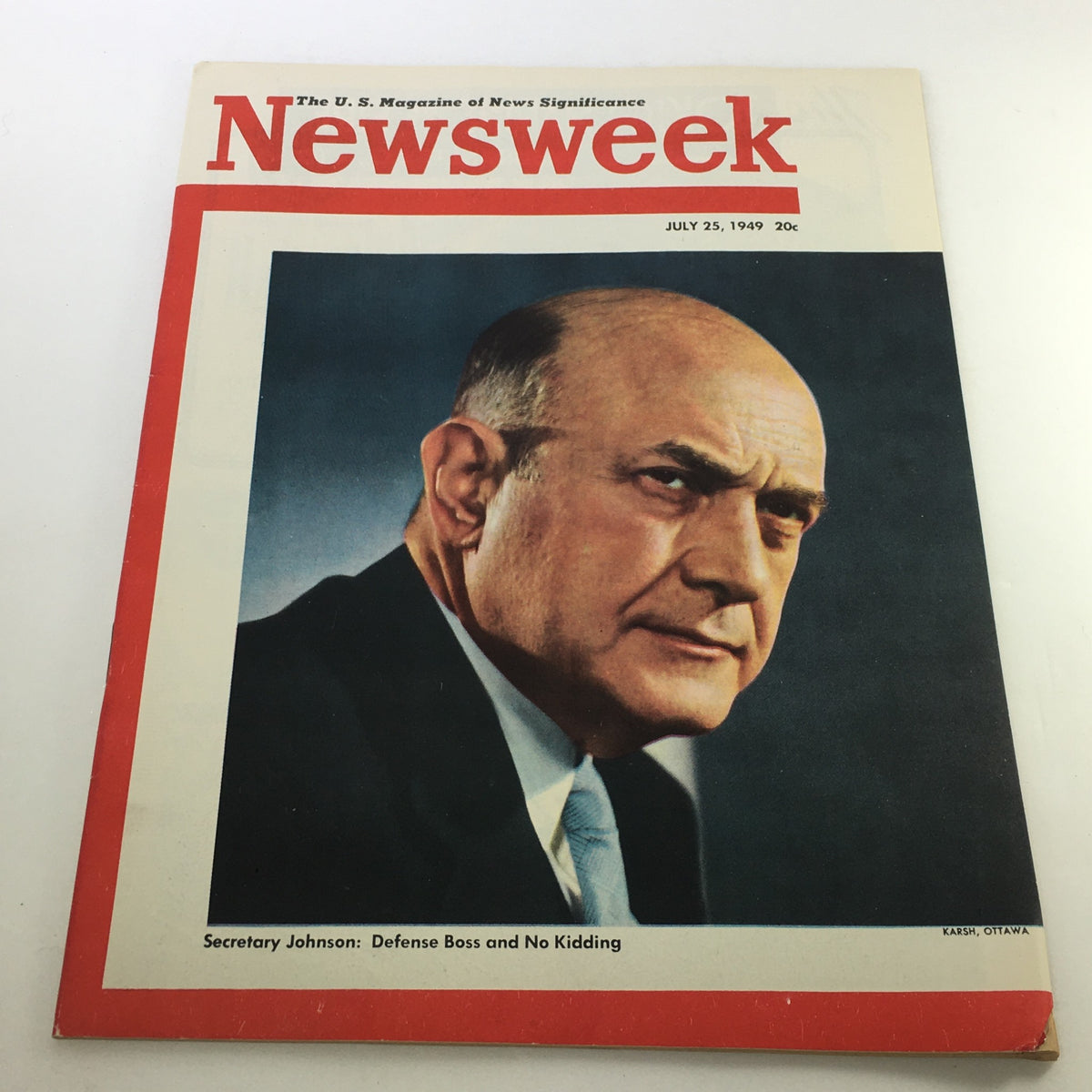

Description
Collector's Note – Why This Issue Matters
The July 25, 1949 issue of Newsweek featuring Louis A. Johnson on the cover is a primary document of one of the most consequential and historically fascinating figures in the early history of American national security policy — and its publication date places it at an extraordinarily specific and consequential moment in Johnson's brief, turbulent, and historically important tenure as Secretary of Defense. Louis Johnson had been appointed by President Truman as the nation's second Secretary of Defense in March 1949, succeeding the first holder of that office, James Forrestal, who had resigned in a state of physical and mental collapse. Johnson arrived in the newly unified Pentagon with a clear and controversial mandate: to cut military spending dramatically, implement the economies that Truman believed the postwar defense budget demanded, and enforce the unification of the military services that the National Security Act of 1947 had mandated but that interservice rivalry was actively resisting. By July 1949, just four months into his tenure, Johnson had already become one of the most controversial figures in Washington — his aggressive budget cutting, his abrasive personal style, and his cancellation of the Navy's supercarrier USS United States had triggered what became known as the "Revolt of the Admirals," one of the most dramatic instances of military-civilian conflict in American history. A Newsweek cover on Louis Johnson in late July 1949 captures him at the precise center of that controversy, when the fight over American military strategy and resource allocation was generating the kind of Washington drama that brought a man to the cover of the nation's most authoritative newsweekly. For collectors building around vintage Newsweek issues focused on Cold War defense history and American national security policy, this cover is a primary document of one of the most consequential and contentious episodes in the early history of the American military establishment.
The specific historical significance of Louis Johnson and the controversies surrounding him in July 1949 rewards careful attention from collectors who understand the full arc of early Cold War defense policy. Johnson's cancellation of the United States supercarrier in April 1949 — just weeks after taking office — had been a thunderbolt in the defense establishment, reflecting his belief that airpower and nuclear weapons had made the large surface navy obsolete and that resources should be concentrated on the Air Force's strategic bombing capability. The Navy's response — which included the unauthorized leak of documents and the eventual congressional testimony of senior admirals against their civilian superiors — was unprecedented in the history of the American military and raised fundamental questions about civilian control of the armed forces that the Truman administration took with the utmost seriousness. This drama was playing out in the weeks immediately surrounding the July 25 publication date of this Newsweek issue, giving the cover story an immediate political context that would have been vivid and urgent to its original readers. The irony of Johnson's tenure — that the dramatic budget cuts he implemented in 1949 would be reversed virtually overnight when North Korea invaded South Korea in June 1950, less than a year after this Newsweek cover appeared — gives this issue a retrospective significance that collectors of Cold War defense history will immediately recognize. For collectors focused on magazines from 1949, this issue documents the American defense establishment at one of its most fraught and historically consequential early Cold War moments.
Louis Johnson's personal biography adds a further layer of historical interest that collectors who research the period will find resonant. He was a West Virginia lawyer and politician who had served as Assistant Secretary of War under Roosevelt and had been a major Democratic Party fundraiser — it was widely understood in Washington that his appointment as Secretary of Defense was partly a reward for his fund-raising role in Truman's 1948 election campaign, a perception that contributed to the skepticism with which some military professionals viewed his authority. His tenure ended in September 1950, when Truman dismissed him — largely as a consequence of the unpreparedness of American forces at the outbreak of the Korean War, which was seen as a direct consequence of the budget cuts Johnson had implemented. He was replaced by General George Marshall, one of the most respected figures in American public life. The arc of Johnson's defense tenure — aggressive, controversial, ultimately discredited — gives a July 1949 Newsweek cover an interesting position in the timeline: it captures him at the height of his authority and the center of the controversy, before the Korean War's outbreak would reveal the consequences of the policies he had championed.
About the Publication
Newsweek was founded in 1933 and had established itself by the late 1940s as one of the two or three most authoritative and widely read news magazines in the United States, competing directly with Time for the allegiance of the educated, civically engaged American readership that consumed weekly news analysis as a matter of regular civic habit. Its editorial format organized the week's news into clearly defined sections covering national and international affairs, business, science, medicine, and culture, written with the assumption that its readers were intelligent adults who wanted both information and interpretation. Its cover choices were deliberate editorial statements about what mattered in American public life at a given moment, and a cover devoted to Louis Johnson in late July 1949 — at the height of the Revolt of the Admirals controversy — reflects the editorial judgment that this defense policy drama was one of the most consequential and revealing stories in American political life at that specific moment. The magazine's coverage of defense policy and national security during the early Cold War was consistently substantive and analytically rigorous, reflecting an editorial staff that understood the stakes of America's military organization as the Cold War hardened.
Key Highlights Inside
- Louis Johnson cover feature — Secretary of Defense at the center of the Revolt of the Admirals controversy: A Newsweek cover story on Johnson in July 1949 would almost certainly have engaged with the drama surrounding his tenure — the cancellation of the United States supercarrier, the Navy's unprecedented resistance to civilian authority, and the fundamental questions about American military strategy and resource allocation that his budget-cutting agenda had placed at the center of Washington political discourse.
- Early Cold War defense policy and interservice rivalry: The specific controversy surrounding Johnson in July 1949 — the fight between the Air Force's strategic bombing doctrine and the Navy's carrier aviation advocates, played out in the context of dramatic budget cuts and the looming question of how to defend the West against Soviet power — was one of the defining institutional dramas of the early American national security state, and a Newsweek cover story at this moment would have engaged those strategic and institutional questions with the analytical depth the subject demanded.
- Truman administration defense and national security coverage: A late July 1949 Newsweek would have included the broader context of Truman's national security policy — the Berlin Airlift's conclusion in May, the NATO alliance's recent formation in April, the Soviet atomic bomb test still two months away — within which the Johnson defense controversy was unfolding, providing the full strategic landscape that gave the interservice rivalry its Cold War urgency.
- Late-1949 American political and domestic affairs: The domestic political landscape of late July 1949 — the Fair Deal's legislative progress, the first full year of Truman's elected term, and the specific political dynamics of a Washington still processing the extraordinary 1948 election upset — would have provided the broader context within which the defense controversy was situated and understood by the magazine's readership.
- Note: Specific interior articles, column subjects, named contributors, and individual features beyond the Louis Johnson cover story have not been confirmed from available listing details. The above reflects what is verifiable from the cover subject, publication date, and the well-documented career of Louis Johnson and the news environment of Newsweek in July 1949.
Condition & Rarity
A seventy-six-year-old weekly newsmagazine surviving in newsstand condition without a mailing label is a meaningful archival result, and the condition attributes described — edge and binding marks and rips — place this issue in the honest range that collectors of late-1940s newsweeklies understand and accept as the authentic marks of survival across more than seven decades. Newsweek in July 1949 was printed on standard newsweekly paper stock — not archival quality, produced to be read and in the overwhelming majority of cases discarded within weeks of purchase — which means that copies surviving in any collectible condition represent a genuinely small fraction of the original print run. The newsstand origin with no mailing label is the most significant positive condition attribute for any surviving copy of this issue. Subscriber copies of Newsweek from 1949 were mailed directly to readers and frequently sustained permanent label adhesive damage to the cover that detracts substantially from both visual presentation and collector appeal. A clean, label-free newsstand copy preserves the full visual integrity of the Louis Johnson cover portrait — the primary collectible draw for this issue — without the permanent disfigurement that label damage causes. Edge and binding wear in a publication of this age are honest marks of survival rather than meaningful disqualifications, and the protective plastic covering provides the appropriate preservation format going forward, stabilizing the issue against further deterioration and environmental exposure.
Looking for More Issues Like This?
A July 1949 Newsweek with Louis Johnson on the cover — documenting the Secretary of Defense at the center of one of the most dramatic controversies in the early history of the American national security establishment, in label-free newsstand condition — is a primary document that appeals to Cold War defense history collectors, early national security policy specialists, and serious Newsweek cover enthusiasts simultaneously, making it sought after across a broader collector market than most single-subject newsweekly covers from this period. If this particular issue has already been claimed, the broader Newsweek collection at OriginalMagazines.com spans the magazine's long run and regularly surfaces issues from the late 1940s that document the early Cold War's most consequential institutional and political developments — the formation of the national security state, the NATO alliance, the Truman administration's foreign policy, and the full density of historically significant events that made 1949 one of the most consequential years of the entire postwar period. Collectors with a specific focus on 1949 will find the 1949 magazine archive an exceptionally rich source of primary material from a year whose documents reward serious collector attention in proportion to the extraordinary significance of what they record.