
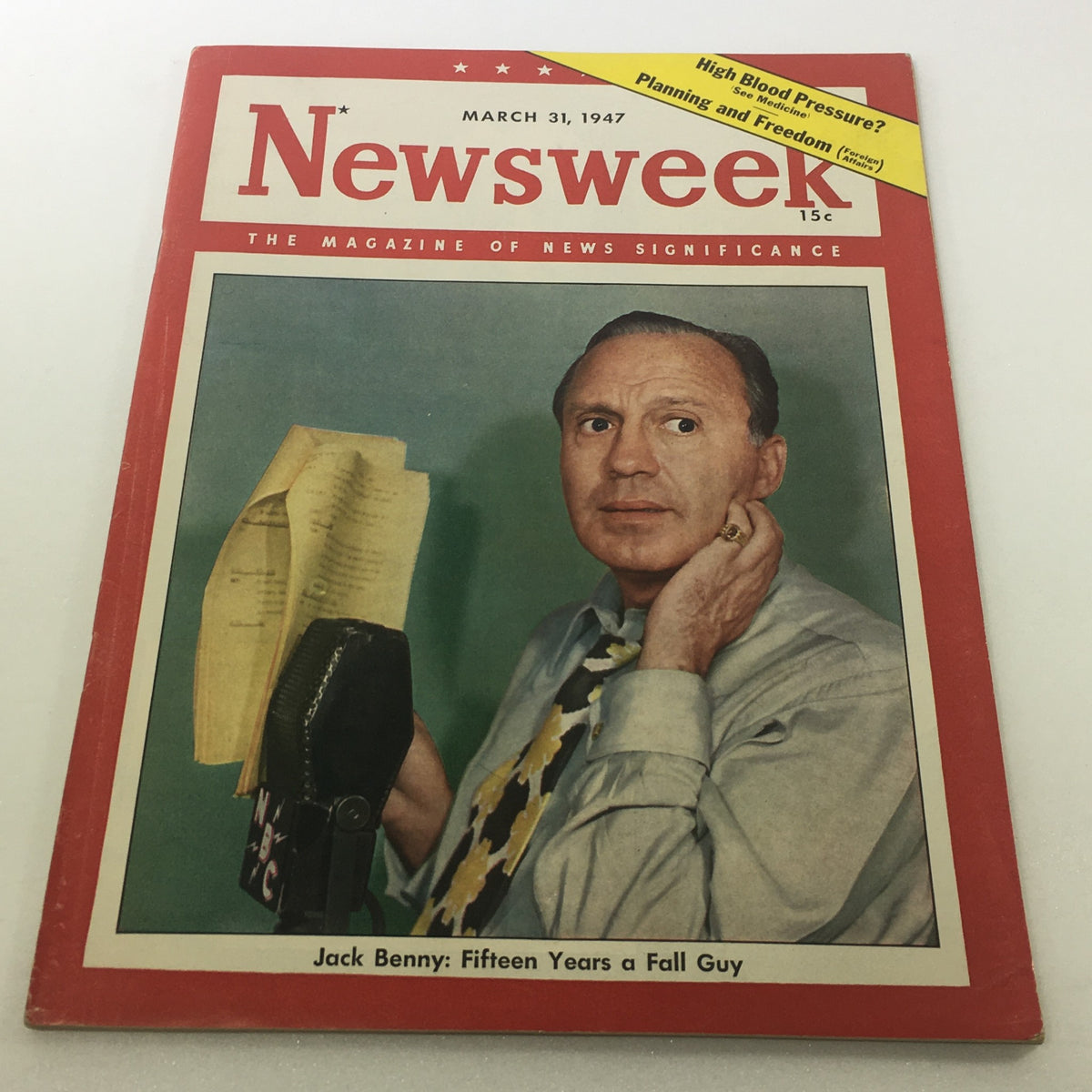

Description
Collector's Note – Why This Issue Matters
The March 31, 1947 issue of Newsweek, featuring Jack Benny on its cover, is a primary document of American popular entertainment at one of the most consequential transitional moments in the history of mass media — the specific window in which radio's dominance as the primary vehicle for American popular comedy was beginning its irreversible decline, and in which the entertainment industry's most successful and culturally significant performers were navigating the uncertain terrain between the medium that had made them and the emerging technologies that would eventually supersede it. Jack Benny in March 1947 was at a specific and historically revealing point in a career that had already spanned vaudeville, film, and more than fifteen years of radio broadcasting — a career whose trajectory documents the full arc of American popular entertainment's evolution across the first half of the twentieth century. The Jack Benny Program had been running on radio since 1932, and by 1947 it was consistently among the most listened-to programs in the country, with an audience reach and cultural authority that made Benny one of the most recognizable and beloved figures in American entertainment. A Newsweek cover appearance in March 1947 was the mainstream media establishment's recognition of that authority, and this issue documents it at the specific moment when the postwar entertainment landscape was beginning the transitions that would reshape Benny's career and American comedy more broadly. For collectors building a serious archive of Jack Benny magazine covers across his career, this March 1947 Newsweek represents one of his most significant mainstream media appearances — a cover whose cultural authority derived from the publication rather than from an entertainment-specific title, and whose timing places it at the precise opening of the postwar era in which American entertainment was most actively reconstituting itself.
The specific significance of Jack Benny's comedic achievement and cultural position in March 1947 warrants careful attention as the primary historical context for this cover. Benny had developed, across fifteen years of radio broadcasting, a comedic persona and a formal approach to comedy that were genuinely unprecedented in American popular entertainment. The character he had constructed — the vain, miserly, perpetually thirty-nine-year-old Jack Benny — was a sustained fictional creation whose consistency, internal logic, and accumulated detail across hundreds of broadcasts represented a kind of comedic world-building that no previous American comedian had achieved at comparable scale. His use of the pause — the silent beat that allowed the audience's imagination to complete the joke — was recognized by contemporaries and subsequent analysts as a technical innovation of the first order, influencing virtually every American stand-up comedian of the following generation. His radio ensemble — including Mary Livingstone, Rochester (Eddie Anderson), Dennis Day, Don Wilson, and the orchestra's Phil Harris — functioned as a repertory company whose individual characters and relationships had been developed across years of broadcast time into one of the most elaborately constructed comic fictional worlds in the history of American entertainment. The March 1947 Newsweek cover is therefore not simply a recognition of a popular entertainer; it is a primary document of the figure who represented American radio comedy's highest achievement at the specific moment when that medium's golden age was reaching its conclusion. Collectors focused on vintage Newsweek magazine issues from the immediate postwar period will find this cover providing primary evidence of how mainstream journalism was recognizing and contextualizing the entertainment culture of the late radio era.
The broader context of March 31, 1947 American culture gives this issue a further historical dimension worth understanding for collectors approaching it as a period document. The postwar entertainment industry in early 1947 was navigating a set of transitions whose full consequences were not yet visible to contemporary observers. Television broadcasting had resumed after its wartime suspension, and while television sets remained rare household items in March 1947, the technology's commercial development was accelerating in ways that would reshape the entertainment landscape within five years. The House Un-American Activities Committee had begun its investigations of the Hollywood film industry in 1947, generating the climate of anxiety and political scrutiny that would culminate in the Hollywood Blacklist and reshape the careers and working conditions of American entertainers across the following decade. The Truman Doctrine, announced on March 12, 1947 — nineteen days before this issue's cover date — had formally committed the United States to containing Soviet expansion, beginning the Cold War's most explicit ideological formulation and introducing the political atmosphere that would color American public life, including its entertainment industry, for the following four decades. A Newsweek cover featuring Jack Benny — a figure whose comedy was resolutely apolitical and whose persona was built entirely on domestic, personal, and interpersonal humor — in this specific political and media atmosphere documents the specific cultural refuge that popular entertainment was providing for an American public absorbing the anxieties of the early Cold War alongside the transitions of the postwar domestic reconversion. Among magazines from 1947, this issue provides primary evidence of how mainstream American journalism was framing entertainment culture at the precise moment when both the political environment and the media landscape were beginning the changes that would define the following decade.
About the Publication
Newsweek was founded in 1933 and by March 1947 had established itself alongside Time as one of the two dominant American weekly newsmagazines, providing the educated American reading public with comprehensive, analytically substantial coverage of national and international events at a depth and regularity that daily newspapers could not sustain. Its entertainment coverage — while secondary to its political, international, and cultural journalism — carried genuine weight precisely because Newsweek was not primarily an entertainment publication: a cover appearance represented mainstream cultural recognition of a kind that entertainment-specific publications could not confer with the same authority. By March 1947 the magazine was operating in the specific postwar atmosphere of a publication whose wartime readership had been sustained by the urgency of global conflict and that was, in the first full year of peace, reorienting its editorial attention toward the domestic and cultural dimensions of American life that the war years had necessarily subordinated. Its readership was educated, culturally engaged, and broadly invested in understanding the full range of American public life — political, cultural, and social — making its cover choices primary documents of what the mainstream cultural establishment considered most significant and most representative of American life in any given week of the publication's long history.
Key Highlights Inside
- Jack Benny cover — March 31, 1947 — Primary Newsweek documentation of the most technically accomplished and culturally significant figure in American radio comedy at the specific moment when the postwar entertainment landscape was beginning the transitions — toward television, toward the Cold War's cultural pressures, toward the decline of network radio's golden age — that would reshape the medium and the career it had made possible, providing a mainstream media primary record of the radio comedy era's peak achievement at the opening of its final phase.
- Postwar American entertainment culture — confirmed historical context — Feature coverage consistent with Newsweek's engagement with American popular entertainment in the first full year of the postwar period, documenting the specific cultural moment when the entertainment industry was reconstituting itself after wartime and navigating the early signs of the media and political transitions that would define the following decade.
- March 31, 1947 — nineteen days after the Truman Doctrine — Published in the specific week following the Truman Doctrine announcement of March 12, 1947, which had formally committed the United States to Cold War containment and introduced the political atmosphere that would reshape the entertainment industry's working conditions through the HUAC investigations and Hollywood Blacklist that followed later in the same year — providing a primary document of American popular culture at the precise hinge between the postwar moment and the Cold War era.
- Late radio era entertainment landscape — confirmed historical period — Coverage produced and received in the specific window when television broadcasting had resumed after its wartime suspension but had not yet achieved the household penetration that would displace radio as America's primary entertainment medium, documenting the entertainment culture of a transitional moment whose full implications were not yet visible to the contemporary audience that consumed it.
- Note: Specific interior article titles, additional confirmed features, and editorial content beyond the Jack Benny cover story have not been independently verified for this issue. The above reflects documented cover content and the publication's known editorial format and historical context for this period rather than comprehensive table-of-contents information.
Condition & Rarity
Surviving copies of this issue described as being in used condition with minor wear, marks, and rips along edges and binding occupy an honest and representative position within the collector grading spectrum for a seventy-eight-year-old weekly newsmagazine — condition attributes that experienced collectors of late-1940s newsweeklies understand as characteristic of honest survival across nearly eight decades rather than as meaningful detractions from historical or collecting value. The newsstand origin designation — confirmed by the absence of a mailing label — places surviving copies in the provenance category that collectors of postwar Newsweek specifically prioritize, as subscription labels on issues of this age were applied directly to the cover in positions that either permanently obscure the primary cover imagery — including the Jack Benny cover photograph — or leave irreversible adhesive damage when removed. A protective plastic covering applied during preservation indicates deliberate archival handling that has helped maintain cover and page integrity beyond what unprotected storage would have produced across nearly eight decades. Newsweek in 1947 was printed on standard newsprint for interior pages with a coated cover stock — a construction that makes interior page yellowing and brittleness common characteristics of surviving copies from this vintage while typically preserving cover photography and color fidelity somewhat better, making the cover's legibility and the Benny cover image's preservation the primary visual evaluation variable and interior page completeness the primary research variable for collectors assessing any surviving example of this issue.
Looking for More Issues Like This?
A newsstand-origin Newsweek from March 31, 1947, carrying Jack Benny on its cover at the precise opening of the postwar era in which American radio comedy's golden age was beginning its transition toward the television medium that would eventually supersede it — and published nineteen days after the Truman Doctrine announcement that marked the Cold War's most explicit ideological beginning — is a historically specific and culturally layered collecting target whose full significance rewards serious attention from collectors of both the Benny archive and the history of postwar American entertainment and media. For collectors tracing Benny's cover presence across the full arc of his career in radio, television, and film, the Jack Benny magazine collection at OriginalMagazines.com is the most focused resource for his appearances across publications and eras. The complete Newsweek archive covers the publication's postwar decades for collectors building a comprehensive picture of the magazine's entertainment and cultural coverage, and the 1947 magazine collection provides the wider immediate postwar cultural context for anyone approaching this issue as part of a broader era-focused archive.