
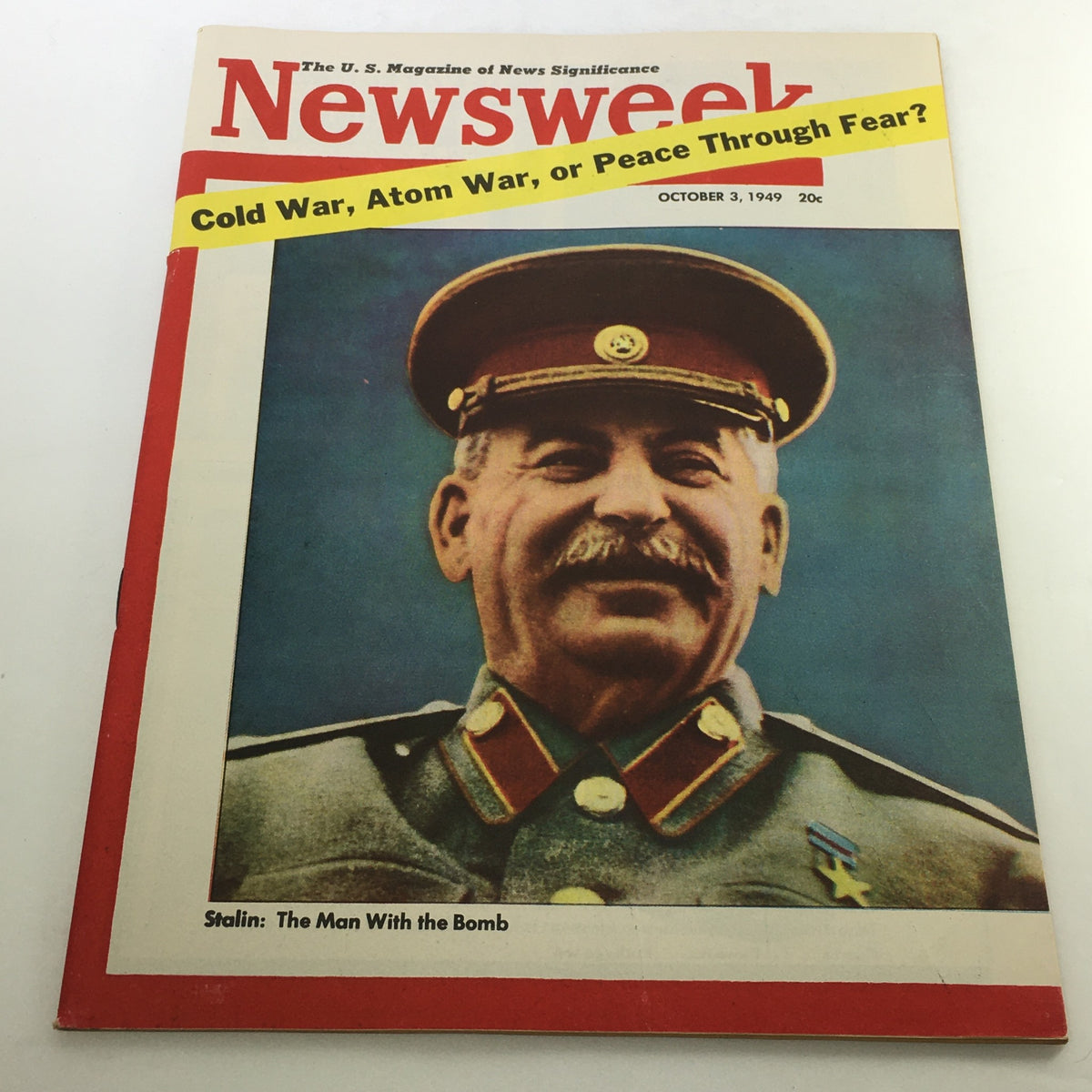

Description
Collector's Note – Why This Issue Matters
The October 3, 1949 issue of Newsweek places Joseph Stalin on its cover at what may be the single most consequential month of the entire Cold War's opening chapter. The timing is not incidental — it is historically precise in a way that makes this issue genuinely extraordinary as a collectible document. On August 29, 1949, the Soviet Union had successfully detonated its first atomic bomb, a test that the American government publicly confirmed in late September of that year. The news shattered what many American policymakers and ordinary citizens had assumed would be a comfortable window of nuclear monopoly, fundamentally and permanently altering the strategic calculus of the postwar world. Stalin's face on a Newsweek cover dated October 3, 1949 is therefore not simply a portrait of a powerful foreign leader — it is a document of the precise moment when the Cold War transformed from a political and ideological contest into an existential nuclear standoff. For collectors who focus on vintage Newsweek issues documenting the Cold War era, this is among the most historically loaded single covers the magazine produced in its entire postwar run.
Joseph Stalin in October 1949 was at the absolute apex of his international power and influence. The Soviet atomic test had announced that the USSR was now a nuclear power. The Chinese Communist Party, allied with Moscow, had just proclaimed the People's Republic of China on October 1, 1949 — two days before this issue's cover date — completing a revolutionary victory that sent shockwaves through Western capitals and dramatically expanded the perceived reach of Soviet-aligned communism across the globe. Stalin himself, at seventy years old, had survived the Second World War as the leader of the nation that had suffered more than any other, had emerged from that war in control of a vastly expanded sphere of influence across Eastern Europe, and was now presiding over a geopolitical moment that seemed to many Western observers to be tipping decisively in the Soviet direction. A Newsweek cover featuring Stalin at this precise convergence of events is a primary document of extraordinary historical density. Collectors building serious archives around the magazines of 1949 — one of the most genuinely pivotal years of the twentieth century — will find this issue among the most significant and purposefully timed covers of the entire year.
It is worth pausing on what it meant for an American mass-circulation newsweekly to put Stalin's face on its cover in the autumn of 1949. This was not neutral editorial territory. The American political climate was moving rapidly toward the anti-communist hysteria that would define the early 1950s — Senator Joseph McCarthy's famous speech claiming communist infiltration of the State Department was still four months away, but the atmosphere that would make McCarthyism possible was already forming. Placing Stalin on the cover in this moment was a journalistic act that acknowledged, directly and without euphemism, the scale of the threat that American policymakers and the American public were being asked to confront. The cover would have arrived on newsstands as readers were still processing the news of the Soviet bomb and the fall of China — two events that, taken together, represented the worst fortnight in American Cold War history to that point. As a physical object, this issue captures that moment of shock and reorientation with a directness that no subsequent historical account can fully replicate.
About the Publication
Newsweek, founded in 1933, had by the late 1940s firmly established itself alongside Time as one of the two dominant American newsweeklies, with a circulation reaching millions of readers weekly and an editorial format built around in-depth reporting, analytical commentary, and cover features capable of dedicating substantial space to a single subject or figure. The magazine's audience was composed primarily of educated, professionally engaged Americans who sought more context, analysis, and interpretive depth than daily newspapers could provide — readers who expected their newsweekly to explain not just the facts of a given week's events but their significance and implications. Newsweek's foreign affairs and geopolitical coverage was particularly highly regarded in this era, reflecting both the enormous stakes of the postwar international order and the magazine's investment in correspondents and editors with genuine expertise in the regions and conflicts they covered. In 1949, with the Cold War rapidly hardening into the defining framework of American foreign policy, Newsweek's ability to contextualize events like the Soviet atomic test and the Chinese revolution for a mass general audience made it one of the most important journalistic institutions in the country.
Key Highlights Inside
- A major cover feature on Joseph Stalin arriving in the immediate aftermath of two world-altering events: the confirmation of the Soviet Union's first successful atomic bomb test in late August 1949, and the proclamation of the People's Republic of China on October 1, 1949 — making this issue a front-row document of the most consequential fortnight in Cold War history to that point.
- Reporting and analysis almost certainly engaging with the profound strategic implications of the Soviet atomic test — the event that ended the United States' nuclear monopoly and forced an immediate and fundamental reassessment of Western defense strategy, eventually leading to the development of the hydrogen bomb and the rearmament programs of the early 1950s.
- Coverage reflecting the dramatic transformation of the geopolitical landscape in Asia following the Communist victory in the Chinese Civil War — an event that American policymakers and the public were processing in real time as this issue went to press, and that would directly shape the political environment leading to the Korean War less than a year later.
- Editorial framing that captures the specific psychological atmosphere of late 1949 in America — a moment of genuine strategic anxiety in which assumptions about postwar security that had seemed settled were being overturned in rapid succession, and in which the question of how to respond to an emboldened and now nuclear-armed Soviet Union was becoming the central preoccupation of American foreign and domestic policy.
- Standard Newsweek front-of-book news reporting covering the full breadth of domestic and international affairs from the first week of October 1949, including the Truman administration's response to the Soviet bomb, the ongoing reconstruction of postwar Europe under the Marshall Plan, and the early workings of NATO, which had been formally established only months earlier in April of that year.
- Period advertising content representing the full spectrum of late-1940s American consumer culture — a significant secondary historical record of the postwar economic boom and the commercial aesthetics of an era when American prosperity and Soviet threat existed in jarring, defining juxtaposition.
Condition & Rarity
This copy originates from newsstand distribution rather than the magazine subscription system — the consistently preferred provenance among serious periodical collectors for well-established and practical reasons. Subscription copies of mid-century newsweeklies were processed through fulfillment operations that applied mailing labels with adhesives frequently damaging to cover stock, and were routed through postal sorting systems that introduced mechanical wear, binding stress, and folding damage before ever reaching a reader. A newsstand copy arrived at retail flat, unlabeled, and entirely unprocessed, with the cover art, typography, and paper stock preserved exactly as printed and trimmed. On a magazine now approaching eighty years of age, the absence of a mailing label is a substantive and meaningful condition attribute — not a cosmetic footnote — that clearly distinguishes surviving newsstand examples from the more numerous subscription-processed copies in the market. The noted edge wear, binding wear, and potential marks are entirely consistent with a newsstand copy of this vintage that has been stored rather than actively handled, and fall within the expected range for the grade without compromising the structural integrity or readability of the issue. The presence of a plastic protective sleeve is a further positive indicator for interior condition, as sleeved copies of this era characteristically show reduced light exposure damage, lower surface oxidation, and less of the paper brittleness that commonly develops in unprotected late-1940s newsprint stock over time. For a 1949 Newsweek featuring a cover subject of this historical magnitude — Stalin, at the exact moment of the Soviet atomic test and the Chinese Communist victory — a surviving newsstand copy in displayable condition represents a preservation outcome of genuine significance.
Looking for More Issues Like This?
A newsstand copy of this particular issue — Stalin on the cover, dated to the most consequential weeks of the early Cold War — is a historically specific find that does not surface frequently in collectible condition, and if this example has already found a home, it is genuinely worth checking back as comparable copies occasionally re-enter the market. The broader vintage Newsweek collection at OriginalMagazines.com is an excellent place to explore for other significant Cold War-era covers from a magazine whose foreign affairs reporting in this period was among the most authoritative and widely read journalism in the country. Collectors with a focused interest in the extraordinary density of events that defined the postwar years will also find it well worth browsing the full 1949 magazine archive, which brings together publications from a year that ranks among the most historically significant — and most actively sought by serious collectors — of the entire twentieth century.