
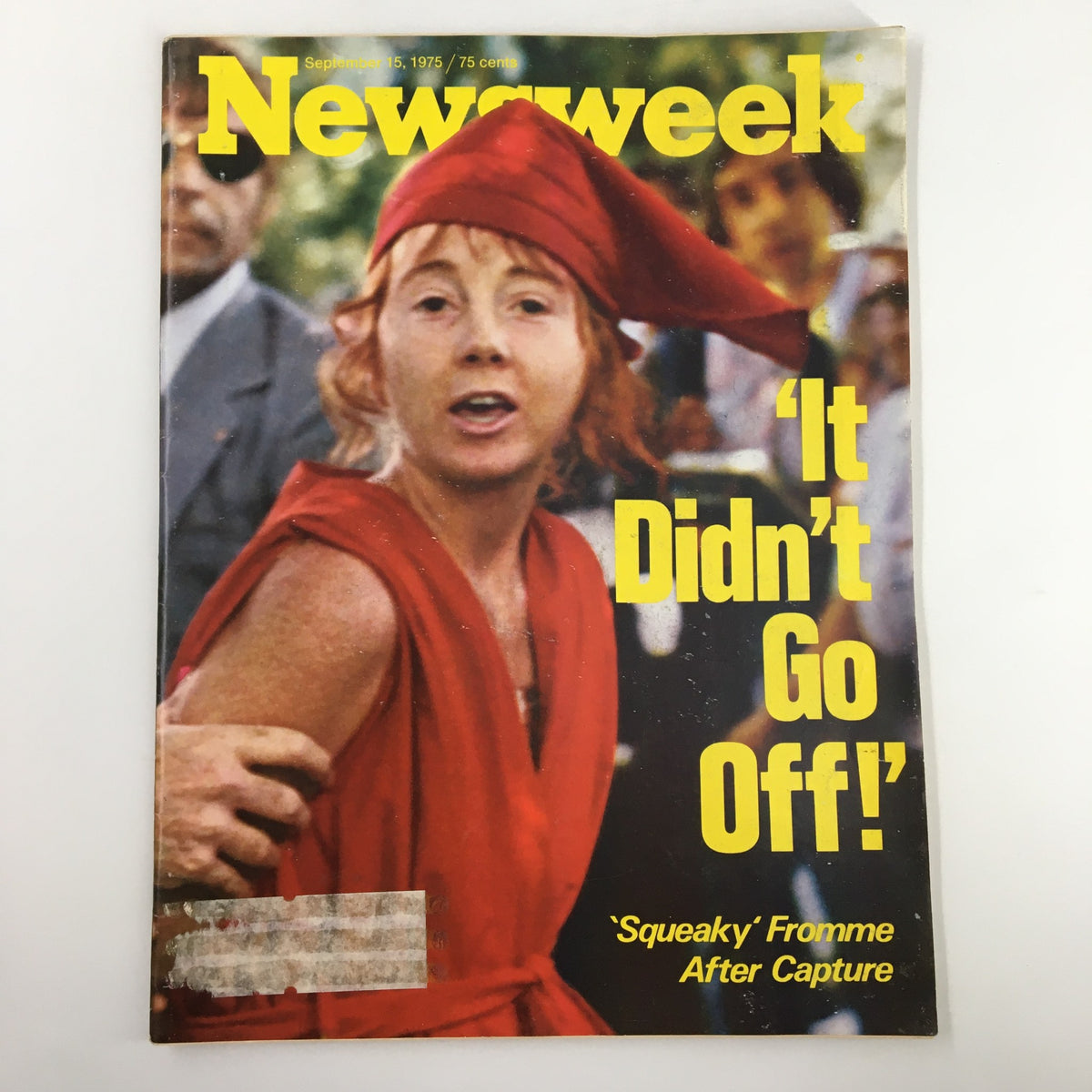

Description
Collector's Note – Why This Issue Matters
The September 15, 1975 issue of Newsweek featuring Lynette "Squeaky" Fromme after her capture is a primary document of one of the most shocking single events in American political history — the first assassination attempt on a sitting president in twenty-two years. On September 5, 1975, Fromme had pointed a .45-caliber pistol at President Gerald Ford during a public appearance in Sacramento, California. The weapon did not discharge, Secret Service agents immediately subdued her, and she was arrested on the spot. This September 15 Newsweek cover story — published ten days after the attempt — was the national weekly press's first comprehensive profile of Fromme following her capture, examining her background as a member of the Manson Family, her motivations, and the specific circumstances of the attempt. The Manson Family connection gave the Ford assassination attempt a specific cultural resonance beyond standard political violence: Fromme had been one of the most devoted of Charles Manson's followers, had been present during the Tate-LaBianca murder period though not charged with the killings, and her September 5 Sacramento action brought the Manson Family back into national consciousness six years after the 1969 murders. For collectors building archives of Squeaky Fromme magazine covers and features, the September 15, 1975 Newsweek is the foundational primary document — the first major national weekly cover following her capture, published at the moment of maximum public attention.
The September 1975 timing gives this issue additional historical density. The Ford assassination attempt was not an isolated event in the specific month it occurred: just seventeen days later, on September 22, 1975, Sara Jane Moore would fire a revolver at President Ford outside a San Francisco hotel — the second assassination attempt on the same president within seventeen days, a concentration of presidential threat without precedent in American history. The September 15 Newsweek cover story on Fromme was therefore published in the specific two-week window between the first and second attempts, at a moment when the national conversation about Ford's security and the specific cultural conditions of mid-1970s American political violence was at its most active. The Manson Family's ongoing cultural presence in American consciousness — Manson had been convicted in 1971 and was serving a life sentence, but his cultural shadow remained substantial — gave the Fromme story a specific retrospective dimension that connected 1975 national security journalism to the late-1960s cultural history. Collectors of vintage Newsweek magazine issues will find no other single-week issue from 1975 that more directly documents a specific act of political violence in its immediate aftermath. The broader 1975 magazine collection provides further context within the year's full political landscape.
The confirmed "life after capture" framing of the feature reflects a specific journalistic approach: not simply recounting the events of September 5 but examining Fromme's trajectory from Manson Family devotee to would-be presidential assassin — a biographical and cultural investigation that positioned her as a primary document of what the Manson era had produced and left behind in American culture six years after the original murders. That framing gives the confirmed feature historical value beyond its news function, making it a primary source for researchers of both the Manson Family's documented aftermath and the specific character of mid-1970s American political culture.
About the Publication
Newsweek, founded in 1933 and by September 1975 one of the two dominant American weekly news magazines alongside Time, was a primary vehicle for national news synthesis, political journalism, and cultural commentary throughout the postwar decades. Its cover choices carried editorial authority — a Newsweek cover was the publication's formal identification of the week's most significant person or subject — and its format combined a cover feature with departmental news coverage across national affairs, international news, business, culture, and science. By the mid-1970s it was operating at the height of its influence, with a readership that consumed it as a primary source of national news comprehension alongside daily newspaper journalism.
Key Highlights Inside
- Squeaky Fromme cover feature — "after capture" profile — A confirmed cover story on Lynette Fromme published ten days after her September 5, 1975 assassination attempt on President Ford — primary mainstream journalism from the immediate aftermath of the first assassination attempt on a sitting American president in twenty-two years.
- Manson Family biographical and cultural context — The confirmed "life after capture" framing places this feature within the specific cultural history of the Manson Family six years after the 1969 murders, examining Fromme's trajectory as a primary document of what that era had produced.
- September 5–15, 1975 historical window — Published ten days after the first Ford attempt and seven days before the second Sara Jane Moore attempt, this issue documents the national conversation about presidential security at its most active and concentrated moment.
- Address label on front cover — confirmed condition factor — The listing specifically confirms a label on the front cover as a visible condition attribute that collectors should assess from available photographs for its placement relative to the cover image.
Note: Specific interior article titles and confirmed content beyond the Fromme cover feature have not been provided in the available listing. The highlights above reflect only what is verifiable from the listing and well-documented facts about the historical events documented.
Condition & Rarity
Good condition with a front-cover address label, some age wear, and plastic protective covering represents a workable collector grade for a fifty-year-old weekly news magazine carrying one of the most historically specific political violence cover stories of the decade. The front-cover label is a permanent condition factor whose size and placement relative to the Fromme cover image should be confirmed from available photographs — front-cover labels are the primary display-quality consideration for this type of cover where the photographic content carries the primary historical significance. Age wear is standard for a publication of this vintage and circulation. The plastic protective covering indicates deliberate preservation. For research-oriented collectors, the label and wear do not affect the journalistic and historical value of the confirmed interior feature content.
Looking for More Issues Like This?
The September 15, 1975 Newsweek Squeaky Fromme cover is the foundational primary document in the Fromme press archive — the first national weekly cover following her capture, published at the moment of maximum public attention and before the second Ford assassination attempt had further complicated the national conversation. The dedicated Squeaky Fromme magazine collection at OriginalMagazines.com is the most direct place to search for other documented appearances across the press coverage of her case. The broader Newsweek archive and the complete 1975 collection are both worth exploring for other issues that document the specific political and cultural intensity of one of the most turbulent years in postwar American history.