


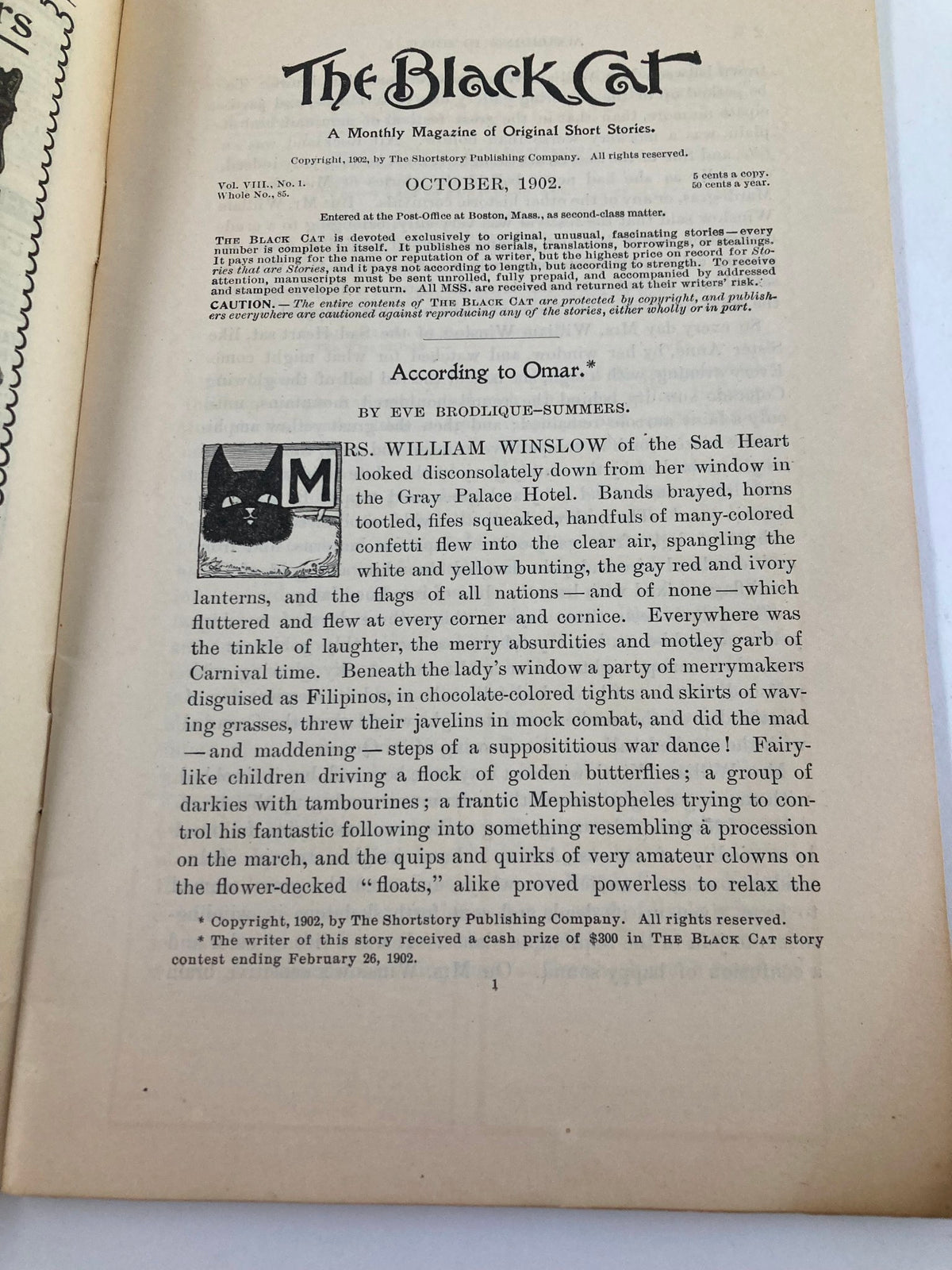


Description
Collector's Note – Why This Issue Matters
The October 1902 issue of The Black Cat Magazine is a primary artifact of one of the most significant chapters in the history of American short fiction publishing. The Black Cat was not a general interest magazine that happened to publish stories — it was a dedicated short fiction magazine with a specific and deliberate editorial mission: to discover and publish new American literary talent, paying competitive rates and accepting submissions from unknown writers alongside established names. Founded in 1895, it had by 1902 published early or significant work by a remarkable number of writers who would go on to sustained careers, and its role in the development of the American short story as a commercial and literary form is well-documented by literary historians. An October 1902 issue represents the magazine at a mature and accomplished phase of its publishing history — past its founding period but still well within the era of its greatest literary influence.
The featured story "The Delegates from Dulverton" is the specific editorial content documented in this issue. Without access to the full text or contemporaneous reviews, its literary significance in isolation is difficult to assess — The Black Cat published hundreds of stories across its run, and many of the authors whose early work appeared in its pages are now obscure. But that obscurity is itself part of what makes complete surviving issues from this period historically valuable: they preserve, in their original published form, the full texture of early twentieth-century American popular short fiction — including the work that did not achieve lasting recognition alongside the work that did. For collectors building archives of The Black Cat Magazine's complete publishing run, this October 1902 number is a document of the magazine operating at its characteristic editorial standard.
The year 1902 itself occupies an interesting position in American literary history. The late Victorian and early Edwardian period was a moment of significant transition in American fiction — naturalism was asserting itself alongside the remnants of the genteel tradition, the short story was being refined as a commercial form by the demands of magazine publication, and the market for popular fiction was expanding rapidly as literacy rates rose and printing costs fell. The Black Cat's particular contribution to this moment was its consistent emphasis on originality and narrative surprise — it explicitly sought stories with unconventional premises and unexpected endings, and its editorial selections from this period reflect those priorities. Collectors interested in the American magazine landscape of 1902 will find this issue a distinctive and historically specific example of the era's literary publishing culture.
About the Publication
The Black Cat Magazine was founded in Boston in 1895 by publisher Herman D. Umbstaetter and ran until 1922, making it one of the longer-lived dedicated short fiction magazines of the era. Its editorial premise was explicitly meritocratic — it offered relatively high rates for short stories and actively sought submissions from unknown writers, positioning itself as a venue for discovering new talent rather than relying on established names. Its stories leaned toward the clever, the surprising, and the slightly sensational, and its consistent emphasis on narrative ingenuity gave it a distinctive editorial character that readers and contributors recognized. Literary historians credit it with publishing early work by a significant number of writers who went on to sustained careers, and its complete run is now studied as a primary document of the development of the American popular short story in the late nineteenth and early twentieth centuries.
Key Highlights Inside
- "The Delegates from Dulverton" — the featured story of this October 1902 issue, published in a magazine whose editorial standards consistently emphasized narrative originality and surprise over conventional storytelling approaches.
- Short fiction content typical of The Black Cat's mature editorial period — stories selected for their unconventional premises and unexpected resolutions, reflecting the magazine's well-documented editorial philosophy.
- Illustrations and visual content from 1902 — the graphic design and artistic production values of an early twentieth-century American literary magazine, now serving as primary documents of the era's print culture.
Note: Specific additional stories and features beyond the named cover story are unconfirmed for this issue. The above reflects what is verifiable from the listing description, publication format, and the well-documented editorial history of the magazine.
Condition & Rarity
Graded Good, with minor wear, marks, and binding wear noted — an honest and meaningful condition profile for a magazine now more than one hundred and twenty years old. Survival in any readable condition at this age represents a significant preservation outcome; the vast majority of popular fiction magazines from 1902 did not survive the century. The no-label newsstand designation preserves the cover as originally presented, without the subscriber label defacement that affects a portion of surviving copies. Marks and binding wear are the expected signatures of a publication of this age, and they do not affect the readability of the interior fiction content, which is the primary research and collector value of the issue. A protective plastic sleeve provides appropriate ongoing archival care for a publication of this extreme age and paper stock. Complete surviving issues of The Black Cat from its pre-1910 run are genuinely uncommon in the collector market, and issues in Good condition with all interior pages present and readable represent a solid preservation standard for material of this vintage.
Looking for More Issues Like This?
Pre-1910 issues of The Black Cat Magazine in readable condition are among the rarer finds in early American literary magazine collecting, and an October 1902 number with intact interior content is a meaningful piece of the publication's archive. The full Black Cat Magazine collection at OriginalMagazines.com is the best place to explore available issues across the publication's long run. For collectors building a broader documentary archive of early twentieth-century American print culture, the complete 1902 magazine archive offers a range of titles from a year that sits at the threshold of the modern American literary marketplace.