

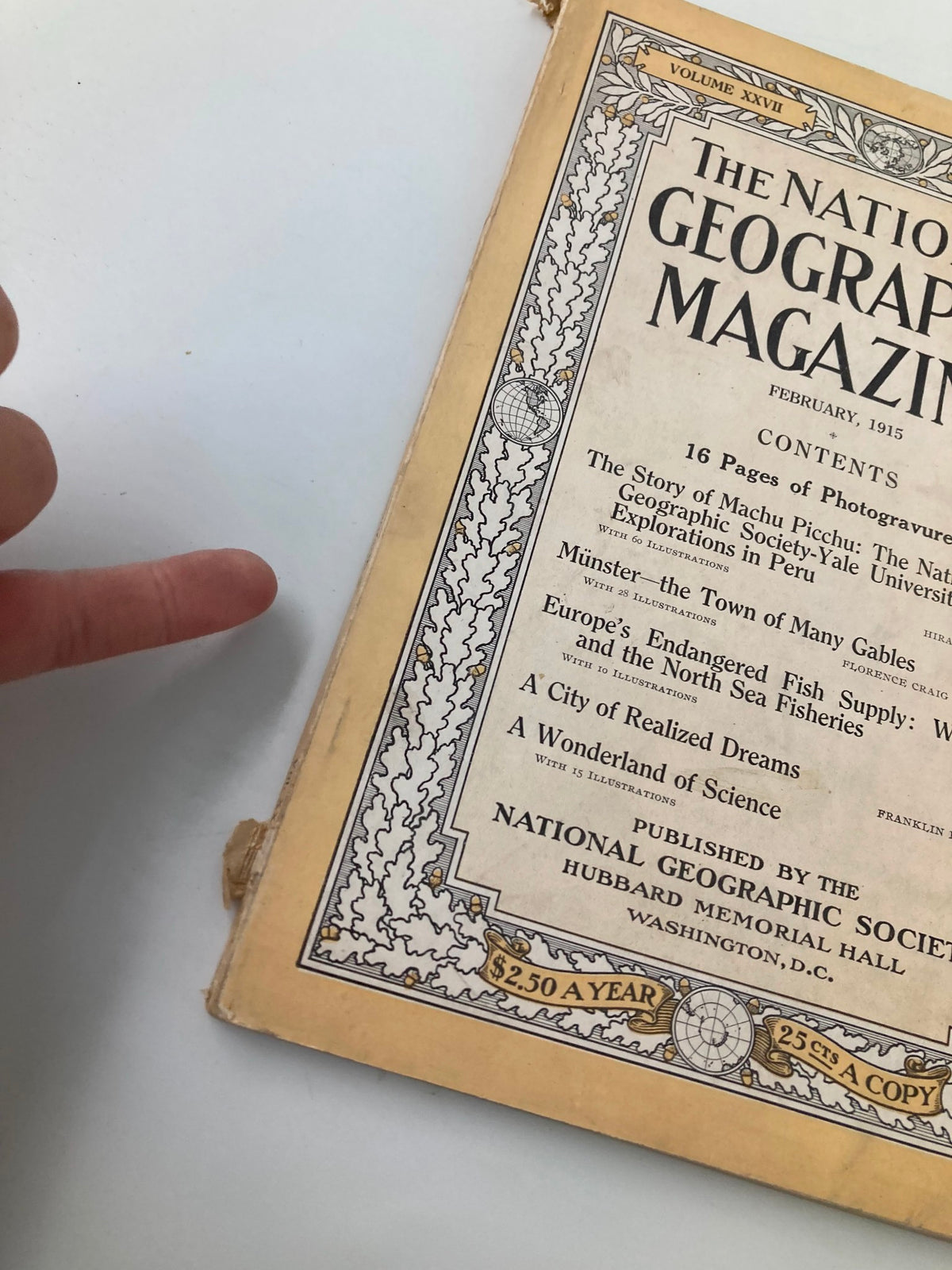


Description
Collector's Note – Why This Issue Matters
This February 1915 issue of National Geographic, Volume 27, Number 2, holds a documented place within one of the magazine's most celebrated editorial threads: its ongoing coverage of Hiram Bingham's Yale-sponsored expeditions to Machu Picchu in Peru. This issue represents the second installment in that series, covering results from Bingham's 1914 expedition, positioned between the magazine's iconic April 1913 issue that first introduced Machu Picchu to the world and the entire-issue follow-up the Society would publish in May 1916 covering the 1915 campaign. Bingham's continued excavations were already reshaping understanding of the Inca civilization at the time of this issue's publication, revealing details about ancient agricultural engineering, pottery craftsmanship, and religious practices that captivated American readers eager for accounts of lost civilizations. The magazine's cover feature on Munster, billed as the "Town of Many Gables," carries its own small but genuine collecting curiosity, since the cover photograph for this issue has been a subject of debate among serious National Geographic collectors, who have worked to determine definitively whether the unlabeled image depicts Munster or the similarly gabled German city of Hildesheim. That the interior article confirms Munster as the subject has settled this minor point of collector lore, but the ambiguity itself reflects the kind of close textual and visual analysis longtime collectors of the magazine continue to apply to early twentieth-century issues. For collectors specifically focused on early National Geographic Machu Picchu coverage, this issue represents a genuinely significant chapter in a sequence that remains one of the most actively studied editorial threads in the magazine's history.
This issue also captures the magazine at a moment of genuine wartime relevance, despite National Geographic's reputation for politically neutral, exploration-focused content. Its feature on Europe's endangered fish supply addressed the disruption that the early months of the First World War had brought to North Sea fisheries, a subject that connected the magazine's traditional focus on geography and natural resources to the immediate, unfolding consequences of the conflict then engulfing Europe. This kind of content reflects how even a publication built around scientific exploration and cultural geography could not entirely separate itself from world events as significant as the war's early disruption of European commerce and food supply. Alongside this wartime-adjacent piece, the issue's article on San Francisco, described as "A City of Realized Dreams," reflects the magazine's continued interest in documenting American urban development during a period when the city was still very publicly rebuilding its identity following the 1906 earthquake and fire. Together, these pieces illustrate the breadth typical of National Geographic during this era, moving fluidly between ancient Andean ruins, medieval German town architecture, contemporary European conflict, and modern American urban achievement within a single issue.
For collectors, this issue's combination of documented Machu Picchu series significance and genuine cover-identification collector lore gives it real substance beyond simple period charm. That combination of scholarly continuity and small-scale collecting mystery is part of what makes early National Geographic issues from this specific stretch of the 1910s a consistently active area of focus within the broader National Geographic magazine collecting community, where the Bingham-Machu Picchu sequence in particular continues to draw sustained scholarly and collector attention more than a century after its original publication.
About the Publication
The National Geographic Magazine, published continuously since 1888 by the National Geographic Society, established itself in its early decades as a publication devoted to exploration, geography, and natural science, supported by photography and illustration that distinguished it from more text-heavy scholarly journals of the period. By the 1910s, the magazine had become closely associated with major exploratory expeditions it helped fund and document, most famously Hiram Bingham's Yale-sponsored excavations of Machu Picchu, which the Society supported beginning with the 1912 expedition and continued covering across multiple issues throughout the decade. Its editorial format during this era typically combined several substantial feature articles on geography, archaeology, and world cultures, illustrated with photographs and maps, alongside shorter pieces addressing current scientific or geopolitical developments relevant to the Society's mission. The magazine's commitment to high-quality photographic reproduction, including the photogravure plates that frequently accompanied major features, set it apart from many general-interest publications of the period and helped establish the visual standard the title remains known for today. This combination of serious exploratory journalism and accessible, image-driven storytelling was already well established by 1915, and issues from this period are frequently cited by collectors and historians as representative of the magazine during one of its most editorially significant early decades.
Key Highlights Inside
- "Munster, the Town of Many Gables," the cover-featured article addressing the German city's distinctive architecture. This piece resolved a small but genuine point of debate among later National Geographic collectors regarding whether the issue's unlabeled cover photograph depicted Munster or the similarly styled city of Hildesheim. The article's confirmed subject matter settled the question in Munster's favor.
- "The Story of Machu Picchu," covering results from Hiram Bingham's 1914 Yale-National Geographic Society expedition to Peru. This article represents the second installment in the magazine's celebrated multi-part coverage of Bingham's excavations, following the landmark April 1913 issue and preceding the entire-issue follow-up published in May 1916. The series remains one of the most actively studied and collected editorial threads in National Geographic's early publishing history.
- "Europe's Endangered Fish Supply: War and the North Sea Fisheries," addressing the early disruption World War I brought to North Sea fishing industries. This piece reflects the magazine's willingness to connect its traditional geographic and natural-resource focus to immediate, unfolding wartime developments. The feature offers a useful period perspective on how the war's earliest months were already reshaping European commerce and food production.
- "A City of Realized Dreams," a feature on San Francisco's continued development. The piece arrived during a period when the city remained closely associated with its rebuilding following the 1906 earthquake and fire. This article reflects National Geographic's recurring interest in documenting significant American urban achievement alongside its international coverage.
- Additional content addressing scientific subjects consistent with the magazine's broader 1910s editorial scope. Specific further details on this content are not independently confirmed beyond available period indexing and are best explored by examining the issue directly. Readers interested in the full scope of this issue's scientific coverage are encouraged to consult the complete table of contents.
Condition & Rarity
Surviving copies of this issue are generally evaluated using the same standards collectors apply across early twentieth-century National Geographic issues: cover and spine integrity, completeness of interior photogravure plates, and overall page condition free of significant brittleness, foxing, or moisture damage given the issue's considerable age. A copy described as being in good condition, with minor wear consistent with its era, would be considered a reasonable survivor for a periodical now well over a century old. The absence of a subscription label is generally noted by collectors as reflective of the issue's original newsstand or non-mailed distribution, though National Geographic issues from this period were predominantly distributed to Society members by mail, making certain distribution variants of interest to specialized collectors. A plastic protective sleeve is a standard and effective safeguard for an issue of this age and fragility, helping prevent further handling wear and environmental damage, though it cannot reverse deterioration that occurred prior to the magazine's preservation. Given the documented significance of this issue's Machu Picchu content specifically, collectors focused on the Bingham expedition series often weigh an issue's completeness and the condition of its accompanying photographic plates particularly heavily. Wear concentrated on the binding is a common characteristic of magazines from this era, since early twentieth-century stitching and paper stock were considerably less durable than materials developed in later decades. Pages free of active brittleness or further tearing represent the most relevant ongoing benchmark for a magazine this old, regardless of cosmetic wear already present.
Looking for More Issues Like This?
A February 1915 National Geographic issue documenting both the second chapter of the Bingham Machu Picchu expedition series and a small genuine point of collector debate over its own cover photograph offers real substance for serious collectors of early twentieth-century exploration journalism. If this particular issue isn't available, it's worth browsing the broader National Geographic magazine collection for other issues from this historically significant publication, including companion issues from the broader Bingham-Machu Picchu series. Collectors focused on the era itself may also want to look through the full range of 1915 magazines for other issues from that pivotal early World War I year. Each of these collections offers a different way into the period, whether the interest lies in this specific title's exploratory journalism or the broader cultural and political snapshot of a single transformative year. A single year's worth of magazines often tells a fuller story than any one issue alone, particularly for a year shaped so heavily by the war's earliest disruptions across Europe. Browsing by publication can also help collectors trace how National Geographic's coverage of the Machu Picchu excavations developed across the full multi-year series. Whichever angle appeals most, these collections are a useful starting point for going deeper into this foundational period of exploration journalism and magazine history.