

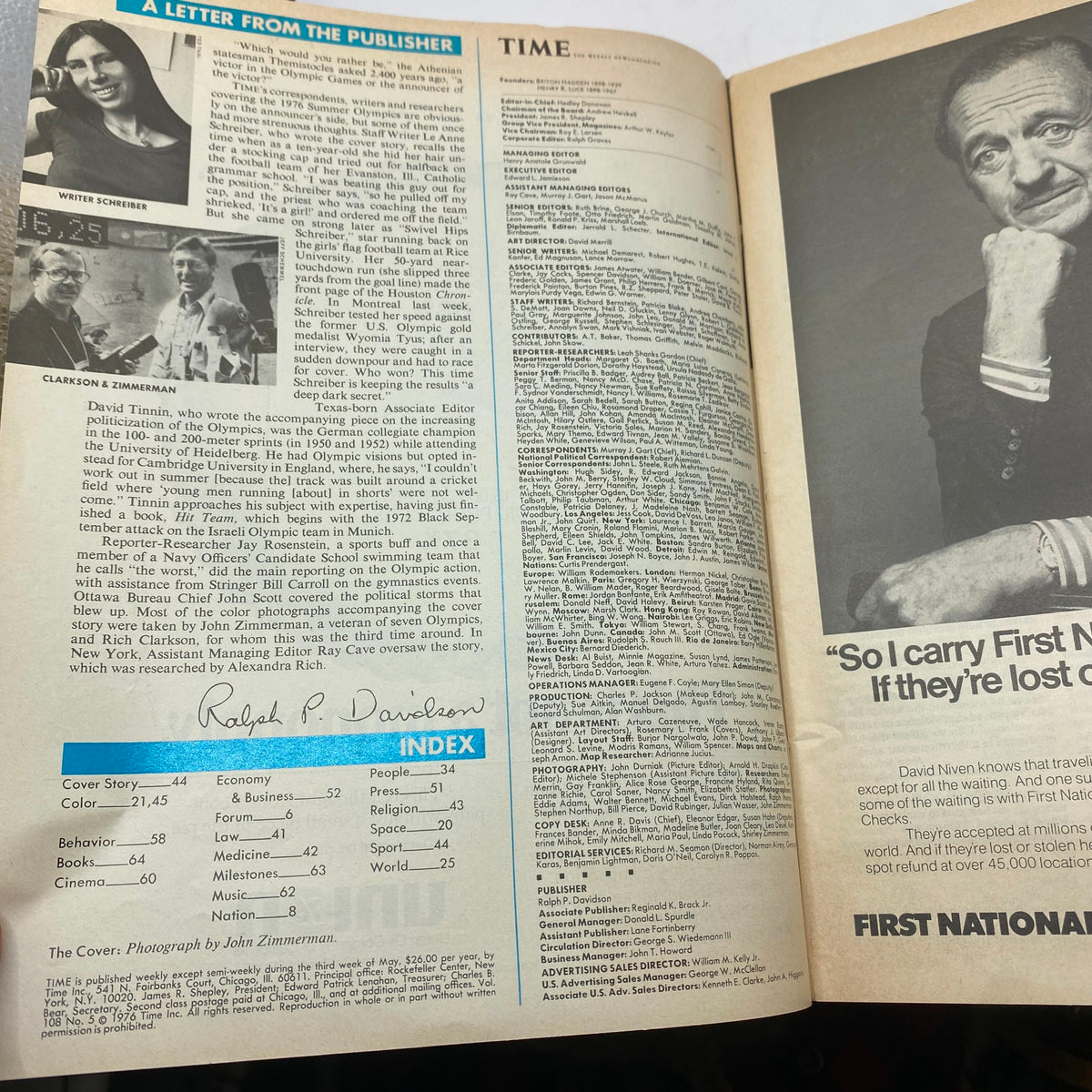


Description
Collector's Note – Why This Issue Matters
The August 2, 1976 issue of Time magazine documents one of the most electrifying moments in Olympic history at the precise instant the world was still processing what it had just witnessed. Nadia Comaneci had scored her first perfect 10.0 on the uneven bars at the Montreal Olympics on July 18, 1976 — a score so unprecedented that the scoreboard, which had not been designed to display a 10.0, showed it as 1.00. She would go on to earn seven perfect scores during those Games, win three gold medals, and fundamentally alter the public's understanding of what was possible in artistic gymnastics. A Time cover published just two weeks after those performances captures the immediate global reaction to an achievement that had no precedent and no adequate frame of reference. This is not a retrospective. It is a document produced in real time, by one of the world's most authoritative news publications, in the immediate aftermath of a genuinely historic sporting event. Collectors focused on this moment in Olympic and sports history will find the Nadia Comaneci magazine archive an invaluable resource for understanding how her achievement was covered and processed across multiple publications in the months and years that followed.
Time's decision to put Comaneci on its cover was itself a statement. The magazine did not routinely feature gymnasts — or indeed most Olympic athletes — on its cover, reserving that placement for figures of genuine global cultural and political consequence. That a fourteen-year-old Romanian gymnast earned that placement in August 1976 reflects the magnitude of what she had done, but it also reflects the particular Cold War context in which she did it. Romania under Nicolae Ceaușescu occupied an unusual position within the Eastern Bloc — officially part of the Soviet sphere but increasingly independent in its foreign policy, and eager to demonstrate its national prowess on the world stage through exactly the kind of athletic achievement that Comaneci represented. Her perfect scores were simultaneously a sporting miracle and a political statement, and Time's coverage, which the listing notes delves into the political and social climate of Romania during the 1970s, engages with that complexity directly. For collectors building a serious archive of the era, the 1976 magazine collection documents a year — the American bicentennial, the Montreal Olympics, a charged moment in Cold War politics — that rewards deep research across multiple titles and perspectives.
The broader significance of this issue extends well beyond gymnastics. The Montreal Olympics of 1976 were themselves a fraught and politically complicated Games — marked by the African boycott over New Zealand's rugby ties with apartheid South Africa, by the looming financial catastrophe that left Montreal paying off Olympic debt for decades, and by the Cold War athletic rivalry that gave every East-West competition an additional layer of geopolitical meaning. Comaneci's performances cut through all of that complexity with something unambiguous and universally legible: a level of athletic perfection that required no translation and no political context to appreciate. The Time cover and the coverage within this issue captures that rare moment when a sporting achievement transcended its sport entirely and became a global cultural event. It is, by any measure, one of the more significant sports-related Time covers of the decade, and its standing in the collector market reflects that.
About the Publication
Time magazine was founded in 1923 by Henry Luce and Briton Hadden as the first weekly news magazine in the United States, and by the mid-twentieth century had established itself as one of the most widely read and culturally authoritative periodicals in the world. Its format combined concise, narrative-driven reporting on international news, politics, science, culture, and sports with the iconic cover image that became one of the most recognized formats in publishing history — a single subject, rendered in a painted or photographic portrait, chosen each week as the magazine's editorial judgment of who or what mattered most in that moment. By August 1976, Time had been making those judgments for over fifty years and had developed a cover selection process that was itself treated as a form of cultural endorsement. Its audience was broad, educated, and global, and its covers from the postwar decades through the seventies and eighties are among the most actively collected periodical covers in the American market, sought by both general magazine collectors and subject-specific collectors for whom a Time cover represents the definitive mainstream recognition of a figure or event.
Key Highlights Inside
- Nadia Comaneci cover feature — published just two weeks after her historic perfect 10.0 scores at the 1976 Montreal Olympics, documenting the immediate global response to the first perfect score in Olympic gymnastics history and the fourteen-year-old athlete who achieved it.
- Political and social context of Romania in the 1970s — coverage that situates Comaneci's achievement within the specific political climate of Ceaușescu's Romania and its complicated position within the Cold War geopolitical order, providing a multi-dimensional account that goes beyond the athletic achievement itself.
- Reporting on the broader 1976 Montreal Olympics — the Games that produced Comaneci's historic performances also featured significant political controversy and Cold War athletic competition, all of which formed the backdrop against which her scores were received.
- Note: Specific additional article titles, secondary features, and further interior content beyond those indicated in the listing have not been confirmed from available sources. The highlights above reflect what is documented in the listing and Time's well-established editorial format for major cover stories of this period.
Condition & Rarity
Surviving copies of the August 2, 1976 Time in genuinely excellent condition are among the more sought-after entries in the magazine's 1970s run. Time was printed on standard newsprint-grade stock and was treated by most of its original readers as a weekly newspaper rather than a collectible — read, perhaps clipped, and discarded in large numbers. Copies that have survived nearly five decades with their covers intact, their page blocks unbroken, and their structural integrity preserved represent a meaningful find by the standards of weekly newsmagazine collecting. The protective plastic sleeve present on well-preserved copies is the appropriate archival measure for a magazine of this paper stock and age, preventing further handling deterioration and environmental damage without requiring any alteration to the original item. Nadia Comaneci cover issues occupy a specific and elevated tier within Time collecting more broadly — the combination of a universally recognized subject, a historically documented cover moment, and the cross-collector appeal that spans gymnastics enthusiasts, Olympics collectors, Cold War history researchers, and general Time cover collectors gives this issue a depth of demand that straightforward condition evaluation alone does not fully capture.
Looking for More Issues Like This?
The August 2, 1976 Time cover is one of the most recognizable sports images in the magazine's history, and copies in excellent preserved condition surface less frequently than casual collectors might expect given the original print run. If this particular issue is no longer available, the Nadia Comaneci magazine collection is the best starting point for finding other issues that document her career and legacy across multiple publications and time periods. The full Time magazine archive covers the complete run of the title for collectors working through its history systematically, and the 1976 magazine collection provides the broader context of a year that produced some of the decade's most historically significant cover moments across multiple titles.