
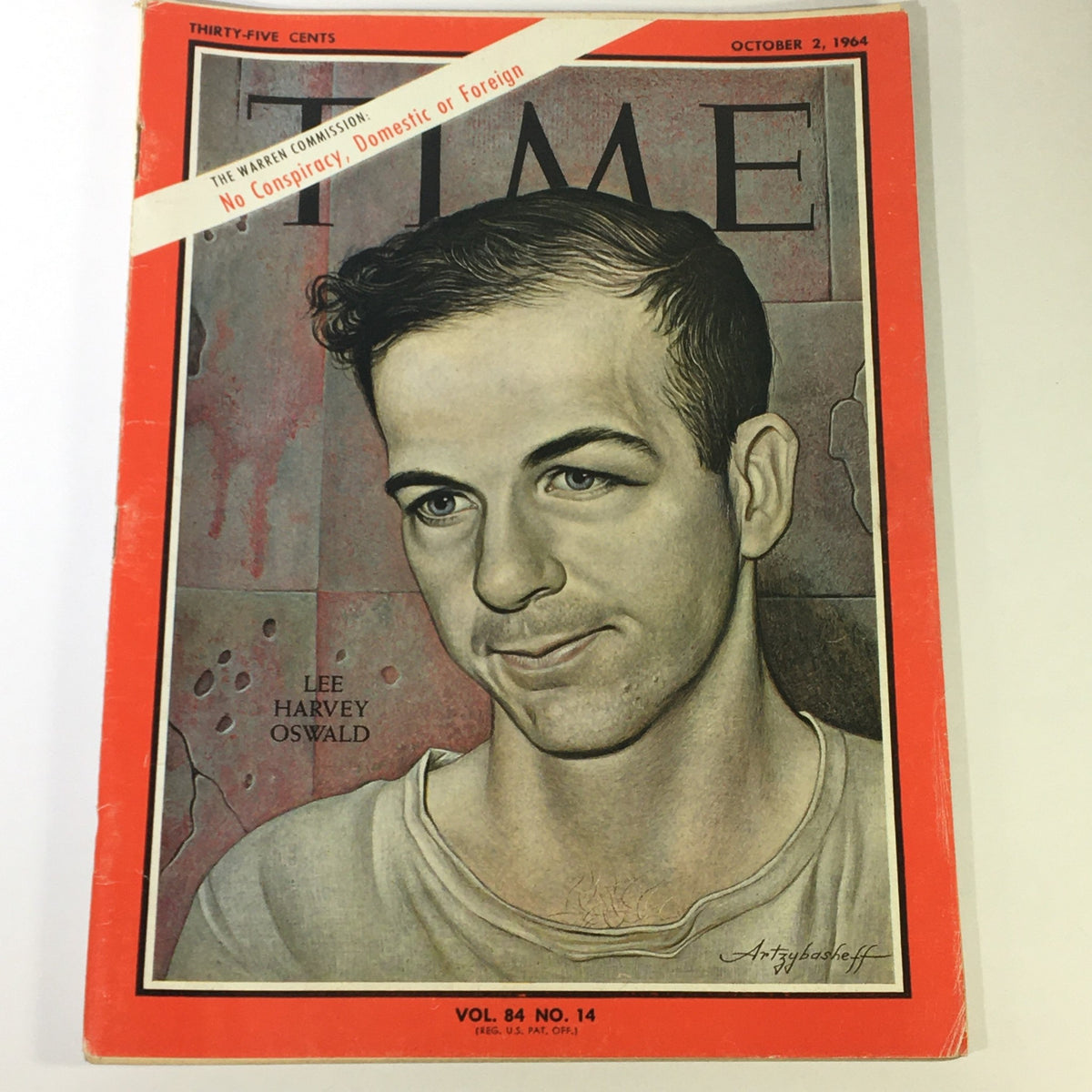

Description
Collector's Note – Why This Issue Matters
The October 2, 1964 issue of Time magazine — Volume 84, Number 14 — featuring Lee Harvey Oswald on the cover is one of the most historically freighted newsweekly covers of the entire postwar era, a document of a specific and extraordinary moment in American political and judicial history: the release of the Warren Commission Report. The Warren Commission, formally known as the President's Commission on the Assassination of President Kennedy, had been appointed by President Lyndon Johnson one week after the assassination and had spent ten months investigating every dimension of the November 22, 1963 killing. Its report — running to nearly nine hundred pages in its original form — was released to the public on September 27, 1964, just five days before this issue of Time appeared on newsstands. The report's central finding, that Lee Harvey Oswald had acted alone in shooting President Kennedy from the sixth floor of the Texas School Book Depository, was the most consequential judicial conclusion in American history up to that point, and the publication of the Warren Commission Report was one of the most significant national events of the entire decade. A Time cover on Oswald in the first week of October 1964 was therefore not merely an editorial choice but a response to a moment of genuine historical magnitude — the country's official attempt to close the most traumatic chapter in its recent history. Collectors building a serious archive of JFK assassination documentation in print will find the Lee Harvey Oswald magazines collection at OriginalMagazines.com the most comprehensive resource for press coverage of the assassination and its investigation across publications and years.
The specific timing of this issue gives it a historical significance that goes beyond even the Warren Commission release. October 1964 was eleven months after the assassination — a period during which American public opinion had been processing the most shocking political event in living memory, and during which the questions that would later generate the conspiracy theories that remain active to this day were already beginning to form in the public discourse. The Warren Commission Report was intended to settle those questions definitively, and this Time issue — appearing in the immediate aftermath of its release — is a primary document of the moment when the official account of what had happened on November 22, 1963 was being presented to the American public for the first time in its full, authorized form. Whether readers found that account convincing or insufficient, they encountered it first through publications like this one, and the immediate public reception of the Warren Report — documented in news coverage, editorial pages, and magazine feature journalism — is a historical record of considerable importance for anyone studying the assassination's long afterlife in American political culture. The Time magazine collection at OriginalMagazines.com provides the broader archive for the magazine's coverage of the assassination and its aftermath across the Kennedy era.
It is worth situating this cover within the broader context of 1964 as a whole — a year of extraordinary historical density that makes any publication from its final quarter particularly significant. The Civil Rights Act had been signed into law on July 2, 1964. The Gulf of Tonkin Resolution, which authorized the escalation of American military involvement in Vietnam, had been passed on August 7. The presidential election of 1964 — Lyndon Johnson's landslide defeat of Barry Goldwater — was just weeks away when this issue appeared. The Warren Commission Report was being released into this atmosphere of compressed historical consequence, and the Oswald Time cover of October 2, 1964, arrived at a moment when the country was simultaneously processing the Kennedy assassination's official resolution, preparing to vote in the first presidential election since his death, and beginning the escalation of the Vietnam conflict that would define the remainder of the decade. For collectors who understand 1964 as one of the most consequential single years in postwar American history, this issue occupies a specific and important position within that year's documentary record. The 1964 magazines collection at OriginalMagazines.com gathers publications from across this extraordinary year.
About the Publication
Time was founded in 1923 by Henry Luce and Briton Hadden as the first American weekly news magazine, built on the premise that educated readers needed a single authoritative source synthesizing the week's events across politics, business, science, culture, and international affairs into a coherent, opinionated, and readable package. By October 1964, it had been the most widely read newsweekly in the world for decades, with a readership spanning every level of American professional and civic life and an international edition extending its reach globally. Its cover choices functioned as definitive editorial statements about who and what mattered in American and world affairs, and a cover featuring Lee Harvey Oswald in the week of the Warren Commission Report's release was simultaneously a news judgment — this was the most important domestic story of the week — and a historical act, placing the assassin's face on the most widely read magazine cover in America at the precise moment when the country was being given its official account of his crime. The magazine's format combined a cover story of substantial length with department coverage across national affairs, foreign news, business, science, medicine, education, religion, the arts, and sport.
Key Highlights Inside
- Lee Harvey Oswald cover story — Warren Commission Report week — a major cover feature published in the days immediately following the September 27, 1964 release of the Warren Commission Report, documenting in real time the country's first encounter with the official account of the Kennedy assassination and its central finding that Oswald had acted alone, representing one of the most historically significant newsweekly covers published in the entire postwar era.
- Warren Commission Report documentation in real time — published five days after the report's public release, this issue captures the immediate journalistic response to the most consequential judicial conclusion in American history at the moment of its first public reception, before the subsequent decades of debate, reanalysis, and conspiracy theory had complicated the historical picture that the Commission was attempting to establish.
- Eleven months post-assassination American cultural atmosphere — appearing nearly a year after November 22, 1963, this issue documents American public life at the precise moment when the country was being officially asked to accept a definitive account of the event that had most profoundly disrupted its political and psychological continuity in the postwar era.
- 1964 presidential election pre-election context — published one month before the Johnson-Goldwater election of November 3, 1964, this issue arrives in a political atmosphere of extraordinary consequence, with the Warren Report's release occurring alongside the final weeks of the first presidential campaign since Kennedy's death.
- Newsstand edition without label — the confirmed newsstand origin and absence of address label places this issue in the cleaner and more desirable subset of surviving copies for a newsweekly whose subscription-based distribution model means labeled copies represent the substantial majority of what survives from any given issue.
- Note on additional interior content: Specific additional features, columns, and department coverage beyond the Oswald cover story are unconfirmed from available sourcing for this individual issue. The highlights above reflect what is verifiable from the cover subject, volume and issue number, publication date, and Time's well-documented editorial format and priorities for the period.
Condition & Rarity
Surviving copies of this issue present with the condition characteristics expected of a newsstand newsweekly now sixty years old that has been in general rather than specialized collector storage. Minor edge wear, the potential for small rips or marks, and light aging of the paper stock are honest condition disclosures consistent with a magazine of this vintage — expected attributes at six decades rather than meaningful deductions from historical or collector value when the structural integrity of the issue remains sound. The absence of a newsstand address label is the most significant positive condition attribute for this issue, preserving the Oswald cover portrait in its undisturbed state and placing any surviving copy in the cleaner and less common subset of the surviving pool. For Time issues from this era, labeled subscriber copies represent the substantial majority of what survives, and label-free newsstand copies are consistently more desirable for display and command a premium accordingly. The plastic protective covering indicates deliberate collector preservation and more careful storage than an unprotected copy would have received. For a cover of this specific historical magnitude — the Oswald portrait in the Warren Commission Report week, published in the most widely read newsweekly in America — condition grades across a reasonable spectrum retain genuine historical and collector relevance, with cover portrait integrity and interior completeness as the primary criteria for evaluating any surviving example.
Looking for More Issues Like This?
Time covers related to the Kennedy assassination and its investigation are among the most historically significant and most actively collected numbers in the magazine's entire run, and the October 2, 1964 Oswald issue — published in the week of the Warren Commission Report's release — occupies the most historically specific and consequential position in that category. For collectors building a focused archive of press documentation related to the assassination and its official investigation, the Lee Harvey Oswald magazines collection at OriginalMagazines.com is the most comprehensive place to explore what's currently available. Those assembling a broader archive of Time's coverage of the Kennedy era and its aftermath will find the Time magazine collection equally rewarding, and the 1964 magazines collection offers essential context from one of the most historically consequential years in postwar American history.