




Description
Collector's Note – Why This Issue Matters
The August 1980 issue of Vogue featuring Gia Carangi photographed by Richard Avedon brings together two of the most significant figures in the history of fashion photography at a moment when both were operating with extraordinary intensity. Gia Carangi had arrived in New York from Philadelphia in 1978 and within months had become the most in-demand model in the American fashion industry — her combination of raw physical beauty, emotional volatility, and complete unselfconsciousness in front of a camera producing images that editors and photographers described as unlike anything they had encountered before. By August 1980 she had appeared on the covers of Vogue, Cosmopolitan, and Essence, worked with virtually every major fashion photographer, and established herself as the dominant face of American fashion at the turn of the decade. Richard Avedon, who photographed her for this issue, was by 1980 the most celebrated fashion photographer in the world — a figure whose work had defined the visual language of American fashion photography since the 1940s and whose Vogue collaborations were among the most technically and emotionally sophisticated editorial photographs being produced anywhere. For collectors tracking Gia Carangi magazine appearances across her brief and extraordinary career, an Avedon-photographed Vogue cover from 1980 is among the most significant pieces available.
The historical dimension of this issue is inseparable from what happened next. Carangi's career began to collapse in the early 1980s as her drug addiction — which had been present since her arrival in New York — became impossible to manage or conceal. By 1982 she was largely unable to work, and she died in November 1986 at the age of 26 from AIDS-related complications, among the first women publicly identified as having died from the disease. The August 1980 Vogue is therefore a document of the last period in which her career was fully intact — photographed by the greatest practitioner of the form, published in the most authoritative American fashion magazine, at the moment of her fullest professional expression. That retrospective weight is what makes this issue significant beyond its considerable immediate aesthetic value. Among collectors building a serious archive of vintage Vogue issues from the late 1970s and early 1980s, the Carangi-Avedon collaboration in this August 1980 number is one of the most historically resonant pairings the magazine produced in that era.
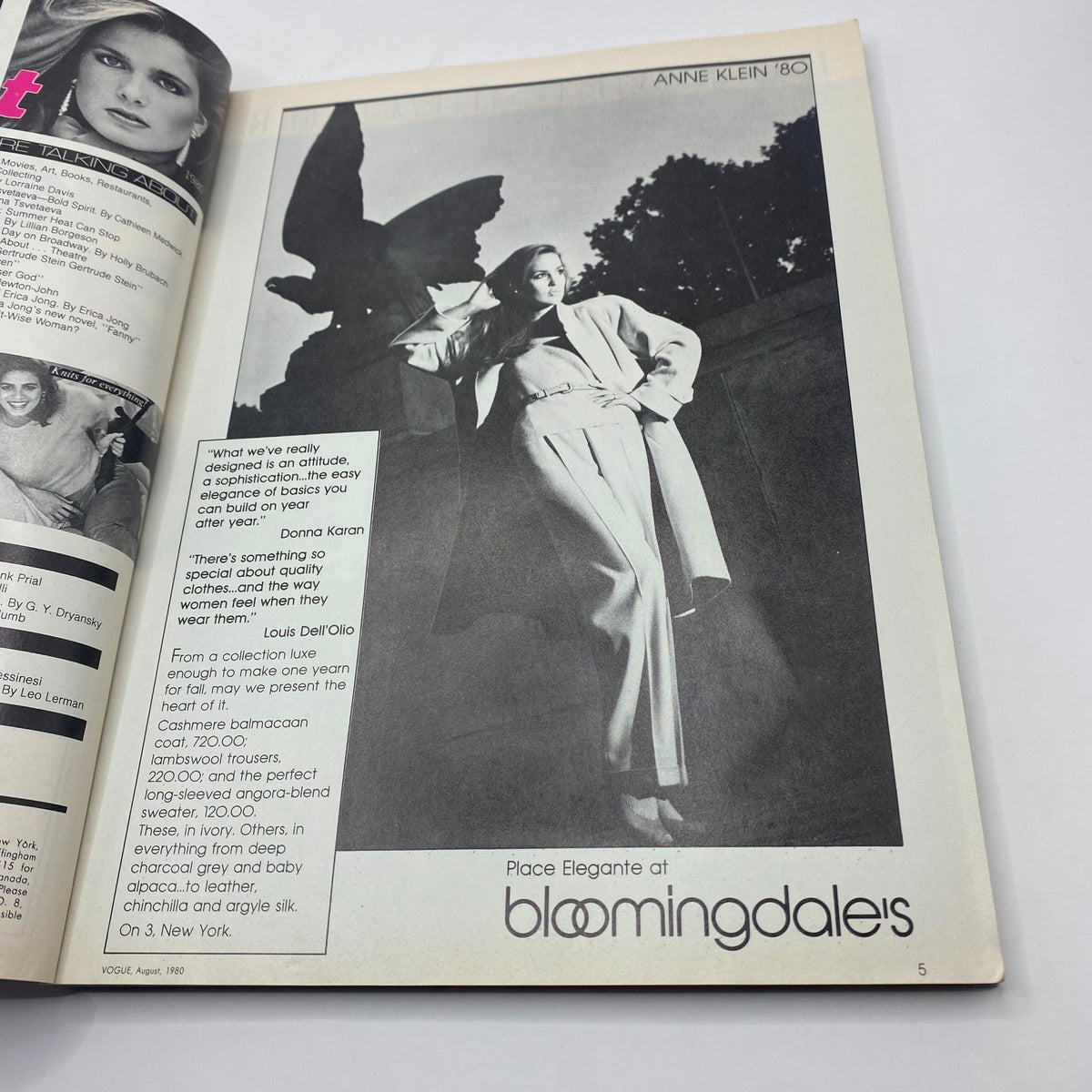
The editorial contents of this issue are rich beyond the cover subject. The fur special report, the Perry Ellis feature with Holly Brubach's profile "An American Original," the Lauren Hutton fashion adventure, the Erica Jong excerpt from Fanny, the Yves Saint Laurent Marrakesh house feature by G.Y. Dransky, and Leo Lerman's piece on Venice's Gritti Palace together constitute a full document of where Vogue's editorial priorities stood in August 1980 — a magazine confidently spanning fashion, literature, design, and lifestyle at a moment when the American fashion industry was entering the commercially explosive decade of the 1980s. The Perry Ellis profile is particularly historically significant: Ellis was in 1980 at the very beginning of the career that would make him one of the defining American designers of the decade, and a Vogue feature at this early stage of his prominence is a primary document of his arrival. For collectors focused on publications from 1980, this issue captures American fashion journalism at a specific and consequential turning point.
About the Publication
Vogue was founded in 1892 and acquired by Condé Nast in 1909, becoming under successive editors the world's preeminent fashion authority. The August 1980 issue appeared during the editorship of Grace Mirabella, who had succeeded Diana Vreeland in 1971 and led the magazine through a period of commercial expansion and editorial broadening that added health, fitness, and practical lifestyle content alongside the traditional fashion and cultural coverage. By 1980, Vogue under Mirabella was the most commercially successful it had ever been, reaching a broad, educated female readership that expected the magazine to engage with their full lives rather than exclusively with high fashion. The editorial range of the August 1980 issue — from Avedon's fashion photography to Maggie Scarf on women's depression to Frank Prial on Italian wines — reflects that broadened editorial mandate at its fullest expression.
Key Highlights Inside
- Cover and editorial photography of Gia Carangi by Richard Avedon — a collaboration between the most significant American model and the most celebrated American fashion photographer of the era, documented at the peak of Carangi's career before the addiction that would end it had fully taken hold.
- Perry Ellis feature including Holly Brubach's profile "An American Original" — an early major Vogue treatment of a designer who would become one of the defining figures of 1980s American fashion, published at the moment of his emergence as a significant creative presence.
- A fashion adventure feature with Lauren Hutton — documenting one of the era's most influential models in the same issue as Carangi, reflecting Vogue's practice of featuring multiple significant model presences within a single edition.
- Fur Appeal special report — a comprehensive fur fashion package including mink 1980 coverage and a buyer's guide, representing one of the last major seasons in which American fashion magazines treated fur as an uncontested prestige category before animal rights activism reshaped the conversation in the mid-1980s.
- Erica Jong excerpt from her novel Fanny, with a profile by Jong herself — representing the magazine's sustained literary engagement alongside its fashion content, and documenting one of the most prominent American female writers of the period at the moment of a new book's publication.
- Yves Saint Laurent's Marrakesh house feature and Leo Lerman on the Gritti Palace in Venice — the living and travel sections documenting the specific geography of European luxury and design culture that Vogue consistently mapped for its readers in this period.
Condition & Rarity
The listing does not itemize specific condition variables beyond the inclusion of a protective covering and the assurance that photographs accurately represent the item's state — cover surface integrity, spine condition, label presence or absence, and page tanning should all be assessed against the accompanying photographs before drawing specific conclusions about grade. The protective sleeve indicates collector-aware storage. For a publication of this age and subject matter, the primary condition factors that affect collecting value are the clarity and surface condition of the cover image — which bears Avedon's photography — and the structural integrity of the binding and page block. Carangi-Avedon Vogue covers from 1980 are sought by collectors across multiple communities simultaneously: fashion history researchers, Avedon photography enthusiasts, Carangi memorabilia collectors, and general Vogue archive builders — a convergence of demand that makes condition particularly consequential for this specific issue.
Looking for More Issues Like This?
Gia Carangi's Vogue appearances are among the most actively collected in the fashion magazine market, and issues pairing her with Avedon represent the apex of that collecting category — they are finite in number and increasingly difficult to locate in strong condition. The dedicated archive of Gia Carangi magazine appearances at OriginalMagazines.com is the most focused starting point for collectors building a chronological record of her career. The broader vintage Vogue collection offers extensive options across the magazine's long run, and the 1980 magazine collection provides wider context from the first year of the decade that would transform American fashion, culture, and commercial life in ways that make its primary documents worth studying carefully.