


Description
Collector's Note – Why This Issue Matters
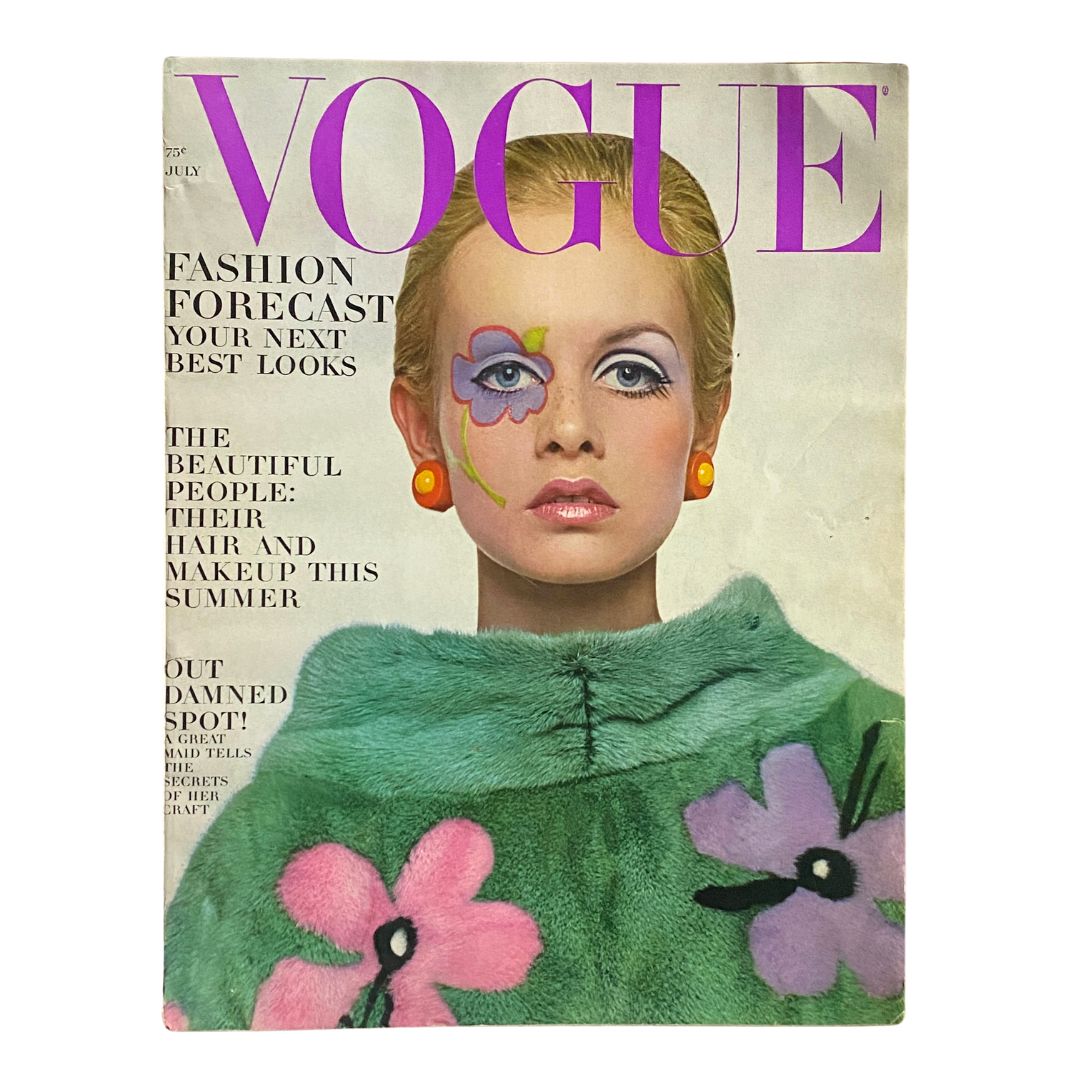
The July 1967 issue of Vogue featuring Twiggy, photographed by Richard Avedon, represents one of the most significant fashion magazine covers of the twentieth century — a convergence of the right subject, the right photographer, and the right cultural moment that produced an image of genuine historical weight. Twiggy — born Lesley Lawson in London in 1949 — had arrived in New York in early 1967 and her reception was immediate and overwhelming. American fashion media had never quite encountered anything like her: the angular silhouette, the enormous painted eyes, the cropped hair, the deliberate departure from every convention of mid-century feminine beauty that had previously defined the model's role. She represented the full arrival of the British cultural invasion in fashion — the Swinging London aesthetic transplanting itself to American newsstands and department stores — and her Vogue cover in July 1967 is the primary document of that arrival in the most authoritative American fashion context possible. Richard Avedon's involvement elevates the issue further: Avedon was at this point not merely a working fashion photographer but one of the defining visual artists of postwar American culture, and his interpretation of Twiggy for Vogue's readership was an act of aesthetic translation that gave the British phenomenon its American canonical form. Collectors building archives of 1960s fashion photography and cultural history will find the Twiggy magazine collection at OriginalMagazines.com an essential resource for tracing her extraordinary media presence across publications during this period.
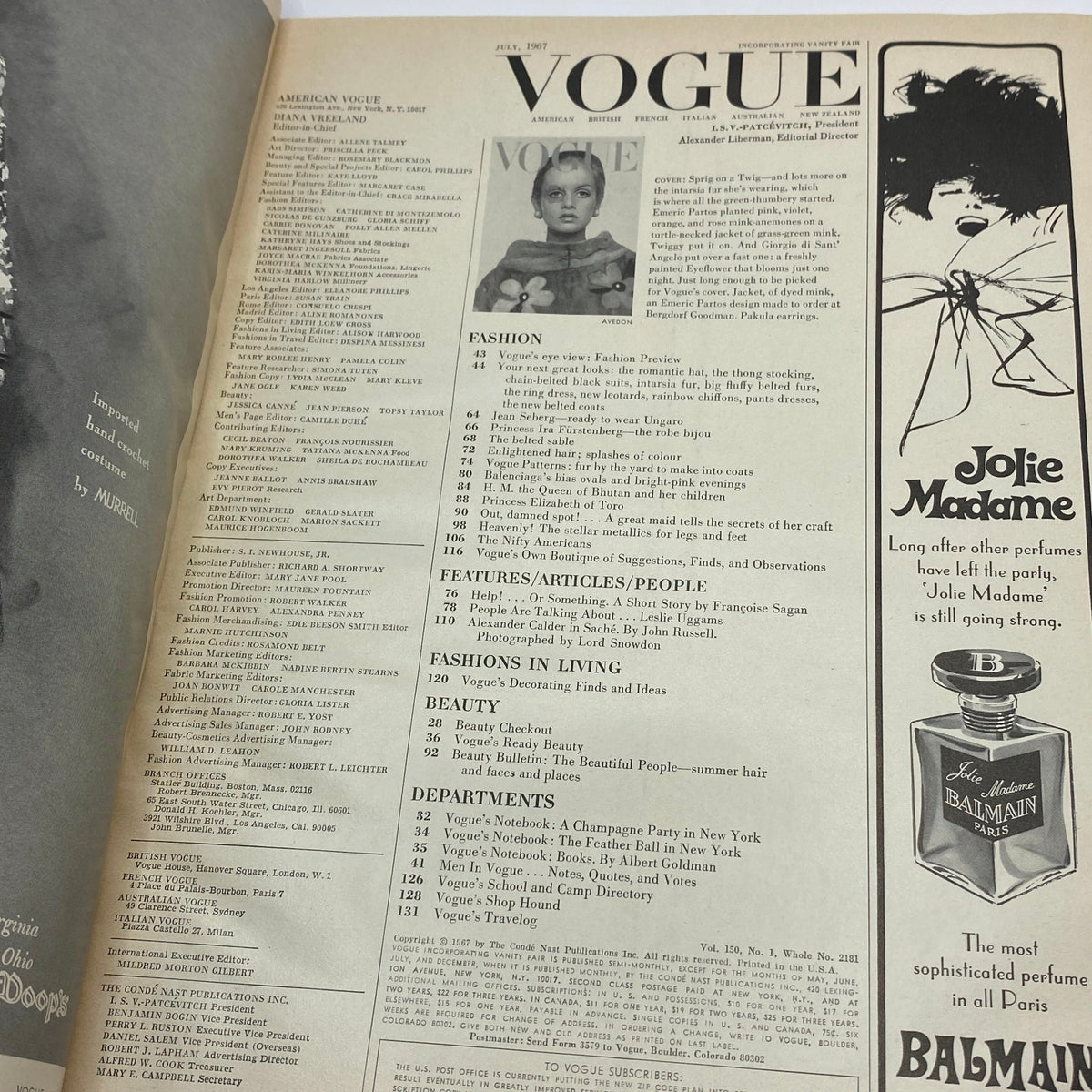
The table of contents for this issue reveals a publication that was simultaneously documenting multiple strands of the cultural revolution happening around it. The fashion content — Balenciaga's bias ovals, Jean Seberg in Ungaro, intarsia fur, the ring dress, the new belted coats — represents the full range of 1967 high fashion at a moment when the industry was being pulled simultaneously toward couture tradition and the youth-driven disruption that Twiggy herself embodied. The literary and cultural content is equally remarkable: a short story by Françoise Sagan, a profile of Alexander Calder photographed by Lord Snowdon, coverage of Leslie Uggams, and book criticism by Albert Goldman place this issue firmly in the tradition of Vogue as a magazine of serious cultural ambition rather than mere fashion reportage. The no-label status of this issue is a meaningful collector attribute — label-free copies of Vogue from this period are the preferred collector state, and their relative scarcity compared to subscriber copies adds to this issue's desirability. Collectors interested in the broader cultural landscape of this extraordinary year can explore the 1967 magazine archive at OriginalMagazines.com, and the full run of Vogue's coverage across its publishing history is archived in the Vogue magazine collection at OriginalMagazines.com.
About the Publication
Vogue is an American fashion and lifestyle magazine founded in New York City in 1892 and published by Condé Nast since 1909. By July 1967 it was operating under the editorship of Diana Vreeland, who had taken the role in 1963 and was in the process of transforming the magazine into one of the most visually and culturally ambitious publications in the history of American media. Vreeland's Vogue was not simply a fashion magazine — it was a vehicle for a particular vision of modern femininity, cultural sophistication, and visual possibility, and its pages in the mid-1960s combined the finest fashion photography of the era with serious literary and cultural content aimed at an educated, cosmopolitan female readership. The magazine's photographers during this period — Avedon, Irving Penn, Helmut Newton, and others — were among the most significant visual artists working in America, and their work for Vogue constitutes a major chapter in the history of twentieth-century photography.
Key Highlights Inside
- Twiggy on the cover, photographed by Richard Avedon — one of the defining fashion images of the 1960s, documenting the full arrival of the British model and the Swinging London aesthetic in American high fashion through the lens of one of the twentieth century's most significant photographers.
- Balenciaga coverage — the legendary Spanish couturier's bias ovals and bright-pink evening designs, representing one of his final creative seasons before his retirement in 1968 and making this issue a document of the very end of his active career.
- Jean Seberg photographed in Ungaro — combining two of the era's most significant cultural figures in a single editorial feature, the French New Wave actress and the Algerian-born Paris couturier who was then at the beginning of his influential career.
- "Help! ... or Something" — a short story by Françoise Sagan, the French novelist whose cultural prominence in this period reflected Vogue's consistent commitment to serious literary content alongside its fashion coverage.
- Alexander Calder in Sâcé, by John Russell, photographed by Lord Snowdon — a cultural feature combining one of the twentieth century's most celebrated sculptors with a writer of serious critical reputation and a photographer of considerable cultural prominence in his own right.
- Coverage of Princess Ira Fürstenberg, Princess Elizabeth of Toro, and H.M. the Queen of Bhutan — a global aristocratic and royal social register entirely consistent with Vogue's mid-1960s editorial vision under Diana Vreeland, which was simultaneously cosmopolitan, aspirational, and genuinely international in its social frame of reference.
Condition & Rarity
The listing confirms no subscriber label on the cover and plastic protective covering — the two most collector-relevant condition attributes for a Vogue issue of this era. The absence of a label identifies this as a newsstand copy, eliminates any cover surface disruption, and places it in the preferred collector state for mid-1960s Vogue issues. The listing directs condition assessment to the accompanying photographs rather than providing a specific grade, which collectors should review directly for information about cover surface integrity, spine condition, and interior page quality. For a glossy monthly of this vintage — now nearly sixty years old — the key evaluation points are color retention in Avedon's cover photography, structural integrity of the spine and binding, and the completeness of the interior page block. The Twiggy-Avedon combination gives this issue collector demand that extends well beyond the traditional Vogue audience into fashion photography history, 1960s cultural history, and dedicated Twiggy archivists — a convergence of collector communities that sustains consistent and active interest in clean copies of this issue across all condition grades.
Looking for More Issues Like This?
A no-label newsstand copy of the July 1967 Vogue with Twiggy photographed by Avedon is one of the most sought-after fashion magazine covers of the decade — the combination of subject, photographer, and cultural moment is unrepeatable, and clean copies in any condition attract serious collector attention whenever they surface. If this issue is no longer available, the Twiggy magazine collection at OriginalMagazines.com is the most focused resource for her appearances across publications during her extraordinary mid-1960s media moment. The Vogue archive is equally worth exploring for other landmark covers from the Vreeland era, and the 1967 magazine archive offers the full picture of American print culture during one of the most culturally charged years of the twentieth century.