



Description
Collector's Note – Why This Issue Matters
The May 1987 issue of Vogue represents a precise and luminous intersection of two careers that defined the visual language of fashion photography in the twentieth century. Tatjana Patitz was, by the mid-1980s, establishing herself as one of the most photographed and editorially sought-after models in the world — a German-born, Swedish-raised presence whose combination of sculptural bone structure, cool intelligence, and almost unsettling photographic stillness set her apart from the more exuberant glamour of many of her contemporaries. She would later become one of the five supermodels featured in George Michael's "Freedom '90" video in 1990, a cultural moment that cemented the supermodel phenomenon in popular consciousness, but the editorial work she was producing for Vogue in the mid-1980s was already at the highest level of the industry. Richard Avedon, meanwhile, had been one of the defining photographers of American fashion for four decades by 1987 — his work for Harper's Bazaar throughout the 1950s and 1960s had essentially reinvented fashion photography as an art form, and his subsequent career at Vogue continued to set the standard for what the genre could achieve at its most ambitious. A cover and editorial package uniting Patitz and Avedon in May 1987 is, for collectors tracing the full arc of Tatjana Patitz's presence in fashion print media, one of the most significant single issues in that archive.
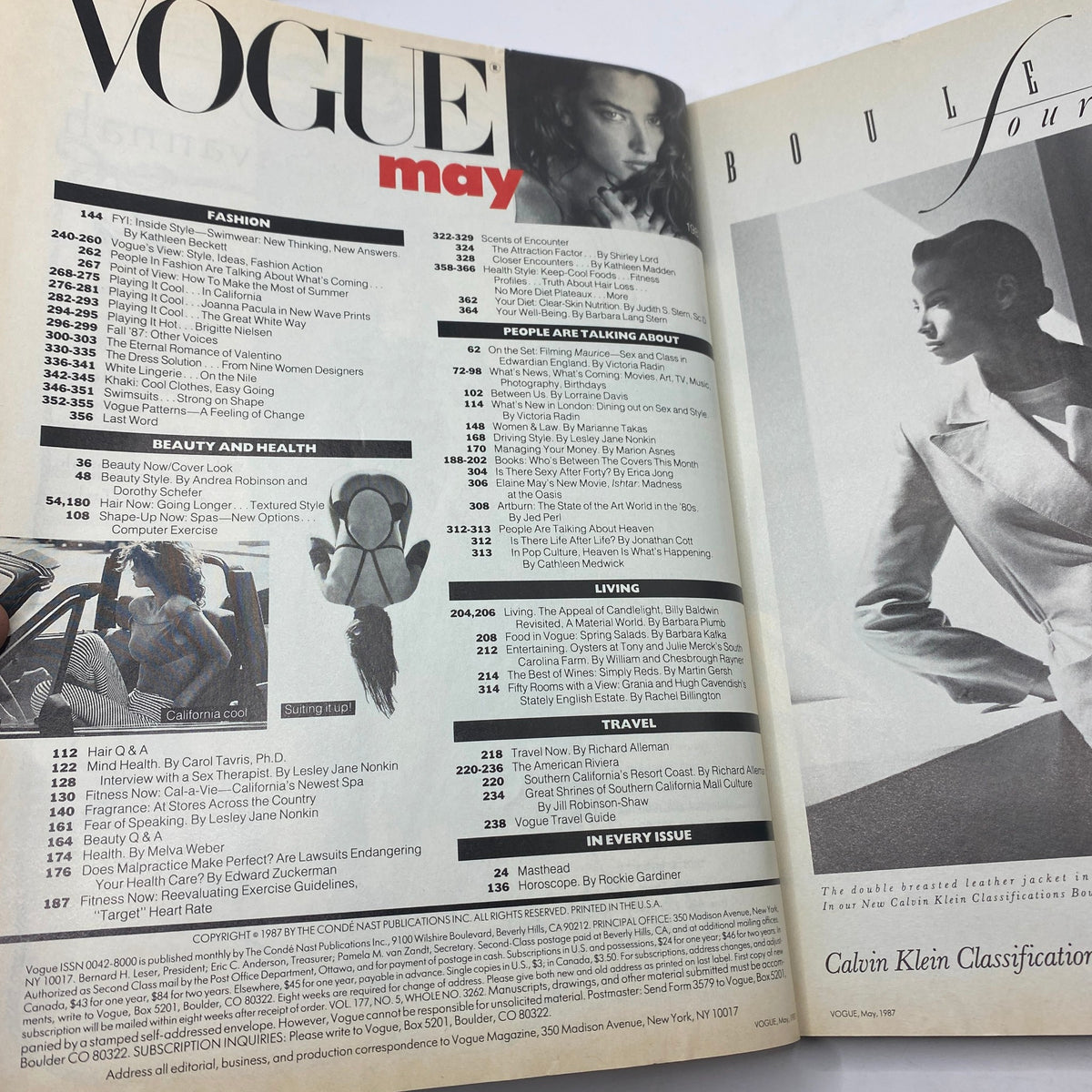
The broader context of Vogue in May 1987 adds further depth to this issue's collecting significance. Grace Mirabella was still editor-in-chief — she would be replaced by Anna Wintour in 1988 in one of the most discussed editorial transitions in magazine history — and the magazine under her tenure had a distinctive character that differed meaningfully from what Vogue would become under Wintour's more aggressively trend-driven and celebrity-focused direction. Mirabella's Vogue was, in the view of many fashion historians, more genuinely interested in clothing as a practical and aesthetic matter for real women, and the editorial mix reflected that — substantive writing on health, culture, travel, and society alongside the fashion spreads, with a breadth of intellectual content that gave the magazine a seriousness of purpose that its detractors sometimes missed. This May 1987 issue, with its extraordinarily rich table of contents, exemplifies that editorial model at full strength: Erica Jong on sexuality after forty, Jonathan Cott on life after death, Edward Zuckerman on medical malpractice, coverage of the filming of Maurice, and a deep dive into Southern California resort culture all share pages with Avedon's photography and the season's fashion editorial. For collectors building a comprehensive run of Vogue across the Mirabella years, this issue is a particularly strong representative of the era's editorial ambition.
The specific editorial contents documented in this issue also make it valuable as a primary source for fashion and cultural historians working on the period. The fall 1987 fashion coverage — including "Fall '87 Other Voices," "The Eternal Romance of Valentino," and "The Dress Solution… From Nine Women Designers" — captures the industry at a transitional moment, with the maximalist power-dressing aesthetic of the early 1980s beginning to give way to softer silhouettes and more varied influences. The swimwear and summer fashion content reflects a seasonal editorial approach to California lifestyle culture that was itself a significant strand of 1980s fashion media. And the cultural coverage — ranging from Elaine May's Ishtar to a piece on the contemporary art world by Jed Perl to an exploration of "heaven" as a pop cultural phenomenon — reflects a magazine that understood its role as a document of its moment rather than merely a catalog of its season. The full magazine landscape of 1987 was one of the richest and most consequential years of the decade in American publishing, and this Vogue issue is one of its finest single artifacts.
About the Publication
Vogue is the oldest and most internationally influential American fashion magazine, founded in 1892 and acquired by Condé Nast Publications in 1909, under whose ownership it developed into the definitive authority on high fashion, beauty, and style for the American market and eventually for fashion culture globally. By the mid-1980s, under editor-in-chief Grace Mirabella — who had held the position since 1971 — the American edition maintained a circulation of well over one million and was widely regarded as the most authoritative single voice in the American fashion industry, setting seasonal trends, conferring prestige on designers and models who appeared in its pages, and serving as the primary platform through which the international fashion industry communicated with the American consumer. Its editorial format combined high-production fashion photography and seasonal style coverage with substantial long-form journalism on health, culture, travel, relationships, and society — a breadth that distinguished it from more narrowly focused fashion titles and gave it a cultural weight that extended well beyond the fashion industry itself. The late Mirabella era, encompassing the mid-to-late 1980s before Anna Wintour's arrival in 1988, is considered by many fashion historians to represent a distinct and underappreciated chapter in the magazine's history — one characterized by genuine editorial range and a commitment to substantive writing alongside the visual content that defined the publication's identity.
Key Highlights Inside
- Cover photography by Richard Avedon featuring Tatjana Patitz — one of the defining pairings of model and photographer in 1980s fashion editorial, uniting a model at the height of her early career prominence with a photographer whose fifty-year body of work had shaped the entire discipline of fashion photography.
- Comprehensive fall 1987 fashion preview content including "Fall '87 Other Voices," a feature on Valentino, and "The Dress Solution… From Nine Women Designers" — a seasonal editorial package capturing the industry at a transitional moment between the power-dressing maximalism of the early decade and the evolving aesthetic directions of the late 1980s.
- Summer fashion and swimwear editorial including "Playing It Cool… In California," "Playing It Cool… Joanna Pacula in New Wave Prints," "Playing It Cool… Brigitte Nielsen," and "Swimsuits… Strong on Shape" — a seasonal package reflecting the California lifestyle influence on mainstream American fashion coverage in the mid-1980s.
- "Is There Sexy After Forty?" by Erica Jong — a culture and sexuality essay by one of the most prominent and provocative American writers of the era, whose 1973 novel Fear of Flying had made her a defining voice in the cultural conversation about women's sexuality and autonomy.
- "On the Set: Filming Maurice — Sex and Class in Edwardian England" by Victoria Radin — coverage of the Merchant Ivory production that would go on to win the Best Director prize at Cannes in 1987, reflecting Vogue's consistent interest in prestige film culture alongside its fashion content.
- "Artburn: The State of the Art World in the '80s" by Jed Perl, alongside cultural coverage of Ishtar, a meditation on heaven in pop culture, and a London dining and style report — demonstrating the breadth of intellectual and cultural content that characterized the Mirabella-era Vogue at its most editorially ambitious.
Condition & Rarity
This issue is presented without a mailing label on the cover, confirming newsstand origin and preserving the full visual presentation of Avedon's Patitz cover photograph without the adhesive damage or paper obscuring that subscriber labels frequently caused on Vogue covers of this era. For a title with the circulation figures Vogue maintained in the mid-1980s, a significant proportion of surviving copies carry subscriber labels, making clean newsstand editions meaningfully less common in the collector market than the magazine's original print run might suggest. The plastic protective covering present on surviving copies in this condition provides ongoing preservation support for both the cover stock — Vogue of this era was printed on a heavier, higher-quality coated stock than most competing titles, which holds up well under careful storage — and the interior pages, which include the kind of high-production photography spreads that represent the primary visual value of the issue for most collectors. The listing notes that condition should be assessed from the provided photographs, which is the appropriate standard for a publication of this age and significance. When evaluating any surviving copy of this May 1987 issue, collectors should pay particular attention to the cover gloss retention around the Patitz portrait, the spine integrity along the perfect binding — thick issues of Vogue from this period can show stress cracking along the spine fold on heavily handled copies — the flatness and tanning levels of the interior page block, and the condition of the Avedon photography spreads, which are the visual centerpiece of the issue and the primary factor in its collector appeal.
Looking for More Issues Like This?
Mid-1980s Vogue issues featuring major Avedon photography in label-free newsstand condition represent a genuinely premium tier of the fashion magazine collecting market — the combination of one of the century's great photographers, a model at the beginning of what would become a defining supermodel career, and the editorial depth of the late Mirabella era makes this a document that serious fashion collectors pursue with real dedication. The full Tatjana Patitz magazine archive at OriginalMagazines.com is the most focused place to explore her other significant editorial appearances across the peak years of her career. The complete Vogue collection spans a wide range of years and covers from across the magazine's long history and is essential browsing for anyone building a serious run of the title, particularly from the Mirabella and early Wintour years. For collectors working through the broader fashion and cultural magazine landscape of this pivotal decade, the complete 1987 magazine collection covers the full range of titles from one of the richest years in 1980s American publishing.