




Description
Collector's Note – Why This Issue Matters
October 2001 was one of the most emotionally and culturally charged months in recent American history. The September 11 attacks had occurred just weeks before this issue would have reached newsstands, and the fashion world — like every other corner of American cultural life — was navigating an abrupt and disorienting shift in what felt appropriate, relevant, and worth celebrating. That W Magazine went to press and reached readers in that atmosphere with a cover as boldly glamorous as this one makes the issue a document of something beyond fashion. It captures the industry at a precise moment of reckoning, continuing to do what it does while the world it operated in had fundamentally changed. For collectors interested in the intersection of fashion publishing and cultural history, the October 2001 issue occupies a uniquely weighted position in the magazine's run. Those building an archive of magazines from 2001 will find this issue among the most historically resonant of the year across any title.
Gisele Bündchen on the cover is not incidental to this issue's significance — it is central to it. By October 2001, Gisele had already completed a transformation from promising newcomer to the dominant figure in international fashion modeling. Her ascent through the late nineties had been remarkable for its speed and its totality; she had effectively single-handedly rehabilitated the commercial viability of the curvy, overtly sensual aesthetic at a moment when the industry had spent years moving in a very different direction. A W cover in this period was a serious editorial statement, not a routine booking, and her presence here reflects both her stature in the industry and the magazine's own ambitions. Collectors focused on Gisele Bündchen's magazine cover appearances will recognize this issue as one of her more significant early-decade placements — a W cover from the peak of her first wave of dominance in the industry.
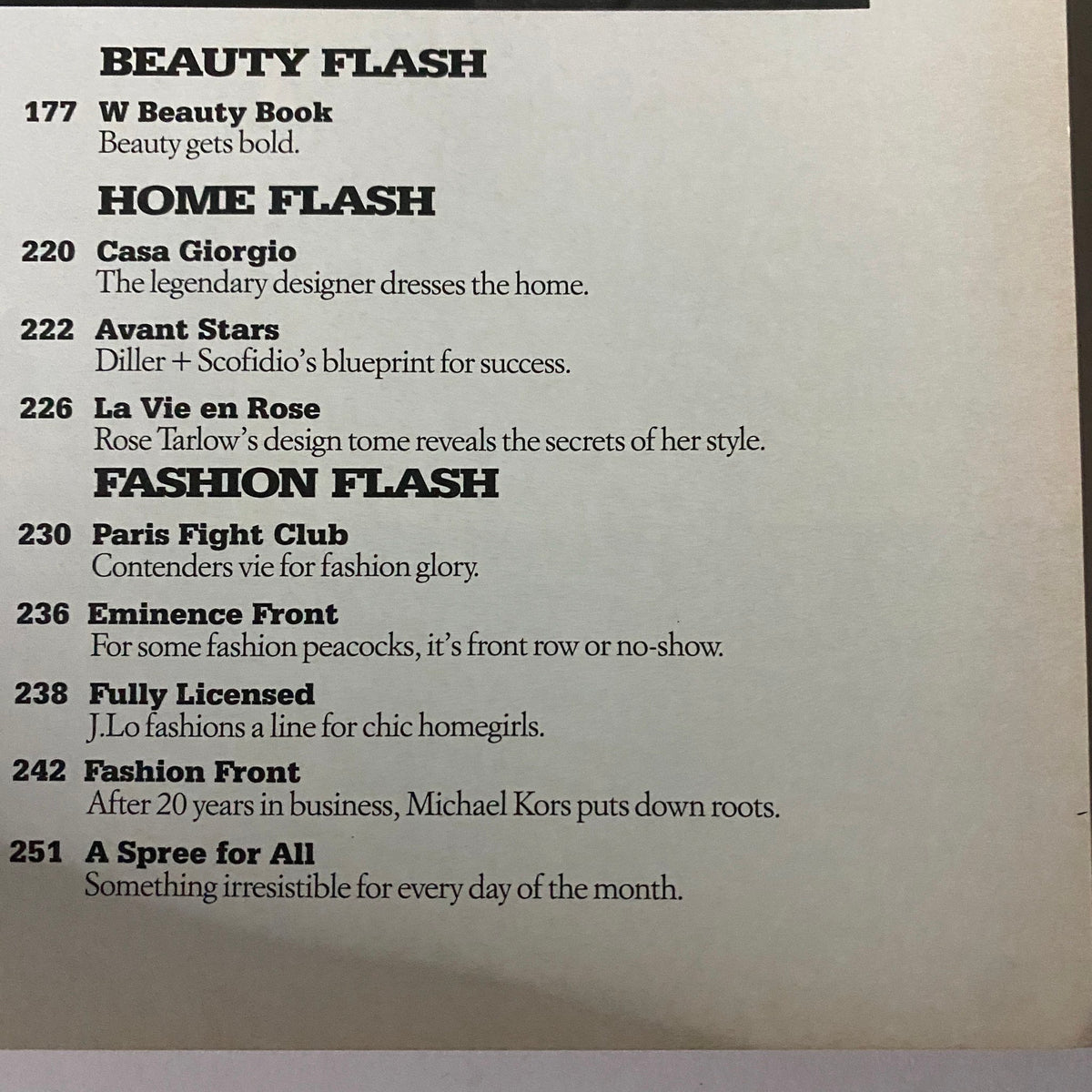
The editorial content documented inside deepens the issue's value considerably beyond the cover alone. With features spanning designer retrospectives, architecture, interior design, beauty, and the competitive theater of Paris fashion week, this issue reflects W's distinctively expansive editorial vision — a magazine that treated fashion as one element of a broader luxury cultural conversation rather than its sole subject. Michael Kors marking twenty years in business, the design world of Giorgio Armani, and the architectural practice of Diller + Scofidio all appearing in the same issue as a Gisele cover speaks to what made W genuinely different from its competitors. Collectors building a comprehensive W Magazine archive will find this issue representative of the title at a moment of particular editorial confidence and cultural weight.
About the Publication
W Magazine was launched in 1972 as a spin-off of Women's Wear Daily, the influential trade publication of the fashion industry, and it quickly established itself as a distinctive presence in the luxury magazine market. Where most women's fashion titles addressed their readers as consumers of fashion, W addressed them as participants in a broader world of art, design, architecture, and culture in which fashion was simply one — if central — element. Its oversized format, lavish photography budgets, and willingness to publish long, serious features alongside its fashion editorial gave it an identity unlike any other title in its category. By the late nineties and early 2000s it had evolved into one of the most visually ambitious magazines being published anywhere in the world, regularly commissioning work from the most significant fashion photographers of the era and treating each issue as something closer to an art object than a conventional periodical. Its readership was affluent, culturally engaged, and accustomed to the magazine delivering something that rewarded close attention — which it consistently did.
Key Highlights Inside
- Gisele Bündchen cover — A no-label newsstand copy of this cover represents the cleanest surviving presentation of one of Gisele's most significant magazine appearances of the early decade, documented at the height of her first period of industry dominance and in the emotionally complex cultural atmosphere of October 2001.
- W Beauty Book: Beauty gets bold — A dedicated beauty editorial reflecting the early-nineties trend toward more assertive, high-impact beauty aesthetics that was emerging as a counterpoint to the minimalism that had defined much of the late nineties.
- Casa Giorgio: The legendary designer dresses the home — A feature on Giorgio Armani's expansion into interior design and home, documenting the broader movement among major fashion designers to extend their aesthetic vision beyond clothing into the designed environment.
- Avant Stars: Diller + Scofidio's blueprint for success — Coverage of the influential architectural and design practice Diller + Scofidio, whose work at the intersection of architecture, performance, and media was generating significant attention in cultural circles at this moment. Its inclusion here is characteristic of W's commitment to treating design and architecture as fashion's natural cultural neighbors.
- Paris Fight Club: Contenders vie for fashion glory — A feature on the competitive dynamics of Paris Fashion Week, capturing the industry's internal hierarchy and the enormous stakes of the seasonal collections at a moment when the fashion calendar was reasserting itself in the aftermath of September's disruptions.
- Fashion Front: Michael Kors marks 20 years in business — A retrospective on Michael Kors reaching his twentieth year as a designer, a milestone that in October 2001 placed his career arc in significant historical context and documented his evolution from emerging talent to established American fashion institution.
Condition & Rarity
Surviving copies of this issue in excellent condition with no address label represent the strongest possible presentation of a newsstand-origin copy from this period. The absence of a subscription label on the cover is a meaningful distinction in the collector market for W Magazine specifically — the title's oversized format and full-bleed cover photography mean that even a small label placed over the cover image results in a disproportionate visual intrusion, making clean newsstand copies substantially more desirable than their subscriber equivalents. Light wear consistent with over two decades of age is expected and does not materially diminish display quality. The plastic protective covering noted in well-preserved copies indicates deliberate preservation stewardship, reducing the risk of surface scuffing, moisture damage, and the spine cracking that is the most common structural failure in large-format magazines of this era and weight. Collectors evaluating any copy of this issue should assess the cover for surface abrasion — W's heavy coated stock shows handling marks more readily than standard magazine paper — along with spine integrity, which on an issue of this physical size is the primary structural vulnerability to look for.
Looking for More Issues Like This?
The October 2001 Gisele Bündchen cover is one of the more sought-after issues in W's early-2000s run, and clean no-label copies are genuinely difficult to locate in the collector market. If Gisele's magazine work is the focus of your search, the Gisele Bündchen magazine covers collection at OriginalMagazines.com is the most efficient place to survey what's currently available across her extensive career in print. For collectors working title-first, the W Magazine collection offers a broad range of issues across the publication's run, and the 2001 magazines collection is worth exploring for anyone building a document of that particular and historically weighted year in American print culture.