


Description
Collector's Note – Why This Issue Matters
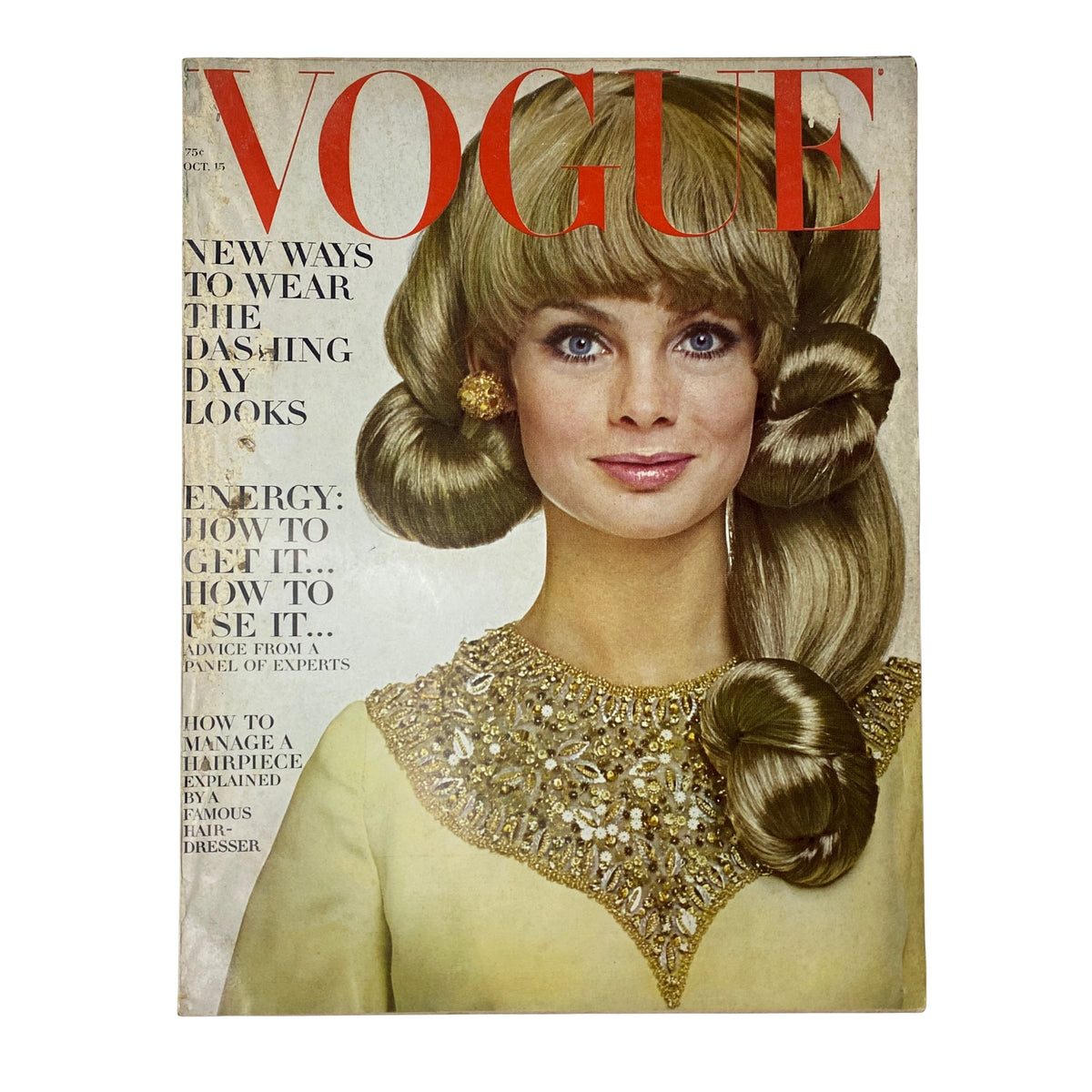
The October 15, 1966, issue of Vogue — incorporating Vanity Fair, under publisher L.S.V. Patcevitch and editorial director Alexander Liberman — places Jean Shrimpton on the cover at the absolute peak of her reign as the defining face of 1960s fashion. Shrimpton had risen to international prominence through her work with photographer David Bailey beginning in the early 1960s, and by 1966 she was arguably the most recognized model in the world — the embodiment of the mod era's particular vision of femininity: long-limbed, slightly detached, effortlessly contemporary. A Vogue cover in October 1966 was still among the most prestigious placements in fashion media, and Shrimpton's appearance here reflects both her continued dominance and the magazine's confidence in her as the face capable of anchoring its most important seasonal issue. For collectors tracking Jean Shrimpton magazine covers across her career, this mid-decade Vogue appearance is one of the most contextually rich — arriving at the moment when the first generation of supermodels had made themselves into cultural figures as recognizable as the designers whose clothes they wore.
The editorial content of this issue is exceptional in its breadth and its documentation of where fashion stood in the autumn of 1966. The fur fashion package — "The Girl in the Fabulous Furs," "The Great Fur Caravan," "Silver-and-Gold Furs," and the spread featuring both Raquel Welch and Veruschka in pale furs — constitutes a complete record of how Vogue was presenting luxury outerwear at a moment when the fashion industry was simultaneously embracing opulence and negotiating the democratizing pressures of the mod revolution. Veruschka's presence alongside Welch is itself a notable editorial pairing: two of the era's most visually striking personalities, each representing a different pole of 1960s beauty culture. The Pauline de Rothschild contributions — both a travel piece and a home feature on her "worldly retreat" — situate the issue within the aristocratic-cosmopolitan register that Vogue maintained alongside its fashion content throughout this period. For collectors building a serious run of vintage Vogue issues, the October 15, 1966, edition offers an unusually complete picture of the magazine's editorial range at mid-decade.
The broader cultural moment of October 1966 adds further dimension. This was the year that Vogue was navigating the full force of the mod revolution while maintaining its commitment to the luxury fashion tradition — a balancing act visible in the contrast between a major fur fashion package and coverage of London's swinging party scene in the same issue. The Philippe Leroy "Strip-Go-Round" feature and the "Swinging Party Near Madrid" notebook entry speak to the liberalizing cultural currents of the mid-1960s, while the Pauline de Rothschild and silver collector features anchor the issue in a more classical world of European wealth and taste. Collectors focused on publications from 1966 will find this issue one of the most complete single-edition documents of that productive tension.
About the Publication
Vogue was founded in 1892 and acquired by Condé Nast in 1909, becoming under his direction and the long influence of subsequent editors the world's preeminent fashion authority. By October 1966, with Alexander Liberman serving as editorial director and Diana Vreeland as editor-in-chief — a tenure that ran from 1963 to 1971 and is widely regarded as one of the most creatively adventurous in the magazine's history — Vogue was producing some of the most ambitious editorial fashion photography and cultural commentary of any magazine in the world. The twice-monthly publication schedule of the mid-1960s American edition meant that October produced two major issues, each carrying the weight of the autumn fashion season. The incorporation of Vanity Fair, noted on the cover masthead, reflected Condé Nast's consolidation of two of his flagship titles — a merger that had taken effect in 1936 and continued to be acknowledged in the masthead through this period.
Key Highlights Inside
- Cover photograph of Jean Shrimpton, one of the defining faces of 1960s fashion, appearing during the peak years of her international prominence and her association with the era's most significant editorial fashion photography.
- Major autumn fur fashion package including "The Great Fur Caravan" by Mary Burr, "Silver-and-Gold Furs," and a spread featuring Raquel Welch and Veruschka in pale furs — a comprehensive document of how Vogue presented luxury outerwear at the height of the mid-1960s fashion season.
- A fashion spread incorporating a look at Audrey Hepburn, photographed at the Secret Snow Inn Garden — connecting the issue's contemporary fashion coverage to one of the decade's most enduring style icons.
- Contributions by and features on Pauline de Rothschild, including travel notes on a transatlantic voyage and a home feature on her worldly retreat — representing the aristocratic-cosmopolitan dimension of Vogue's editorial identity alongside its fashion content.
- Vogue's Notebook sections covering Paris, San Francisco, and Madrid, alongside film criticism by Myrna Mannes and book coverage by Jean Stafford — documenting the full range of the magazine's cultural engagement beyond fashion.
- Beauty coverage including a hairpiece feature explained by Kenneth, the influential New York hairstylist whose client list in the 1960s included Jacqueline Kennedy — a specific and documentable connection between this issue's beauty content and the broader celebrity culture of the era.
Condition & Rarity
This issue presents with a condition profile that requires honest evaluation. The noted water damage is the primary factor affecting its grade and display potential — water damage on a Vogue issue of this vintage typically manifests as tide lines, page waviness, possible ink bleeding, and cover discoloration, and its extent and location should be carefully assessed against the accompanying photographs before drawing conclusions about how significantly it affects the cover image and interior fashion photography. The listing notes that the magazine maintains a readable interior despite the cover wear, which suggests the water damage is concentrated toward the exterior of the issue rather than throughout the page block — a meaningful distinction for researchers and content-focused collectors. The absence of an address label on the cover is a genuine positive for display purposes under any condition grade. The plastic protective sleeve provides ongoing protection against further deterioration. For collectors whose primary interest is the complete table of contents — one of the most fully documented in any listing for this issue — a readable copy with intact pages represents legitimate research value regardless of cosmetic condition.
Looking for More Issues Like This?
Jean Shrimpton's Vogue covers from the mid-1960s are among the most actively collected in the magazine's archive, and issues with this level of documented interior content are particularly valuable to fashion historians and researchers. The full archive of Jean Shrimpton magazine appearances at OriginalMagazines.com is the most focused starting point for collectors tracing her career across publications and years. The broader vintage Vogue collection offers extensive options across the magazine's long run, and the 1966 magazine collection provides wider context from one of the most visually and culturally consequential years in twentieth-century fashion history.