

Description
Collector's Note – Why This Issue Matters
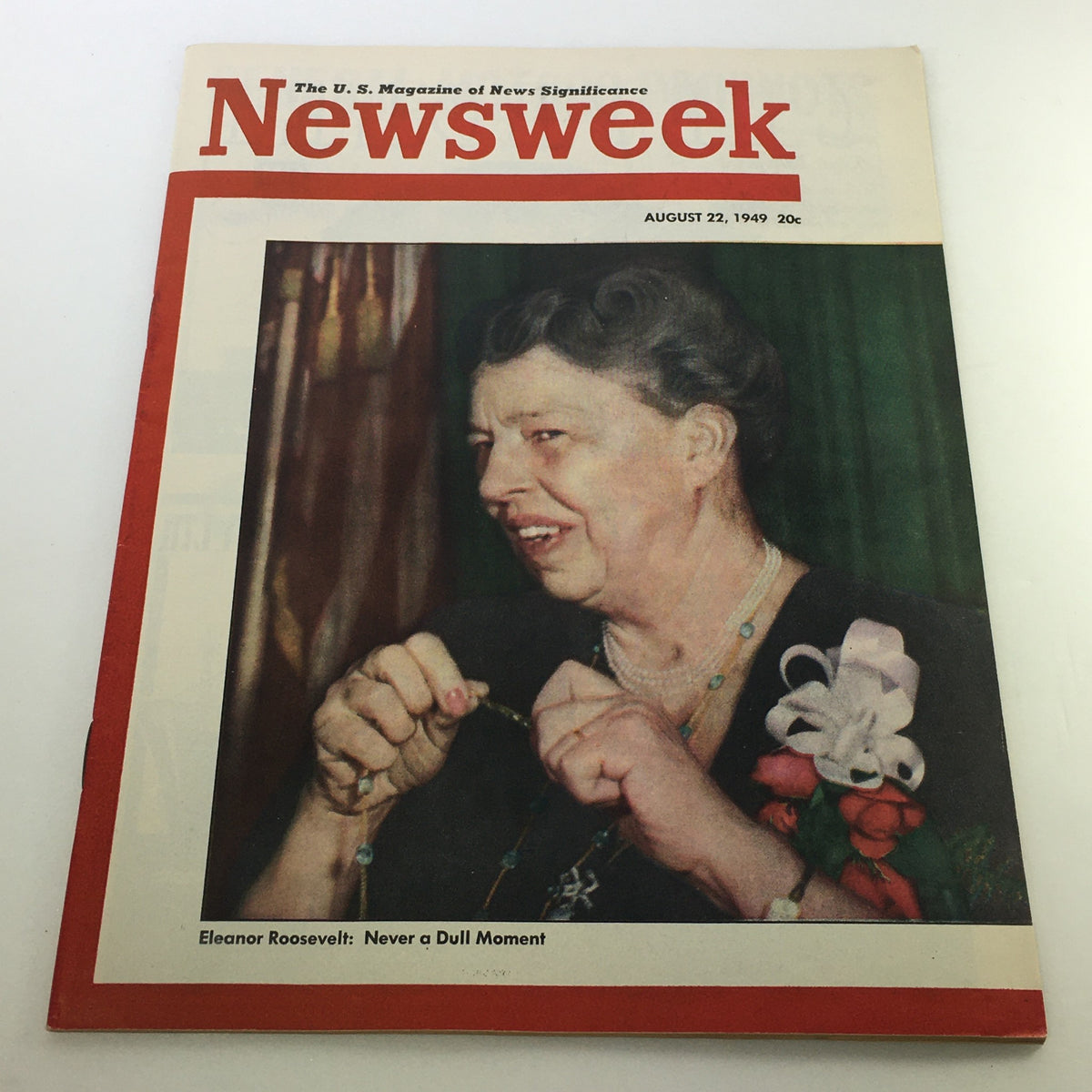
The August 22, 1949 issue of Newsweek featuring Eleanor Roosevelt on the cover is a primary document of one of the most consequential and genuinely extraordinary figures in the history of American public life — and its publication date places it at one of the most productive and historically significant phases of Roosevelt's postwar career. By August 1949, Eleanor Roosevelt was sixty-four years old and had been a private citizen for more than four years, since Franklin Roosevelt's death in April 1945 had ended her tenure as First Lady. But the description of her as a "private citizen" is almost comically inadequate. Truman had appointed her as a United States delegate to the United Nations in December 1945, and she had served in that capacity with extraordinary distinction — most importantly as the chair of the UN Commission on Human Rights, which had produced the Universal Declaration of Human Rights, adopted by the UN General Assembly on December 10, 1948. That declaration, which Eleanor Roosevelt had shepherded through an extraordinarily complex process of drafting, negotiation, and consensus-building among nations with profoundly different political systems and cultural values, is widely regarded as one of the most significant documents in the history of international human rights. A Newsweek cover in August 1949 — less than a year after the Universal Declaration's adoption — captures Roosevelt at the peak of her postpresidential influence, at a moment when her reputation as a global figure of moral authority was arguably greater than it had been at any point during her years in the White House. For collectors building around Eleanor Roosevelt magazine covers, this August 1949 issue represents one of the most historically specific and substantively important appearances in her postwar media presence.
The specific historical context of August 22, 1949 gives this issue a richness that extends well beyond Eleanor Roosevelt's individual biography. The year 1949 was, as a whole, one of the most consequential and alarming in the history of the early Cold War — the Soviet Union had detonated its first atomic bomb in August, the People's Republic of China had been proclaimed in October, and the Western alliance was actively constructing the institutional architecture of Cold War containment. The United Nations in 1949 was still in its earliest and most idealistic phase, operating with the genuine belief — however complicated the political realities were making it — that international institutions could prevent the kind of catastrophic conflict that had just ended. Eleanor Roosevelt's role at the UN placed her at the center of that institutional project, and her personal authority — her moral credibility, her global recognition, and her genuine commitment to the principles of the Universal Declaration — gave the UN's human rights work a visibility and legitimacy it might otherwise have lacked. A Newsweek cover devoted to her in this context was an editorial recognition that Roosevelt was not merely a former First Lady but an active and consequential figure in the most important international institution of the postwar era. For collectors focused on vintage Newsweek issues with a focus on American women in public life and Cold War history, this cover represents a primary document of unusual historical weight and documentary richness.
Eleanor Roosevelt's broader significance as a historical figure — and as a subject for magazine collectors — deserves careful appreciation, because her trajectory from First Lady to global human rights icon is one of the most remarkable second acts in American public life. She had, by August 1949, outlasted and outgrown the political constraints of her years in the White House, during which her genuine progressive commitments had frequently been subordinated to the political calculations of her husband's administration. As a UN delegate and as a public intellectual, columnist, radio personality, and activist, the postwar Eleanor Roosevelt was in many ways more fully herself than the wartime First Lady had been — more direct, more willing to stake out positions that made powerful people uncomfortable, more clearly the moral voice that history has recognized her as. A Newsweek cover at this particular moment in her career captures that postwar Roosevelt — the figure who would continue to be a major presence in American and international public life until her death in 1962 — at one of her most historically productive and personally realized phases. For collectors focused on magazines from 1949, this issue documents one of the twentieth century's most significant women at a moment of genuine and consequential public authority.
About the Publication
Newsweek was founded in 1933 and had established itself by the late 1940s as one of the two or three most authoritative and widely read news magazines in the United States, competing directly with Time for the allegiance of the educated, civically engaged American readership that consumed weekly news analysis as a matter of regular civic habit. Its editorial format organized the week's news into clearly defined sections covering national and international affairs, business, science, medicine, and culture, written with the assumption that its readers were intelligent adults who wanted both information and interpretation. Its cover choices were deliberate editorial statements about who and what mattered in American public life at a given moment, and a cover devoted to Eleanor Roosevelt in August 1949 — in the immediate aftermath of the Universal Declaration of Human Rights and in the midst of the early Cold War's most anxious phase — reflects the editorial judgment that Roosevelt was not a historical figure but an active and consequential contemporary force in American and international life. The magazine's coverage of women in public life during this period was more substantive and seriously considered than most of its contemporaries, reflecting an editorial staff that understood figures like Roosevelt as political and intellectual actors rather than merely social celebrities.
Key Highlights Inside
- Eleanor Roosevelt cover feature — UN human rights work: A Newsweek cover appearance in August 1949 would almost certainly have been accompanied by substantial interior coverage of Roosevelt's role at the United Nations — her leadership of the Commission on Human Rights, the Universal Declaration's significance and reception, and her broader position as one of the most recognized and respected American figures in international public life in the immediate postwar period. The specific content of that feature is not confirmed from available listing details, but the cover placement makes interior engagement with the subject essentially certain.
- Universal Declaration of Human Rights context: Published less than a year after the Universal Declaration's adoption on December 10, 1948, any serious treatment of Eleanor Roosevelt in August 1949 would have engaged the declaration's significance, the process of its creation, Roosevelt's personal role in shepherding it through the UN's complex political dynamics, and the question of what the declaration's adoption meant for the future of international human rights law and institutions.
- Early Cold War and UN international coverage: August 1949 falls in one of the most consequential phases of the early Cold War — just weeks before the Soviet atomic bomb test that would shatter American assumptions about nuclear monopoly — and any Newsweek issue from this date would have engaged the developing international situation and the UN's role within it with the urgency and analytical depth that the moment demanded.
- Eleanor Roosevelt's postwar public role: By August 1949, Roosevelt had established herself as one of the most active and consequential American public figures of the postwar era — a syndicated columnist, radio broadcaster, UN delegate, and global moral authority whose postpresidential career was in many respects more fully realized than her White House years. Any serious Newsweek profile of this period would have engaged the full range of her activities and influence.
- Period advertising and domestic American coverage: The advertising and domestic news content of an August 1949 issue of Newsweek constitutes primary historical material reflecting the commercial landscape and everyday aspirations of Americans at the beginning of the postwar prosperity that would define the following decade, providing the documentary context within which Roosevelt's international work was situated and understood by its original readers.
- Note: Specific interior articles, column subjects, named contributors, and individual features beyond the Eleanor Roosevelt cover story have not been confirmed from available listing details. The above reflects what is verifiable from the cover subject, publication date, and the well-documented editorial practices and news environment of Newsweek in August 1949.
Condition & Rarity
A seventy-six-year-old weekly newsmagazine surviving in newsstand condition without a mailing label is a meaningful archival result, and the condition attributes described — potential edge and binding wear with marks and small rips — place this issue in the honest and contextually appropriate range that collectors of late-1940s newsweeklies understand and accept as the authentic marks of survival across more than seven decades. Newsweek in August 1949 was printed on standard newsweekly paper stock — not archival quality, produced to be read and in the overwhelming majority of cases discarded within weeks of purchase — which means that copies surviving in any collectible condition represent a genuinely small fraction of the original print run. The newsstand origin with no mailing label is the most significant positive condition attribute for any surviving copy of this issue. Subscriber copies of Newsweek from 1949 were mailed directly to readers and frequently sustained permanent label adhesive damage to the cover that detracts substantially from both visual presentation and collector appeal. A clean, label-free newsstand copy preserves the full visual integrity of the Eleanor Roosevelt cover portrait — the primary collectible draw for an issue documenting one of the most significant women in the history of American public life at one of her most historically productive and personally realized career phases — without the permanent disfigurement that label damage causes. The protective plastic covering provides the appropriate preservation format going forward, stabilizing the issue against further deterioration and environmental exposure.
Looking for More Issues Like This?
An August 1949 Newsweek with Eleanor Roosevelt on the cover — documenting one of the twentieth century's most significant women at the peak of her postpresidential moral authority, in the immediate aftermath of the Universal Declaration of Human Rights she had shepherded into existence, in label-free newsstand condition — is a primary document that appeals to Eleanor Roosevelt biographical collectors, UN history scholars, early Cold War historians, and serious Newsweek cover specialists simultaneously. The Eleanor Roosevelt magazine cover collection at OriginalMagazines.com brings together the issues that document her extraordinary public life across its full postwar arc — from her UN years through her continued influence in American progressive politics until her death in 1962 — and is the natural starting point for collectors building a comprehensive record of her presence in American print media. The broader Newsweek archive and the 1949 magazine collection offer equally rich sources of primary material from one of the most consequential and historically dense years of the entire postwar era.